
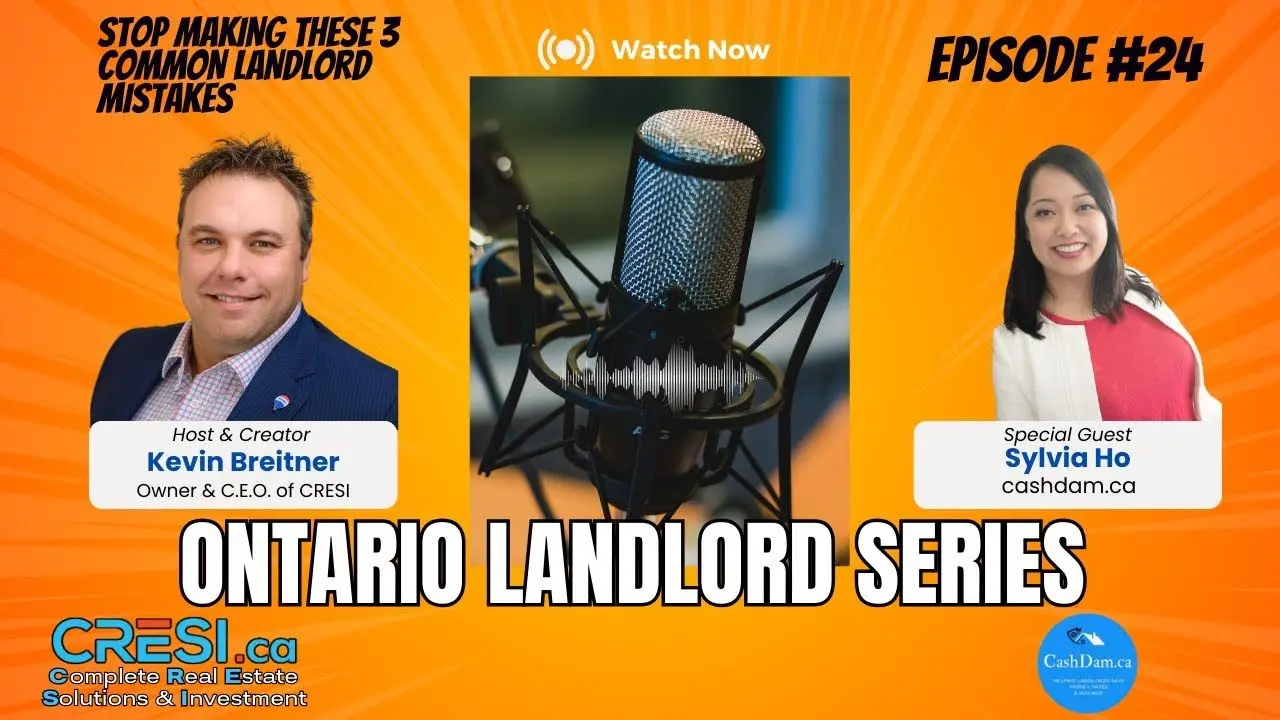
Episode 24 · with Sylvia Ho
3 Financing Mistakes Ontario Landlords Make on Basement Apartments
Sylvia Ho says the three biggest basement-apartment financing mistakes are using personal savings instead of borrowed funds, merging the renovation loan into the existing mortgage instead of keeping two standalone mortgages, and not using rental cash damming to prepay the personal mortgage with rental income — errors that can delay mortgage freedom by years.
Key takeaways
- Sylvia Ho says mistake number one is funding a basement-apartment renovation with personal savings — after-tax dollars — instead of borrowing, since interest on money borrowed to invest with a reasonable expectation of rental income is deductible under a CRA rule.
- Mistake number two, per Ho, is refinancing an existing mortgage into one larger loan (her example: a $500,000 mortgage refinanced to $540,000 to cover a $40,000 renovation) instead of keeping two standalone mortgages, which keeps the personal and rental debt separate for tax purposes.
- Ho recommends working with an accountant who is also a landlord, since a landlord business has deductions a general accountant may not flag, and says most new landlords don't realize they're running a business rather than just filing a regular T4 return.
- Mistake number three, Ho says, is depositing basement-apartment rental income and paying all rental expenses from the same account; the fix is 'rental cash damming' — using the rental income to prepay the personal home mortgage while a line of credit covers the basement-apartment mortgage portion and expenses, converting non-deductible interest into deductible investment-loan interest.
- Ho says applying rental cash damming to a basement apartment's rental income can pay off an owner-occupied home mortgage eight to twelve years earlier than planned, without changing the landlord's family lifestyle or budget.
Frequently asked questions
Should I use my own savings to pay for a basement apartment renovation?
Is it a mistake to refinance my existing mortgage to cover a basement apartment renovation?
Why does Sylvia Ho recommend hiring an accountant who is also a landlord?
What is rental cash damming, and how does it apply to a basement apartment?
How much faster can rental cash damming pay off a mortgage?
What's the most common financing mistake landlords make with basement apartments?
Guests
Sylvia Ho — Mortgage Agent & Financial Landlord Consultant, Cash Dam
Toronto-based mortgage agent and landlord of over 20 years; financial landlord consultant specializing in rental cash damming and tax-reduction strategies for landlords. (Not yet on the canonical roster — flagged for Kevin/Jason to confirm bio details.)
Full transcript
Welcome to this week’s episode of CRESI’s podcast for Ontario landlords. Today though, we’re specifically talking to Ontario landlords of basement apartments and to connect with the other topics. This time we’re coming at it from a financial point of view. Joining us again is a friend, colleague and financial genius Sylvia Ho.
She’s here to talk about different ways that we can take care of and save us hundreds of thousands of dollars over the course of your mortgage term. How you doing? Doing good Kevin. Thanks for having me on the show.
Yeah, if you remember Sylvia from before, she’s talked to us — she is a landlord consultant, has been a landlord herself for over 20 years, and again, it’s about different mortgage strategies and tax savings that we have as landlords that we need to take advantage of, and just different financial strategies that we can put in place regarding a mortgage and other things. So from that basement apartment landlord perspective, we’re talking earlier and you said that there’s three major mistakes that a landlord can make when starting out this venture. So why don’t we start with the first mistake? Sure, absolutely.
Thanks again for having me, Kevin. I’m really excited to share some strategies that can literally save basement landlords tens to hundreds of thousands of dollars over their investing career. So mistake number one, the biggest mistake that I see that comes to financing a basement apartment for the sole purpose of renting it out, will probably be a surprise to many listeners. Because they’re not small oversights.
They are actually fundamental errors in how people structure their financing. And it can dramatically impact their bottom line, and it will delay their mortgage freedom by years. Let’s talk about mistake number one.
Mistake number one that I see on a regular basis — that landlords do, that new landlords do, and even experienced landlords — is they use their own personal cash to fund the renovation. I see this all the time, and my friends, please do not use your own savings to fund an investment, because that money is after-tax dollars. It’s money that you’ve already paid income taxes on.
So please don’t do that, because the wealthy don’t do that. And that’s why the wealthy stay wealthy. For us middle-class individuals, we do things backwards. We use after-tax dollars to pay and buy an investment.
The wealthy — what the wealthy do is they borrow to invest. And whenever you borrow to invest in this basement apartment, and there’s a reasonable expectation that you’re going to make money, which is the rental income, you can deduct those interest costs. It’s a CRA rule. It’s a fundamental CRA rule that whenever you borrow to invest with a reasonable expectation to make money, you can deduct the interest costs.
So my friends, if you’re looking to put in a basement apartment and rent it out and make money, borrow the money instead. The great thing with real estate investing is about leverage. How can we leverage something to get something else, to do something else? And that’s exactly it.
And the other thing — that’s a famous term that we all know, right? OPM, use other people’s money. Again, best part about real estate is when you’re buying a new property, you only need 20% of the actual cost, right? You’re borrowing, leveraging that rest, and that’s how you want to be with an investment, always maximizing it.
So there’s obviously a mistake, number one. What would be mistake number two that you find people are making a lot on basement apartments? Yeah, so mistake number two would be when aspiring landlords borrow the money.
So they do that step correctly — they borrow the money, but they borrow the money incorrectly. And what they do is they’re like, hey, they go into their branch and they’re like, hey, banker, I have a $500,000 mortgage. I need $40,000 to put in a basement apartment.
Could you refinance and do a brand new mortgage for $540,000? So what this particular landlord has done is they merged their debt together, their own personal debt and their debt for the basement apartment. And then what we want to do — so don’t do that.
Don’t do one mortgage for $540,000. What you want to do is you want to have two standalone mortgages. Now, a lot of banks will allow these two standalone mortgages, but that’s only if you actually ask them, because they won’t necessarily recommend it, even though it’s in their product selection. Because the individuals at the branch, they aren’t taught advanced financial strategies.
They are more like order takers, right? So you say you want this and then you get this. I personally, early years of me being a mortgage agent, I used to be an order taker. But with my experience over the last 24 years as a mortgage agent, I’m not that anymore. That’s not me.
I’m a strategist. It’s definitely something that you need to understand — different people’s situations — and looking at something and guiding them through that.
You know, I say all the time as investors, we’re as individual as our fingerprints, right? So much is good for a lot of people, but we have to also look at it individually as well. So no, being a strategist that breaks down the situation for people and understanding their specific situation, I think is something that a lot of us overlook.
So with mistake number two, it’s all about keeping it separate, not merging it together. And now that you have two separate mortgage products, you need to work with an accountant.
A lot of new landlords, before they were a landlord, they would just do their taxes on their own because they had their T4 income and that’s it. And then they just file their taxes. And then whatever RSPs they got, they will get tax refunds. But with aspiring landlords, the one thing that they don’t know is that they’re actually running a business. And more specifically, they’re running a landlord business.
And when you run a landlord business, there are certain deductions that you aren’t aware of that your accountant is. So if you don’t use an accountant, you’re more likely leaving money on the table. So to recap so far, Kevin: don’t use your own savings — if you’re a landlord, don’t use your own savings to put in that basement apartment.
Borrow the funds, but definitely keep it separate. Okay? And use an accountant. Use an accountant that’s also a landlord, folks. Don’t just grab any accountant — use an accountant that is also a landlord, because they will understand things that a regular landlord — or a regular accountant, sorry — isn’t going to really think about. Again, order-taker versus server. Use one that is in the same field as you. So those are the first two mistakes, Sylvia.
What is mistake number three? Mistake number three costs landlords the most money, and it’s incorrectly running your landlord business. And when I say cost, I’m not talking about $10 to $20 or thousands of dollars. I’m talking about tens to hundreds of thousands of dollars over time, which directly will impact how quickly you achieve mortgage freedom.
So Kev, let me just explain to you what they’re doing wrong. Okay, so 99% of landlords, what they do wrong is they take the rental income and they deposit it into their bank account. And then from that account, they pay all the rental expenses.
So let me give you an example. Let’s take a step back and let’s just pretend for two seconds that it’s not a basement apartment — we’re talking about a standalone rental unit. So again, what most landlords will do is they’ll deposit the rental income.
Let’s just say it’s $1,800 into a bank account. And then from that same account, they pay all the rental expenses for that standalone rental unit. So that standalone rental unit will have a mortgage payment, property taxes, condo fees, and house insurance, right? This is a typical setup, but it’s totally wrong.
Instead, what they should do is they should apply an advanced financial strategy called rental cash damming. What is rental cash damming? So as someone that’s known in the industry as the cash damming queen, I’ve helped hundreds of landlords transform their rental properties into cashflow challenges into making them wealth acceleration engines. Rental cash damming is essentially an advanced financial tax strategy that the wealthy use, but middle-class individuals don’t know what we don’t know.
And what rental cash damming does is it maximizes your tax deductions, which eventually results in paying off your owner-occupied home mortgage eight to 12 years earlier than planned. That’s right, my friends. So if you’re a landlord and you are collecting rent on a regular basis and you have a mortgage against your owner-occupied home, when you apply this advanced financial strategy called rental cash damming, you will pay off your home mortgage eight to 12 years earlier than planned.
And this is how it works. When you get your rental income, you put it into a bank account. And then from that bank account, you’re going to take that $1,800 in rental income from your basement apartment, and you are going to prepay your personal home mortgage. Remember that $500,000 mortgage?
You’re going to take $1,800 and you’re going to do a lump sum payment against your personal home mortgage. And then the next thing that’s going to go through your mind — you’re like, well, hold on for a second. If I took the whole $1,800 and I prepaid my $500K mortgage, how do I pay that $40,000 section? Remember, we separated the mortgage into two sections, one $500,000, one $40,000?
Well, what you’re going to do is you’re going to use your line of credit — your readvanceable line of credit — to pay for that $40,000 mortgage portion and any other rental expenses associated with the basement apartment. And by doing this, you’re effectively converting non-deductible interest, which is your personal $500K mortgage, into a tax-deductible investment loan on your rental property. And by applying this specific advanced strategy approach, it will accelerate paying off your $500K mortgage. Part of what’s great about all this — it does not change your family lifestyle or budget.
It still stays all the same. All I’m asking you to do is reallocate the way you run your landlord business. I love it. And just on that, we are actually going to be having a webinar where we are going to talk to aspiring landlords about just how they can buy a property and become a landlord where they’re not going to change their family’s monthly expenses.
But Sylvia, I think that’s a lot of information there. If there’s anything else that you want to share that we need to get out to a landlord, let’s do so now.
But as always, Sylvia’s information has been across the screen. There’s going to be a link in the bio to connect with her. If you can’t figure that out, reach out to me. I’ll make sure you get to her.
But yeah, this is definitely someone you want to talk to if you are a landlord, if you want to be a landlord, to financially understand the best way you can use your money. Sylvia, anything else you want to add? Yeah, absolutely. Just one last thing.
As a financial landlord consultant, I will show you how to set up rental cash damming, okay? Where we will work together for a full 12 months to ensure there’s at least one tax cycle in there to make sure you’re doing it properly. Rental cash damming is not for the faint of heart, okay? It’s for landlords who are very organized, or who want to be organized, all right?
When we work together, I’ll give you a checklist. I’ll give you video training. I’ll also give you one-to-one regular personal check-ins with myself to ensure that you’re doing it compliantly with CRA. Okay.
So to recap, what’s going to happen when you’re looking to put in a basement apartment — you’re going to not use your own savings. You’re going to borrow that money. But when you borrow that money, you’re going to have two separate components: one, your regular mortgage — let’s just say $500,000 — and the $40,000 that you’re using to put in the basement apartment. And then when you get the rental income from that basement apartment, say that $1,800, you take that $1,800 and you prepay the $500,000. And then you use your line of credit to pay for the interest costs on the mortgage payment on that $40,000.
And that, my friends, is a blueprint on how to run rental cash damming. If you’re interested in learning more, Sylvia has a one-hour training available at cashdam.ca. It’ll be linked down below, or in the corner.
And that’s where you’ll get the full one-hour training on how to properly do rental cash damming. The final result of rental cash damming is to pay off your owner-occupied home mortgage eight to 12 years earlier than planned and transform your long-term wealth building. And that’s it, Kevin. That’s all I wanted to say.
No, I love it. Thank you so much for your time, for your expertise, and for sharing with all of our landlords out there. Thanks so much, Sylvia, for joining us, and we’ll talk to you all soon. Bye for now.
Please remember, while we are professionals, this podcast is for informational and entertainment purposes only. The advice shared may not apply to your unique situation. Always seek personalized advice from a qualified professional before making any investment decisions.
Hey everybody, thanks so much for joining us this week. I hope you enjoyed the episode. If you’re finding it informative and useful, make sure to like, subscribe, and share with a friend so we can keep getting the information out there to Ontario landlords. Keep on joining us — we’ll see you next time.
Derived guide: read the full guide.