
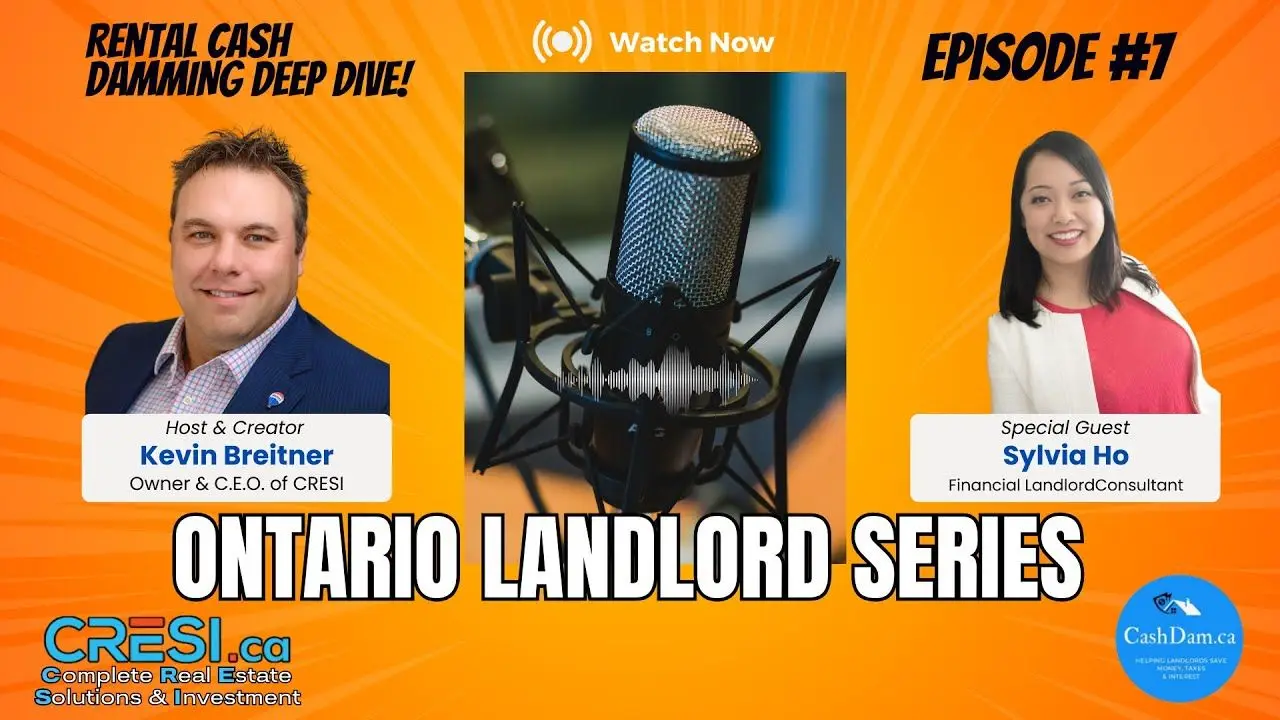
Episode 7 · with Sylvia Ho
How Ontario Landlords Can Use Cash Damming to Cut Taxes and Pay Off Mortgages Faster
Cash damming lets Ontario landlords restructure debt to maximize tax-deductible mortgage interest on a rental property, says mortgage agent and financial landlord consultant Sylvia Ho. In a real client case, consolidating a car loan and re-amortizing a rental mortgage to 30 years generated $112,000 in extra tax refunds and cut the mortgage payoff timeline from 27 to 17.75 years.
Key takeaways
- Sylvia Ho explains the CRA simply adds a landlord's job income and rental income together as total income — someone earning $5,000/month at work and $3,000/month in rent is taxed as if they make $8,000/month, regardless of how the mortgages are structured.
- In her client case study (Frank and Susan, names changed), consolidating a $40,000 car loan into their primary mortgage freed up roughly $650/month, while re-amortizing their rental condo's mortgage from 20 back to 30 years increased the tax-deductible interest write-off.
- The restructuring generated $112,000 in extra tax refunds over the 17-year period, according to Ho, and cut the family's mortgage payoff timeline from 27 years down to 17.75 years — without changing their total monthly budget.
- Ho says landlords commonly hurt themselves by keeping a rental mortgage's amortization artificially short, which reduces their interest write-offs and increases the income tax they pay; she recommends re-amortizing rental mortgages back to 30 years.
- Kevin Breitner notes mortgage interest on a rental property is a tax-deductible business expense, so the strategy is to maximize leverage on the rental while paying down the primary residence faster.
Frequently asked questions
What is the cash damming strategy for landlords?
Why does the CRA treat rental income and employment income together?
Should landlords choose a short or long amortization on a rental property mortgage?
How much can cash damming actually save a landlord?
Does cash damming require landlords to spend more money each month?
Is cash damming a legitimate, CRA-approved strategy?
Guests
Sylvia Ho — Mortgage Agent & Financial Landlord Consultant, Cash Dam
Toronto-based mortgage agent and financial landlord consultant who helps Canadian landlords use the CRA-approved cash damming strategy to restructure debt, reduce income tax, and pay down mortgages faster. (Not yet on the canonical roster — flag for Kevin/Jason.)
Chapters
- 0:00 Introduction & The Business of Property Investment
- 2:10 The Reality of Cash-Strapped Canadians
- 4:00 Frank & Susan's Case Study
- 8:00 Current Family Budget Breakdown
- 10:11 Smart Mortgage Restructuring
- 13:30 The Cash Dam Strategy Explained
- 16:00 Breaking Down the $500k+ Savings
- 19:30 How to Get Started & Next Steps
Full transcript
Introduction & The Business of Property Investment
Welcome again, landlords of Ontario. Are you feeling financial pressure with your rental property? Is it producing negative cash flow? One thing that comes up with many landlords is that owning a rental property — whether it’s a condo unit, a house, or a small multifamily building — is a business.
And you are now a business owner. There are expenses, write-offs, and tax advantages that come along with being a business owner. To many people, buying an investment property is simply their retirement plan, and that’s all they treat it as. They take the rent they collect month after month and use it to pay off that property’s mortgage — and that’s all they do. But what they don’t realize is that’s not how the government looks at their situation.
The CRA, if you go to work every single day and make $5,000 a month, and you also collect $3,000 a month from your rental property, sees that as $8,000 a month in income. That’s how they look at it. It doesn’t matter about a primary mortgage or secondary mortgage or anything like that — they simply look at that as $8,000 a month in income.
So to help with how we can maximize the money we keep in our pockets and minimize what we have to give away to the government, joining today is financial landlord consultant Sylvia Ho, who helps landlords save money. Sylvia is going to speak to us about a way to tweak a mortgage to maximize the tax benefits available, and how to then use those tax refunds to speed up paying off a mortgage — by sharing a scenario about a couple we’ll call Frank and Susan, and how they saved.
The Reality of Cash-Strapped Canadians
The reality is that Canadians are cash-strapped. People are living paycheck to paycheck, just making ends meet, and it comes down to the cost of living being so high.
A majority of our money is going to income taxes and to paying our mortgage — hence interest to the banks. If we can decrease the amount of income tax we pay and decrease the amount of interest we pay to the banks, we overall have more money in our pocket.
Just going back to income taxes: if someone makes $300,000 a year, they’re automatically in the 50 percent tax bracket. They’re paying $150,000 in income taxes. That’s a lot of money, and that’s every single year. And someone with a half-million-dollar mortgage is going to pay a million dollars in mortgage payments to pay that off over a 25- to 30-year period, meaning they paid $500,000 in interest. That’s a lot of money.
So let’s run a scenario — this is actually a live client, but we’re changing their names to Frank and Susan. Frank and Susan make $300,000 a year and pay $150,000 in income taxes.
Frank & Susan’s Case Study
They also have a small rental property — a condo they used to live in before they had kids. That’s one of the easiest ways to get a first rental property: keep the first starter home and move on when you upgrade.
A lot of people believe they must sell their home to upgrade to a new one, but that’s not necessarily true — you don’t have to make a ton of money, but you do have to qualify for two mortgages. Until you know the numbers, until you know whether the banks will lend two mortgages, you don’t know for sure.
So Frank and Susan decided to keep their condo. They were able to upgrade, and over the years rates went up, condo fees went up, property taxes went up, their income went up, and they ended up in negative cash flow — about $300 a month. For a family making $300,000, $300 a month feels affordable for a long-term investment, and that’s understandable — but there’s a better way to use the money they already have coming in.
This better way is an advanced financial strategy used by wealthy Canadian landlords to legally cut the income taxes they pay the government and pay less interest to the banks.
This family, Frank and Susan, make $300,000 a year and pay $150,000 in income taxes. Let’s demonstrate how to get some of that hard-earned money back into their pocket. They own a house worth $1.2 million with a mortgage of $580,000, currently on a 27-year amortization — meaning it will take 27 years to pay off that $580,000. With this advanced tax strategy, we’re going to get them down to below 18 years.
Current Family Budget Breakdown
Here is the family budget. This family has a mortgage of $580,000, making payments of $3,400 per month. They also pay property taxes of $500 a month, insurance and utilities of another $600 a month, and two car loans totaling $650 a month (those loans total $40,000). So every month, out of pocket, the mortgage payment, property taxes, house insurance, utilities, and car loans total $5,150. Combined, the family makes $300,000 total income and has a current mortgage of $580,000 on their primary residence, with monthly expenses of $5,150 — and this $5,150 is just for the owner-occupied home.
Remember, they’re also in negative cash flow on the rental. The mortgage payment, property taxes, condo fees, and insurance on the rental condo total $2,772 in expenses. Rental income is $2,500, so they’re negative $72 — and this comes out of their pocket from their regular income. Their total family budget, combining both properties, comes to just under $5,500.
When a client works with Sylvia, she always looks at what their budget is today, then does a mortgage audit and cash flow audit — figuring out the mortgage situation. After 24 years as a mortgage agent, she can identify the type of product a client is in and recommend a better one.
Smart Mortgage Restructuring
Here’s the plan: go from a $580,000 mortgage up to a $620,000 mortgage. The reason for increasing it by $40,000 is to get rid of the car loan. Getting rid of the car loan frees up $650 a month in mortgage payments — and car loan payments, credit card debt, and line-of-credit debt are among the number-one killers for building wealth, because after-tax dollars end up going to pay that debt. Consolidating it means starting fresh — now at a 30-year amortization. That sounds like going backward from 27 to 30 years, but the strategy brings it back down to 17.75 years.
After paying off the car loan by increasing the mortgage payment, the mortgage payment goes from $3,400 to $3,480 per month — it only cost $80 more to pay off the $40,000 in car loans. They still pay property taxes, house insurance, and utilities, but no more car loans, so total family expenses drop to $4,580 — a decrease of about $650 a month, the car loan payment.
The second part of the audit looks at the mortgage product on the current rental. Because they owned the condo previously, they’d been running a 20-year amortization on it — meaning it would be paid off in 20 years. But that’s the wrong move: putting the amortization on a rental property too low means paying more in income taxes, because a longer amortization produces more interest write-offs. So instead, re-amortize the mortgage on the rental property back to a 30-year amortization — this puts more money in the landlord’s pocket and less in the government’s pocket in the form of income taxes, since interest is a tax-deductible business expense.
After this change, the mortgage payment on the condo went from $1,822 down to $1,683. With the rental expenses and rental income of $2,500, they’re now only at a negative cash flow of $133 — a much better position.
The Cash Dam Strategy Explained
The total family budget is now $4,713 — almost $1,000 in savings, or exactly $709 in cash flow savings, just from the mortgage audit and cash flow audit.
The last, fun step is applying this advanced financial strategy called rental cash damming. Rental cash damming is an advanced financial strategy that is CRA-approved. Wealthy Canadian landlords have been doing it for decades to save money and save on taxes, but many middle-class landlords don’t know it exists.
By applying this specific financial strategy — remember, they moved from a 27-year to a 30-year amortization — this particular family is going to get an extra $112,000 in extra tax refunds. This is money they weren’t expecting.
Breaking Down the $500k+ Savings
Susan and Frank are going to get $112,000 in total tax refunds over the 17-year period. But here’s the key component: instead of taking 30 years to pay off this mortgage after the debt consolidation, it’s only 17.75 years. They’ve essentially shaved nine years off their mortgage payments — and that nine years’ worth of mortgage payments is essentially over half a million dollars in mortgage payment savings.
That $511,000 of future mortgage payments they no longer need to make — even though they’ve committed to making it — can be redirected from year 17.75 all the way to year 30 toward retirement savings instead. Another way to think about these future mortgage payments saved: since mortgage payments are made with after-tax dollars, this future savings is essentially $1,000,000 worth of income a person would need to make to cover those payments. And because this family decided to keep their rental property, the future value of that rental property is $1.2 million.
The real kicker of this entire exercise is that Sylvia hasn’t asked this family to bring out any more money than they’re currently committed to. All she’s asked them to do is reallocate and rearrange the way they’re using their money — and they get to mortgage freedom nine to ten years earlier than planned. On top of the same family budget, they were actually spending slightly less every month.
How to Get Started & Next Steps
When Sylvia shows these numbers to a client in their first chat, people are blown away — they realize they could save half a million dollars and wonder why they aren’t already doing this. It’s simply that you only know what you know, and you don’t know what you don’t know.
If you’re a landlord, share this strategy, share this idea. Connect with Sylvia so you can figure out how to start saving yourself money monthly, annually, and overall — keeping more money in your pocket instead of giving more to the government than absolutely necessary.
Connect with Sylvia, watch her webinar at cashdam.ca, and go through the one-hour training that walks through the exact blueprint for applying the strategy. It sounds straightforward, but it’s not just the push of a button — book an appointment with Sylvia and she’ll show you your exact numbers and how much money you’re leaving on the table. It’s typically not five to ten thousand dollars, but hundreds of thousands of dollars.
That’s Sylvia Ho, the cash damming expert saving hundreds of thousands of dollars for her clients in their mortgage strategy. Thanks so much for listening, and now you know about a strategy you didn’t before. Thanks so much for watching this episode, and we’ll see you next time. Bye for now.
Hey everybody, thanks so much for joining us this week. I hope you enjoyed the episode. If you’re finding it informative and useful, make sure to like, subscribe, and share with a friend so we can keep getting the information out there to Ontario landlords. Keep on joining us — we’ll see you next time.
Derived guide: read the full guide.