
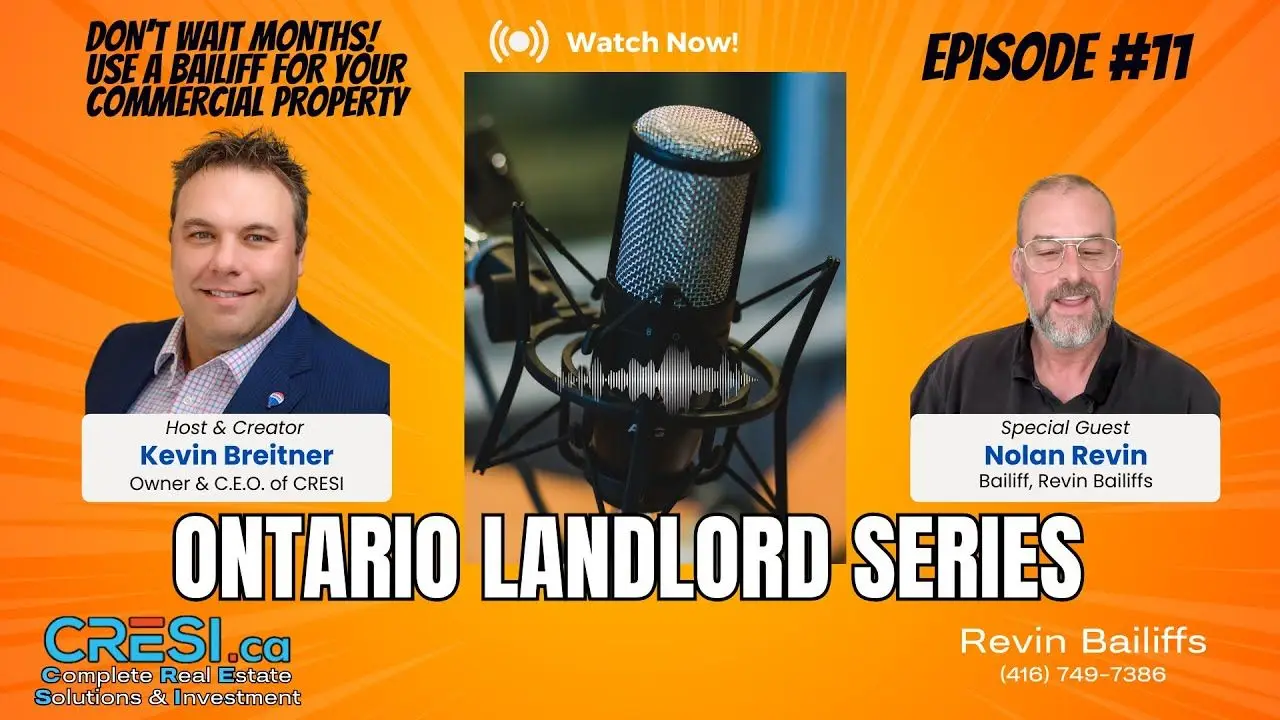
Episode 11 · with Nolan Revin
Commercial vs. Residential Landlording in Ontario: How a Bailiff Can Help With Non-Payment
Commercial leases favor the landlord far more than residential tenancies, says bailiff Nolan Revin, because lease terms govern rather than the LTB. For non-payment, an Ontario commercial landlord can choose a lease termination (changing the locks after day 16) or a distress/distrain action giving the tenant five to seven days to pay arrears before goods are seized.
Key takeaways
- Nolan Revin says the biggest structural difference between commercial and residential tenancies is that the Commercial Tenancies Act lets the lease terms govern, rather than the LTB, which he and Kevin Breitner note tends to favor residential tenants.
- For non-payment of commercial rent, Revin explains a landlord has two remedies: terminating the lease (changing the locks and posting notice, which he says can happen after the 16th day — i.e., on day 17) or filing a distress/distrain, serving a statement of account and giving the tenant five to seven days to pay arrears before further steps like seizing goods.
- Even after a lease termination, Revin says a landlord isn't forced to let the tenant back in — it remains the landlord's choice whether to accept a late payment or keep the lease terminated, with the tenant still given five to seven days to remove their goods.
- Revin says most of the commercial landlords he works with wait too long — sometimes years — before acting on a non-paying tenant, and advises landlords not to delay enforcing the remedies available to them.
- Kevin Breitner notes that once a building has more than five units it typically needs a commercial mortgage instead of a residential one (apart from RBC's program allowing up to six units on a residential mortgage), and that Stonegate's paralegals handle residential matters while a bailiff like Revin handles commercial non-payment.
Frequently asked questions
How is commercial landlording different from residential in Ontario?
How quickly can a commercial landlord act on a non-paying tenant in Ontario?
What is a "distress" or "distrain" action for a commercial tenant?
Can a commercial landlord let a tenant back in after terminating the lease?
What's the biggest mistake commercial landlords make with non-paying tenants?
At what point does a rental property need a commercial mortgage instead of a residential one?
Guests
Nolan Revin — Professional bailiff, Revin Bailiffs
Ontario-appointed bailiff since 2000, specializing in commercial landlord remedies such as lease terminations and distress/distrain actions for non-payment of rent. (Not yet on the canonical roster — flag for Kevin/Jason.)
Chapters
- 0:00 Introduction to Commercial Real Estate
- 0:30 Power Dynamics in Commercial vs Residential
- 1:00 Understanding Commercial Properties
- 2:00 Commercial Tenant Issues
- 3:30 Meet Nolan Revin, Professional Bailiff
- 5:00 Handling Non-Payment in Commercial Properties
- 7:00 Termination vs Distress Options
- 9:00 Large Scale Commercial Properties
- 11:00 Managing Landlord-Tenant Relationships
- 14:00 Closing Thoughts
Full transcript
Introduction to Commercial Real Estate
Hey there, Ontario landlords, welcome to another episode. Today’s conversation is a bit different.
Power Dynamics in Commercial vs Residential
As a mentor once put it, once you get into commercial real estate the game changes and the power shifts. In the RTA and on the residential tenancy side of things, so much power lies with the LTB and in the tenant’s favor. On the commercial side, it really matters what’s set out in the lease — and that’s what it all comes down to once you’re in the world of the Commercial Tenancies Act.
Understanding Commercial Properties
This isn’t as common a topic as residential investing, but here’s the idea: everybody kind of understands how residential works — buy a house, watch it appreciate, buy a second house, rent it out, and treat it as a retirement fund. Roughly 40 percent of Canadians pay rent right now across the country, which means a lot of opportunity to be a residential landlord — but there are also a lot of businesses in this country that need brick-and-mortar space to run out of. The biggest difference: renting out a house means renting out somebody’s home, their place to live, and Canadians are understandably reluctant to see anyone lose that.
Commercial Tenant Issues
On the commercial side, a business is renting from a business, and there’s no reason any business should be allowed to simply not pay. There are different ways to solve problems there, and landlords don’t have to wait 6 to 10 months to get someone evicted for non-payment — that’s probably the single biggest difference people talk about. With everything going on in Ontario around the LTB right now, a lot of investors are thinking about leaving the province or the country, even though Ontario is still a great place to invest in real estate — 40 percent of the country pays rent, and a lot of them live right here.
Whether it’s a large apartment building or a small retail-plaza unit rented out to a dog groomer or similar small business, today’s guest is Nolan Revin, an appointed bailiff for the province of Ontario. Nolan and Kevin have known each other since childhood, when their dads played baseball together.
Meet Nolan Revin, Professional Bailiff
Nolan has been a bailiff since the year 2000, helping clients get results in situations they found difficult or thought wouldn’t turn out well — helping people is what drives him to do the work. Today’s conversation leans on his experience and knowledge on the commercial side, understanding how the Commercial Tenancies Act works and how a bailiff can be beneficial for commercial landlords. There are plenty of things that can be resolved well before any legal intervention is needed, and most of the time issues are solved without court or legal ramifications against the landlord or the bailiff.
Handling Non-Payment in Commercial Properties
When something starts going wrong, it does cost money to correct — the goal is to stay out of court, because that’s what costs the most once lawyers get involved. The main issue is non-payment of rent, the biggest fear for any landlord: having to cover the bills without anything coming in.
Say a landlord has a small retail plaza with five units, and one tenant isn’t paying rent. This is a common situation — most tenants are great, and then there’s the occasional problem tenant. There are two remedies available. The first is a termination of lease: terminating the lease, changing the locks on the premises, posting a notice, and telling the tenant they are not allowed back into the unit, ending the lease in every respect. The second remedy is a distress, or distrain: attending the premises while the business is open, serving a notice of statement of account, and giving the tenant a reasonable amount of time — five to seven days — to pay the arrears.
Termination vs Distress Options
The act typically stipulates paying the amount of arrears within that window, or the next step begins — appraisals, seizing goods, and so on. If a tenant is behind $7,000 in rent, they have five to seven days to come up with that money to keep the lease in good standing.
For a termination, the timing is after the 16th day of non-payment — so a landlord can act on the 17th day: post a notice after business hours, change the locks, aiming for no confrontation. The tenant is advised the lease is over and told to call in the morning. Even then, the ball stays in the landlord’s court — they don’t have to forcefully end things. If the tenant comes back the next day with the money owed and promises to do better, the landlord can choose to let them back in, or can say the lease is over and give the tenant five to seven days to move their goods out. That’s a useful thing for a landlord to know: they can solve this problem quickly if they need to, without the business sitting there not making any money while the landlord covers all the bills.
Large Scale Commercial Properties
To be clear, this conversation is about business-to-business commercial tenancies — not, for example, a 12-unit apartment building, which makes the owner a residential landlord holding a commercial-scale property but not a commercial tenancy in this sense. Anything larger than five units normally needs a commercial mortgage (unless using RBC’s program covering up to six residential units), but from a legal-remedy standpoint, once it’s a business-to-business lease — not somebody’s home — the landlord works with a bailiff rather than paralegals like Stonegate Legal Services.
On scale, Nolan has handled buildings as small as a single room where someone runs a very small business, up to 100,000-square-foot warehouses that weren’t being paid for. What’s consistent across the years is that most landlords aren’t acting on day 17.
Managing Landlord-Tenant Relationships
Some landlords wait years, hoping a struggling tenant — someone they believe is a good tenant going through a rough stretch — will pull through, and sometimes they don’t. Nolan’s advice, briefly touching on the subject today, is: don’t wait too long. There’s a remedy available, and also a softer approach — showing a tenant the landlord is serious without necessarily following the letter of the law all the way through — since a little prod can be enough to fix things, given nobody wants to repeat this exercise (and pay the bailiff fee, locksmith fee, and arrears on top of it). It can teach a lesson without pushing the tenant all the way out, and it’s helpful for a landlord to simply know the tool is there.
It’s about the relationship, and also about not waiting too long — treating it as a business either way, whether residential or commercial. On the residential side, that means increasing rent and giving proper notices if rent isn’t paid on time, to preserve the relationship while making clear payment is expected, documenting everything in case it’s needed further down the road at the LTB. On the commercial side, this conversation is a good introduction to how the landlord is a bit more protected, and how the process moves faster than residential. Filling a vacancy, whether commercial or residential, generally takes about the same amount of time when looking for a good tenant.
This was a good introduction to commercial landlording and how a bailiff can help — Nolan will be back for a deeper dive into specifics on each of these remedies, and other situations commercial landlords run into.
Closing Thoughts
The goal of this podcast is to keep things bite-sized so listeners can get useful information about a specific topic quickly. Thanks to everyone for listening, and thank you, Nolan, for joining us — we’ll talk again soon. Bye for now. Please remember, while we are professionals, this podcast is for informational and entertainment purposes only. The advice shared may not apply to your unique situation. Always seek personalized advice from a qualified professional before making any investment decisions.
Hey everybody, thanks so much for joining us this week. I hope you enjoyed the episode. If you’re finding it informative and useful, make sure to like, subscribe, and share with a friend so that we can keep getting the information out there to Ontario landlords, and keep on joining us. We’ll see you next time.
Derived guide: read the full guide.