
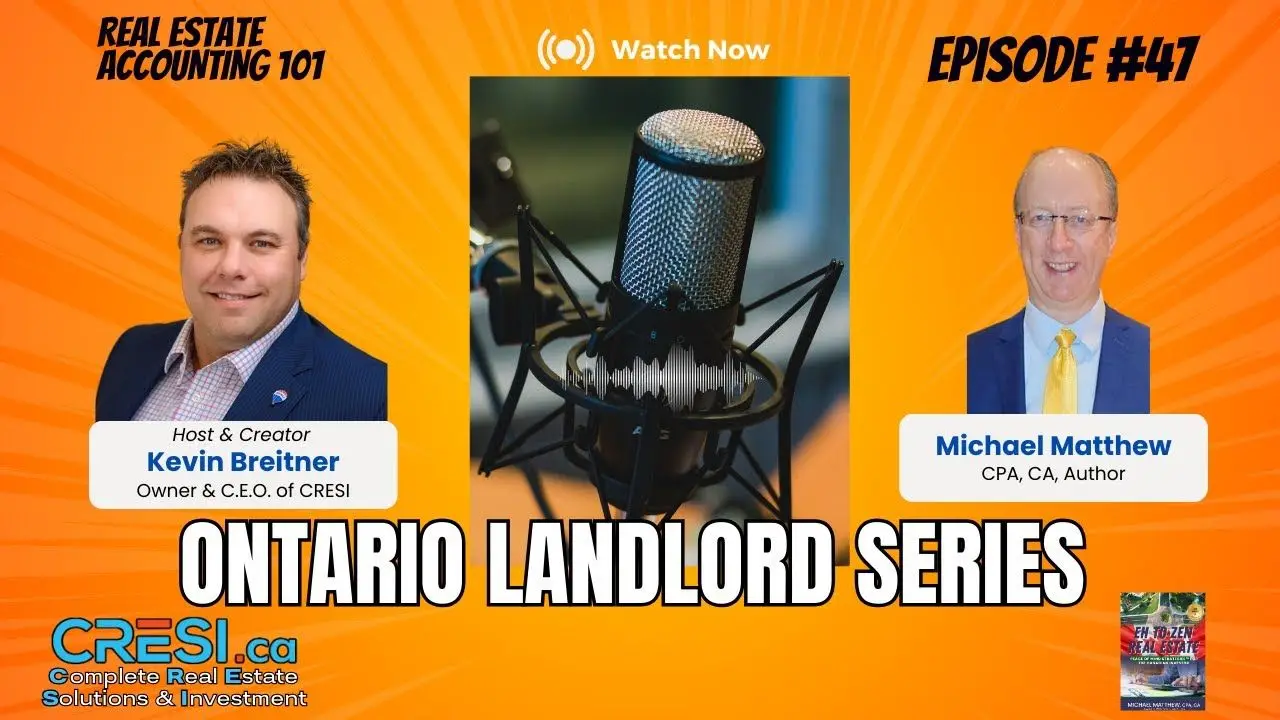
Episode 47 · with Michael Matthew
A CPA's Guide to Real Estate Tax Structuring for Ontario Landlords
CPA Michael Matthew says the personal-vs-corporation decision for a rental property comes down to liability protection and control over income timing, not automatic tax savings — corporate rental income is taxed above 50% from dollar one in Ontario. He also flags capital cost allowance, loan-arrangement fees, and receipt-keeping as commonly missed deductions.
Key takeaways
- Michael Matthew says holding a rental personally in Ontario means paying tax at your marginal rate — roughly 20% rising to 53%+ only above $248,000 of income — while a corporation is taxed at 50%+ on rental income starting from the first dollar earned.
- Matthew's two reasons to incorporate are legal liability protection (he cites a hypothetical slip-and-fall lawsuit on a multi-unit property) and control over the timing and nature of how income is paid out — salary, dividend, or deferred to a later year — which isn't possible with personally held rental income.
- Capital cost allowance (CCA), the tax term for depreciation, lets an investor write off roughly 4% of a property's cost annually against rental income; Matthew notes some investors in high-appreciation markets like Toronto and Vancouver deliberately skip claiming it, since CCA is recaptured as taxable income when the property sells.
- Matthew says the CRA will not accept bank or credit card statements alone as proof of expenses — landlords need to keep the actual receipts, ideally organized monthly and backed up digitally, since thermal-paper receipts fade within weeks and CRA audits typically look back three years.
- Matthew's 'must not do' for new investors: don't treat a rental like a hobby — run it as a business, keep proper records, and don't discount rent out of sympathy for a tenant's situation, since costs like insurance and condo fees only ever go up.
Frequently asked questions
Should I own my Ontario rental property personally or through a corporation?
What is capital cost allowance (CCA) and should I claim it on my rental property?
What tax deductions do Ontario landlords commonly miss?
Does the CRA accept bank or credit card statements instead of receipts for rental expenses?
When does it make sense to incorporate a rental property in Ontario?
Is property management a deductible expense for Ontario landlords?
Guests
Michael Matthew — CPA, CA, Real estate tax and accounting advisor; author, Eh to Zen Real Estate
Chartered Professional Accountant with 35+ years of experience and a real estate investor himself; specializes in tax consulting, structuring, and accounting for Canadian and American rental properties, and is the author of Eh to Zen Real Estate.
Full transcript
Michael Matthew (00:04)
(brief opening exchange)
Kevin Breitner (00:08)
Hi everybody, welcome to another episode of CRESI’s Ontario Landlord Series, where we’re here to educate and inform landlords with rental properties here in Ontario. Today we’re taking things back a bit — we’ve done this podcast for a while covering different aspects of being a landlord, but today we’re circling back to really talk about how to get started: how to set things up from an accounting and financial point of view. Joining us is a friend and colleague, Michael Matthew, a CPA and CA with 35-plus years of experience, and a real estate investor himself who specializes in helping other investors. One thing I’ve said before — get advice from people actually doing it themselves; an accountant who doesn’t own a rental property will probably miss some of the deductions you should be capturing. Michael also helps investors with both Canadian and American properties, and he’s the author of a book called Eh to Zen Real Estate, also geared toward helping investors get started. He helps with tax consulting, structuring, and tax returns for his clients. Michael, welcome — say hi and thanks for joining us today.
Michael Matthew (01:45)
Thanks for having me, Kevin. Great to be here.
Kevin Breitner (01:48)
I’m going to put you right on the spot. Let’s say I’m a brand-new investor, and with the market the way it is right now, I think it’s a great time to buy something. What should I be doing, how should I set myself up, what advice would you give me as I’m getting started?
Michael Matthew (02:07)
Well, to quote my lawyer’s favorite response: it depends. And it really does depend on your situation. For some people it makes sense to set themselves up in a corporation, for others it doesn’t, and you need to talk to a professional advisor who can walk you through those distinctions, because the last thing you want to do is talk to your neighbor and copy how he did it — you have no idea what his situation actually is, and what worked well for him could be disastrous for you.
Kevin Breitner (02:43)
That’s bang on. We always say this — get personalized, specific guidance. For the purpose of this episode, Michael and I are going to speak in generalities, so definitely get specific advice for your own situation when you’re starting out, because we’re all as individual as our fingerprints, and that matters in so many ways. So, on a general level — I’m a regular person making about $100,000 a year, my wife makes about the same, so household income is just over $200,000, and we’re looking to buy our first investment property. What would you talk to us about?
Michael Matthew (03:31)
You want to think about what works best for your situation. If you set yourself up in a corporation, you get legal liability protection — that’s one of the major reasons to do it. But what people don’t always realize is that in Ontario, if you’re holding long-term rental income in a corporation, you’re automatically taxed at 50%-plus from dollar one. If you held that same property personally, you’d have to make over $248,000 before you’re taxed at a rate that high — the personal rate actually starts around 20%. So you really need to look at your situation. That said, if you’re investing in something like a small apartment building — say, 10 units — every person has at least one friend who’s a bit of an idiot, and once you have 10 tenants, statistically one of them is going to do something like decide to jump off the roof into a snowbank, possibly with alcohol involved. At that point you’re going to want the protection of a corporation, because otherwise all your personal assets — your house, your car, valuables like art or jewelry — are exposed in a lawsuit. Insurance is necessary, but it doesn’t cover everything; there are limits and exclusions, and you can’t rely on it as absolute protection. We’re thankfully not as litigious as our neighbors to the south, but if you’re flipping a property, there’s really no discussion — you need some kind of corporate structure to protect yourself.
Kevin Breitner (05:37)
Right, and generally when I get that question, people tend to incorporate after they already have a few properties and are getting deeper into the game. With the first one, they’re usually just owning it personally, running it through their annual income and being taxed in that bracket, but still carrying the liability and ties of having it under their own name. It seems to come down to a risk-reward and cost-benefit question — does it make sense to bring in the extra cost of an incorporation to look after just one condo or something small? From what I’ve seen, most people incorporate once they have multiple properties — I know of maybe five people with a corp who have larger portfolios, versus two who have it for just one or two properties.
Michael Matthew (06:32)
Cost-benefit is absolutely the key — I try to run everything I do for clients through that lens. You’re right that most people start out owning the property personally, and if it’s in Canada that can work out just fine. You have the ability to claim additional expenses that can get you to positive cash flow with no tax to pay, and that’s largely because of CCA — capital cost allowance, the tax term for depreciation. This lets you write off 4% of the cost of your rental property after the first year, which reduces your rental income. That may be a good move for you, depending on your situation — but we’ve actually seen in high-value areas like Toronto and Vancouver, where there’s a lot of appreciation, that you sometimes don’t want to take that depreciation, because it comes back as taxable income when you sell the property. So again, it depends — you need to discuss your goals and situation with a professional advisor to get the best advice.
Kevin Breitner (08:08)
Definitely, everything’s different. My sister has a property in Windsor, and she records everything — gas, travel time when she goes down there — to think about what she can write off. There’s money we should be writing off, business expenses like travel time, and things like a property management company being a deductible expense — a business expense that not only gives landlords peace of mind day-to-day but also offsets their income. Because the government looks at total income together — if I make $5,000 a month at my job and $3,000 a month in rental income, the government sees $8,000 a month; they don’t factor in the actual mortgage principal payment, only the interest you can write off on an investment property. So we have to think about total income before and after rental income, to make sure we’re netting the most and giving the government the least amount legally possible. You mentioned earlier, off-air, a client who missed one of the largest business expenses available on rental income — mortgage interest. What other things do you see people frequently miss or overlook when tracking expenses?
Michael Matthew (09:58)
That wasn’t an unusual case, honestly — most people do remember to claim mortgage interest. Other frequently large deductions are property tax and maintenance and repairs. But some of the commonly missed ones are the CCA I mentioned, and also the fees lenders charge on top of the interest when you arrange a loan for a rental property — those fees can actually be written off over five years or less, depending on the length of the mortgage. These things add up and can make a real difference to your bottom line, because as a taxpayer you have the right to arrange your affairs to pay the least tax possible — that’s actually been stated by a judge in a court case. That’s the overall philosophy I try to apply for my clients — pay the least amount possible, without getting too aggressive with the deductions. It’s important to track your expenses and keep all your receipts. People sometimes say, “I don’t know where the receipts are, but I have my bank and credit card statements for all the transactions” — but the CRA has explicitly said they will not accept that. You need the actual receipts alongside the statements. With good representation you can sometimes push through that, but why set yourself up for that grief — just keep the receipts organized.
Kevin Breitner (11:57)
My mother’s a bookkeeper and helps with all of our books — that’s something I hear all the time, keep everything, mark it off, track it, print it, manage it. There are also software tools now to upload receipts if you don’t want to keep physical copies. The old shoebox method probably isn’t the best, though people still use it. I think the best approach is physical receipts organized in monthly folders or envelopes, tracked into a spreadsheet as well, so you have a digital backup that’s also easier to share with your professional.
Michael Matthew (12:46)
That’s a good point — it’s less common now, but a lot of receipts used to print on thermal paper, and the issue is that fades within weeks. You’re supposed to keep receipts for about seven years, and CRA typically audits within a three-year window, so if you go to pull receipts from two and a half years ago and find blank paper, that doesn’t help you. Having them organized in monthly folders, plus an electronic copy, saves you hours of frustration later if you’re ever asked to produce a particular receipt.
Kevin Breitner (13:52)
Like a lot of things, the tedious stuff up front pays off later. I get in trouble from my wife for letting little things pile up instead of just doing them — but that’s a conversation for another episode. We touched on personal versus corporate earlier — is there more we can dig into to separate the two and help people understand the advantages and disadvantages of each?
Michael Matthew (14:32)
Sure — incorporation really comes down to two main categories: legal liability concerns, which we touched on, and control over the nature and timing of your income. Legal liability covers things like a slip and fall — a visitor, or even the tenant themselves, slipping on icy outdoor stairs and suing you, even though they’re the one living there; you have to weigh how big that risk is. If you own a commercial property, like a restaurant you’re leasing to a restaurateur, there’s really no decision to make — you automatically want a corporation, because hundreds of customers a day means slip-and-fall risk in winter is essentially guaranteed, and they’ll sue the restaurant, which means suing you.
On controlling the nature and timing of income: if you’re taking rental income personally, there’s no planning to be done — it’s rental income on your personal return in the year it’s earned, full stop. If it’s corporate income, you can choose to pay it out as salary, a year-end bonus, or a dividend, split it across years, or defer it entirely, because salary and dividends are taxed differently, which can influence how you want to be paid in a given year — say a year where you also sold a property and have a large capital gain to offset, so you decide not to take any salary at all. You have that flexibility in a corporation, and none of it if you’re not incorporated — it’s all coming in the same year regardless.
On the tax-rate side: in Ontario, personal tax rates run from a little over 20% up to just over 53%, with that top rate reserved for income above $248,000. Rental income coming into your personal return just gets stacked on top of whatever else you earn. In a corporation, there’s no sliding scale — you hit 50%-plus from the first dollar of rental income, which can mean as much as 30% more tax paid corporately versus personally. That said, having a professional advisor look at your specific situation matters — for example, if you have a spouse with no other income who can do the bookkeeping and property management for the corporation, you can pay them a salary and shift income from being taxed at 50% in the corporation to maybe 20% in their hands, saving that 30% difference while still keeping the corporation’s liability protection.
Kevin Breitner (18:42)
Again, it comes down to personal situations. I have a colleague whose husband is retired and manages their roughly ten properties himself — we offered to take that on, and she said her husband likes doing it and has the time. I told her flat out: if he’s going to do it, he should start his own small property management company, and the family should be paying that company for the work, rather than just keeping it as undocumented income they’re spending. A lot of times people get caught up on two numbers — how much they’re about to spend, and how much they might save — when the number that really matters is what you’re netting, what you’re walking away with. Sometimes it’s better not to save money, and sometimes it’s better to spend more, depending on what you end up netting, which is why your specific situation matters and why you should be talking to professionals about it.
Michael Matthew (20:11)
I’d add that property management is something you should factor into your decision before you even buy a property. If the only way the deal works financially is by self-managing it, it’s probably not a good deal — even if you plan to manage it yourself at first, eventually you’ll get tired of dealing with tenants calling every two weeks, and you have to ask whether that’s a good use of your time. I had a dishwasher installed at home recently and watched the installer and his daughter do it in about 45 minutes; I could have done it myself, but it would have taken me all day and I’d probably have said a few choice words along the way. Instead I spent that time doing 45 minutes of consulting work, which more than covered the cost of the installers. Leaving things to professionals takes away the hassle and frees up your time — if you put that freed-up time to productive use, you’re effectively saving money by spending it.
Kevin Breitner (21:38)
I agree — I have that conversation with my wife too, about using our time better and hiring professionals for certain things. My dad always told me: do what you do, and hire professionals to do what they do. It builds your network too. This has been a great conversation — I want to wrap up with your book. Can you give us a rundown of what it’s about and how it can help new investors thinking about getting into the market, since now’s a good buying time given where pricing is?
Michael Matthew (22:49)
Sure — the title is Eh to Zen Real Estate: Peace of Mind Strategies for Canadian Investors, with “Eh” spelled the Canadian way. It’s directed at beginner investors primarily. There’s a section on taxes and another on structuring, but I didn’t want the whole book to be a textbook for accountants, so it also covers the areas beginner investors need to know — the importance of mindset, building a power team, and different types of investment. It’s not just condos or single-family homes — you can look at multifamily, or accessory dwelling units in your backyard, which aren’t just for living in; some people build them as a workshop space, or as a satellite office when the main house is full of screaming kids. The whole idea is to give beginner investors the courage to step forward and take action, because you don’t want to rush in with no information and just hope it works out — the worst thing that can happen is it does work out the first time, because then you think it’s easy and you don’t need to know what you’re doing, until you’re stuck with a tenant who doesn’t pay for a year and a half while you’re fighting to get an LTB hearing. On the other end is the person who reads every book, watches every video, and never actually takes action. You need proper information, guidance from advisors and coaches, and then you need to take action — otherwise the information is meaningless.
Kevin Breitner (25:21)
The hardest thing to do is start — that’s very true.
Michael Matthew (25:26)
When I was young and jogging every day, the hardest step was the one out the door.
Kevin Breitner (25:35)
Right, and then it just rolls after that, once you get going.
Michael Matthew (25:39)
Once you get going, you’re going.
Kevin Breitner (25:40)
Same as working from home — it’s better to get dressed and start your day than stay in your pajamas. All the info on the book will be linked. Before we go, I’m going to put you on the spot one more time, Michael — give us your number one “must do” and number one “don’t do” for someone getting started on the accounting side.
Michael Matthew (26:24)
Must-do: expose yourself to a variety of ways of investing in real estate, find the one that truly resonates with you, and work that one until you’ve got it humming before you jump to something else. There are many paths — we never even mentioned wholesaling, probably the most affordable way to start a real estate career, where you’re finding a house at a good price, getting it under contract, and assigning that contract to the buyer who actually closes — you never take title, never need a corporation since you never own it, and only need a few thousand dollars for the deposit, yet you can make five, ten, up to $30,000 or more in a high-priced market like Toronto or Vancouver. Some people build a career out of exactly that; others would never do it. Don’t just copy the first person you talk to about real estate — find out what’s possible and run down the path that fits you. My book covers a range of options to get started.
Kevin Breitner (27:57)
I like that — figuring out what resonates with you, because there are so many different strategies, and they can all be profitable if done well and understood properly. Having guidance to do what you actually want to do matters — if you want to flip houses, learning from someone who wholesales isn’t necessarily the best path. Building that team, like we’ve talked about in other episodes and at the start of this one, is very important.
Michael Matthew (28:31)
The must-not-do: don’t treat this as a hobby. It’s a real estate business — treat it as one. You can have fun doing it, but take it seriously, keep proper records, get proper advice for your specific scenario, and dedicate real time to it — the time commitment varies with your situation, but everything requires effort, and you need to build that into your schedule rather than saying you’ll get to it eventually, because you won’t be a successful investor if you don’t treat it as a business.
Kevin Breitner (29:26)
Love it — that’s another thing we say all the time, this is a business, and you should treat it that way, including with things like rent increases.
Michael Matthew (29:39)
That’s where people get in trouble — “he’s a good guy,” “she’s a single mom” — no. What you do is set the rent as high as the market will bear, and if you want to help people out, take some of your profits and donate to a charity, or give it directly to a family that could use the help — but run it as a business, not a charity. You’re not going to cut the rent in half because a student can only afford half; the bank isn’t going to cut your mortgage payment in half because you’re renting to a student. You’ve got costs — insurance goes up, and if it’s a condo, your condo fees never go down, only up; I own a condo, I know that well. You need to cover your costs — it’s a business, not there to help someone out at your own expense. And there was a presentation just last night saying that by 2030 — only five years from now — Ontario will need an additional 5.8 million homes, and we’re on track to build only about half of that, which means a severe housing shortage, and rents are going to go up as a result.
Kevin Breitner (31:21)
That’s coming — I was talking with a builder I work with the other day who showed me a demographic breakdown of new housing units bought and built from 2018 through what’s projected for 2029. The province’s goal is 32,000 new dwellings a year; since I started in this business in 2012, we’ve never come close except in maybe 2023 and 2024, when we hit somewhere in the high 20,000s, and this year, 2025, we got up around 40-something thousand because of demand. Next year, 2026, we’re projected back down to around 20-25,000, and it keeps tapering down toward 2028 and 2029, where less than 1,500 units a year are currently slated to be built — which tells you how far behind supply will be, and how much pricing will shift when demand catches back up. Builders overbuilt one-bedrooms and one-bedroom-plus-dens for the current demand, but the need is coming back for larger units. I’ll close with this: a mortgage contact at RBC told us years ago, back when price per square foot was around $200, that we’d eventually see it cross $1,000 — we thought he was crazy, and now we’re there, sitting around $800 to $850 per square foot currently. He now says we’ll be north of $2,000 a square foot before 2030. So if you’re thinking about buying a condo and planning to hold long-term, now could be the right time — but be aware that maintenance fees only ever go up, especially with amenities like a pool or a concierge, since those are driven by rising labor costs.
Michael Matthew (33:48)
Funny you say that — I have both of those in my condo.
Kevin Breitner (33:52)
Those are the big ones — pool maintenance and a 24-hour concierge, which does provide security people appreciate, but most people in a condo don’t actually use the pool.
Michael Matthew (34:09)
I use it regularly — about once a year.
Kevin Breitner (34:13)
There you go — and that’s the biggest driver of rising maintenance fees. Anyways, folks, that was a great chapter — I hope you enjoyed it as much as I did with Michael. If you want to reach out to him about getting your accounting started, or getting help with your current rental property accounting, I’m sure he’d love to talk and help guide, advise, and consult you toward keeping more money in your pocket. All of his information is below — reach out to him, and connect with us. Thanks for listening, share this with a friend, and we’ll talk to you soon. Bye for now.
Michael Matthew (34:49)
While we are professionals, this podcast is for informational and entertainment purposes only. Advice shared may not apply to your unique situation. Always seek personalized advice from a qualified professional before making any investment decisions.
Kevin Breitner (34:54)
Hey everybody, thanks so much for joining us this week. I hope you enjoyed the episode. If you’re finding it informative and useful, make sure to like, subscribe, and share with a friend so that we can keep getting the information out there to Ontario landlords, and keep on joining us — we’ll see you next time.
Derived guide: read the full guide.