
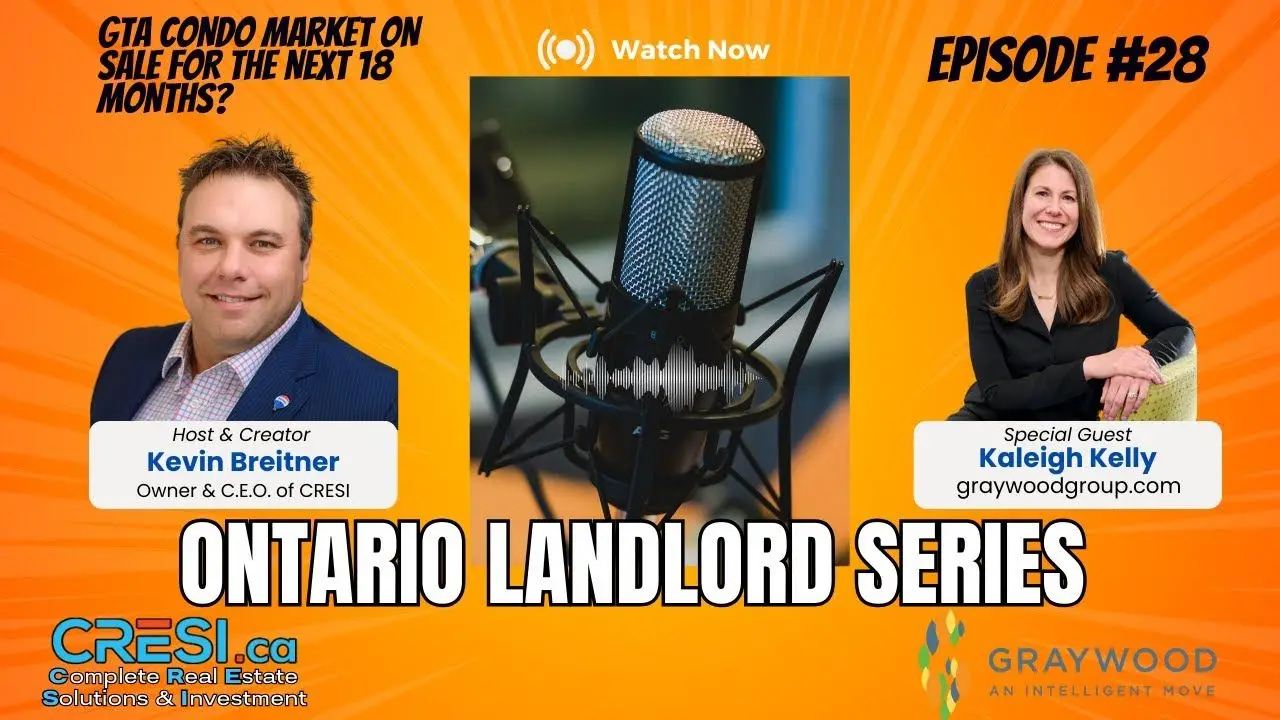
Episode 28 · with Kaleigh Kelly
Is Now the Time to Buy Pre-Construction in the GTA?
Kaleigh Kelly of Graywood Developments says the GTA is oversupplied with roughly 40,000 condo completions in 2024–2025 against a balanced-market need of about 25,000 a year, creating a buyer's window with pre-construction pricing close to resale — a window she and Kevin Breitner say narrows as completions fall toward 2,000 units by 2029.
Key takeaways
- Kaleigh Kelly says Graywood is in its 40th year, has built over 31,000 residences across North America (including the Ritz-Carlton Toronto), and controls the process in-house from land acquisition through construction, sales, and homeowner relations.
- Kelly says the GTA needs about 25,000 new housing completions a year for a balanced market, but 2024 saw roughly 40,000 completions and 2025 is tracking similarly — an oversupply she attributes to pandemic-era construction delays stacking projects sold between 2018 and 2022 into the same completion window.
- Kelly and Kevin Breitner both cite CIBC economist Benjamin Tall's estimate that the current buyer's window is about 18 months before the market rebounds, since Kelly says completions are projected to fall to roughly 5,000 units by 2028 and under 2,000 by 2029.
- Kelly says pre-construction pricing is currently close to resale pricing, compared to 2021–2022 when pre-construction ran roughly 40% above resale, and deposits can typically be staged over months to years rather than paid in full up front.
- Kelly and Breitner discuss Graywood's Claystone project in Oakville's Bronte Village — a 7-storey, 140-suite mid-rise co-developed with Japan's Hankyu Hanshin Properties, in a pocket of Oakville Kelly says has little existing condo supply.
Frequently asked questions
Is now a good time to buy pre-construction in the GTA?
Why is there a condo oversupply in the GTA right now?
How long will the GTA condo buyer's market last?
How does pre-construction pricing compare to resale right now?
How are pre-construction deposits typically structured?
What is Claystone, and where is it located?
How much new housing does the GTA need to complete each year for a balanced market?
Guests
Kaleigh Kelly
Representative of Graywood Developments, a Toronto-based developer marking its 40th year in business with over 31,000 residences built across North America, including the Ritz-Carlton Toronto. (Not yet on the canonical roster — flag for Kevin/Jason to confirm title.)
Full transcript
Hey everybody, welcome to another episode of CRESI’s Ontario Landlord podcast series. We are here to always educate and inform our Ontario landlords. Today we’re going to have a conversation about pre-construction, new construction, why the GTA still makes sense today, and what’s going on. We’re going to talk with a representative from Graywood Developments.
Kaleigh Kelly is here with us today. Hello, how are you? Good morning, welcome. Good morning, thanks for having me here. We’ve been chatting a lot lately about a specific development that Graywood’s doing down here in Oakville, and we’ll get to touch on what you guys have going on specifically with your developments as well, to let everybody know.
Let’s start off with a little bit about who Graywood is. Sure — Graywood is a Toronto-based company. This is actually our 40th year in business, so a really exciting milestone for us. Over the past 40 years, we’ve developed and constructed over 31,000 residences across North America, primarily focused in the GTA. Our most notable project to date is the Ritz-Carlton in downtown Toronto — a pretty landmark building. We’ve also constructed homes across North America, in Calgary, in Texas. We’ve done everything from hotel through the Ritz-Carlton, to high-rise, town homes, low-rise, and mid-rise.
One thing I know about Graywood is that you guys do everything in-house, from funding all the way through to sales at the end. You still work with brokers like myself to sell some products, but you have your own in-house sales team as well, right — a full-service, one-stop shop from acquisition of raw land all the way through development to unit sales, which I think is great. Absolutely — one of the best benefits I’d say to anyone researching developers is having the ability to do everything in-house under one umbrella gives us full control over the process from start to finish. We’re not third-partying items — our construction team is in-house, so we control the quality. Our sales and marketing team is in-house, our homeowner relations team is in-house. So when you’re talking to us, especially on the floor, at one of our sales offices or one of our sites, you’re talking directly to the developer, which I think is really important in today’s market.
In any market, but especially buying pre-construction, I think one of the most important things — other than location, because that’s the number one rule in real estate — is knowing a developer, how their project will complete and how their finishes will turn out. When you buy pre-construction, folks, you’re buying a plan — something on a piece of paper that’s going to be built in the future. So knowing how that’s going to turn out, and that it is going to complete, is one of the most important things.
I won’t mention any names, but there was a development in Burlington, when I was first getting started in real estate about 13 years ago — this would be about 10 years ago — where they were selling the 27th, 28th, and 29th floors of their project, but they didn’t even have the first 26 floors of their original plan approved yet by the city, and they were already selling more floors because they needed more money to keep things going. That’s not a very good thing — selling units you haven’t been approved for. Again, knowing who your developer is, to get through all this, is so important. Graywood, with over 40 years of experience, is definitely a reputable builder in my eyes.
With the market right now going on in the GTA, I think a lot of people got fooled and thought real estate became a get-rich-quick thing rather than a get-wealthy-slow thing. People were buying up units just to flip them with assignment sales, with appreciation for a while, making $100,000-plus in just a few years by putting some money down. Obviously that market has changed and caught up to us, and now here we are — we can’t even move an assignment sale, there are so many of them out there that people are trying to get rid of. So people are stuck. The pre-construction condo market is definitely slowed, but is it still a good time to buy? Are there reasons why we should be in the GTA?
Yeah, absolutely. I think a lot of times we forget what got us to this point where we are today. Looking back, we’ve been in a rising market for over 30 years — prices just kept coming up, and going up at an incredibly fast pace. Where we got to the issue we’re at today is that we have an oversupply of inventory coming to the market — a lot of buildings and projects that are closing. Looking back a little bit: pre-COVID, 2018, we were in a very healthy, balanced market where projects were still selling — not necessarily selling out in a weekend, but certainly being absorbed. Then 2019 hits, COVID hits, construction completely shuts down, there are delays. Projects sold in 2018 and 2019 aren’t able to be developed, or there are delays in closings. Plus you’ve got the buildings and projects that sold in 2020 and 2021, when the market was on a very upward trajectory — we really peaked at the end of 2021 into 2022. So fast forward to 2024 and 2025, all of those projects are being completed at the same time. In 2024 we had record levels of completions, about 40,000 homes. So far in 2025 we’re seeing that number come down a little bit — I think we’re around 40,000 completions taking place in 2025, which is what’s creating this oversupply. A balanced market to meet the needs of people coming to Toronto is about 25,000 units a year that we need to complete. So we’re well above that, which creates a great opportunity for buyers if you’re looking. But over the next few years, that number starts to come down, because we’re in a slower market where projects aren’t being launched — we’re seeing projects delayed, cancelled, or converted into rentals. That’s putting pressure on what’s to come in the next few years, where there are going to be very few projects completing. I think by 2028 we’re at about 5,000 units, and in 2029, less than 2,000 units completing. By the time we get there, we’re going to see a pretty drastic shift in market conditions. So if you’re a buyer looking right now, you’ve got this window of opportunity you wouldn’t have seen over the last 30 years, as prices just continued to climb. You’ve got choice, people looking to get out of their deals, amazing pricing out there. Especially if you’re looking at pre-construction, developers that have launched recently want to sell their units, so you’re looking at pricing incredibly close to resale — whereas in 2021 and 2022, pre-construction was about 40% higher than resale. So it’s a great opportunity for people that have the money and see where the market’s headed to get in and buy something.
You were talking about the build-to-sales ratio — I want to circle back and touch on that, and bring back a graphic from you guys that I think is great, we’ll make sure it pops up on the screen for anybody watching on YouTube. If you’re just listening on Spotify, Amazon, or Apple, check us out on YouTube as well so you can see the graphics. Like I said, I’ve been doing this now for 13 years with RE/MAX, concentrating on pre-construction and investment for almost a decade. The amount of new homes economists say we try to build to keep things on a normal roll is about 30,000 new homes a year, whether condominiums, town homes, or detached homes — just consider them homes. We had never gotten to that mark until we just cleared it, getting into the high 20s. Then, as Kelly was saying, in 2024 and now 2025, we’re delivering somewhere around 40,000 new units — 10,000 more each year than our goal, which we were never hitting before. And now that number is starting to come back down, to somewhere around 5,000 in 2028, and over 1,000 but less than 2,000 in 2029.
That’s because projects are not being sold right now — builders want to make money doing this, that’s why they do it, so they’re either pausing or unloading what they haven’t been able to sell. So there are definitely a lot of opportunities for new construction, and you guys have some projects across the city with ready-to-move-in units you’re trying to unload as well, right? Yeah, absolutely — pre-construction is great for buying yourself some time. We’re seeing people, whether moving into the suite themselves or using it as an investment property, use it to stagger their payments and put down more at closing. The deposit is typically staged over several months to years depending on the stage of the project, giving you the opportunity to reinvest some money and earn interest on it. If you don’t have the full 20% or 15% deposit today, you can pay it in installments, which is great — it’s a great avenue for people to invest. I’ve always invested in pre-construction too, it’s done very well, as long as your goal is to hold onto it long-term. I think where the market got caught up is that the intention of a lot of people was to never close on it, to make it a quick flip — and real estate, as you mentioned, is always a long-term gain.
There’s also inventory, as you mentioned — several projects across the GTA that are move-in ready. We have Wonder Condos in Leslieville, a beautiful heritage building loft conversion. We have 250 Lawrence, up at Avenue and Lawrence, a beautiful boutique building. And we have Jack Condos downtown at the corner of Jarvis and Carlton, a great opportunity for those looking to tap into the student rental market — the location is just around the corner from TMU. And we have Good Condos, right in the heart of the Distillery District — we’re topped off now, occupancy later this year. Normally at the end of the sales cycle, you’re looking for end users, because they can now walk through it, touch it, feel it — at the beginning of the cycle it’s normally more investors, because they’re not as worried about their money being held up for four or five years during the build, but it’s the end user that comes in at the end.
Different sales opportunities builders do, folks — just so you understand builders’ mindsets and how it all works: they need to collect 15% deposits on 70% of their units, so 70 units out of a 100-unit building have to be sold and have that 15% down collected. That’s normally at the beginning of the sales, when it’s mostly investors, and that allows them to get their construction financing. Once they have 70% of their units sold, the banks say, you’re a viable project, here’s the rest of your funding, you can start building and come out of the ground. After that last 30%, builders don’t need to get 15% from you, so for first-time home buyers, they’ll only need you to put down 5%, making it easy to get into the market. Whether you’re living at home or renting and looking to get into new construction, this is a great transition and a way to do it with just 5% down, knowing the project is going to complete — there’s no guessing, you can see it being built, and sometimes you can even walk through units later in the stage.
We’re in a great market for first-time buyers as well. We’ve met with a lot of people who’ve been told they’re never going to be able to afford to buy real estate in the City of Toronto, and that’s simply not true. There are great opportunities for first-time buyers now, and we’ll need to see what plays out with the new government’s programs to help first-time buyers get in. But with the market the way it is, first-time buyers have choice, they’ve got time, and great pricing they can take advantage of. And I think with what’s gone on lately in Canada and in Ontario, it was too easy for people to get into the market a few years back — we had the most people under the age of 35 who owned real estate per capita of any country in the world. Owning real estate is something we all have to work towards — I’ve helped first-time home buyers in their 20s and first-time home buyers in their 40s and 50s finally get into the market. Everybody needs a roof over their head, so as an investment or as ownership, real estate is something everybody needs.
To get back to buying now versus in a couple of years — Benjamin Tall, one of CIBC’s economists, says you have about 18 months to buy a condo before the condo market rebounds and that window closes. Eighteen months seems like a long time, folks, but it’s going to fly by. If you’re thinking about getting into a condo, there are lots of opportunities out there — maybe part of the problem is that there’s too much opportunity, and people pause because they think maybe there’s something else coming that they don’t know about, rather than seizing the opportunity in front of them. But there’s a lot of inventory out there — resale, new construction, and pre-construction.
We’ve been talking a lot about a little boutique project out in Oakville that I want to touch on now, because a lot of new construction and pre-construction sales aren’t happening right now — it doesn’t make sense for those builders to launch projects at this time — but you guys did launch, just recently, back at the beginning of April, this great little project down in Bronte Village for the downsizers of Oakville, in a spectacular location. Tell us a bit more about Claystone. Yeah, absolutely — we were so excited to launch Claystone. We had a lot of phone calls from people saying, are you crazy to launch in this market? But this little project is in such a special community — if you’re not familiar with Bronte Village, it’s right by the water, a great little village with amazing amenities, you can walk to shops, retail, some of the best restaurants. Plus you’re a five-minute walk to Bronte Harbour, you can go for a walk along the water, grab a coffee, walk up to the ravine. It’s also very accessible in terms of transportation — a short drive to the GO station, and super easy to get on the QEW. One of the things that attracted us to this neighbourhood is not only the lifestyle — easy living, close to the water — but there really isn’t much supply in this area. We’re in a niche spot where you’re not seeing an oversupply of condominium projects — there are very few condo projects in the area, mostly detached or low-rise. We really felt there was a niche opportunity here, and if you look at the pockets of the city where there isn’t much supply, and not much projected to come over the next few years, there’s an opportunity to get into a market with a clear undersupply, which will help condo values down the road.
We partnered with a group out of Japan on this project, which I think is really important for people to know — Bronte is now on a global scale. The group we partnered with is Hankyu Hanshin Properties, who’ve been around for over a hundred years, developed all over the world, have a great reputation, very well capitalized. They started in railway and have since expanded into entertainment — they actually own a baseball team and a stadium in Tokyo. They’re publicly traded on the Tokyo Stock Exchange, and they were looking to get into the Canadian market — they shopped around, met with a bunch of different developers, and we were honoured they chose to partner with Graywood because of our reputation and 40-year portfolio. They decided to partner with us on Claystone, because they loved the area, being close to the water, the feeling of the community, and the people they met. The project itself is seven storeys, a mid-rise building, 140 suites, very boutique, higher-end.
Claystone has a great collection of suites, ranging in size from 480 square feet up to 1,830 square feet — one-bedroom, one-bedroom-plus-den, two-bedroom, two-bedroom-plus-den. Plus an exclusive collection of rooftop terraces — only 18 of them, up on the eighth floor, with an amazing view of the lake. It’s definitely a great spot down in Bronte Village — as you mentioned, there aren’t a lot of smaller units there for people wanting one-floor living in that area. Oakville is a growing town — it’s still technically a town, believe it or not — but the newer condos are more north, uptown, so this downtown core, walking distance to the lake and the shops on Bronte Road, is a great little spot, a perfect place for people to downsize who’ve been in Oakville for years and want to stay in the area, with a bit of a luxury touch to everything — not cookie-cutter. There were 42 different floor plans in the building, all designed for livability — whereas a couple of years ago builders tried to make units as efficient as possible, cramming in a den that could double as a bedroom, these floor plans have walk-in closets, bigger living spaces, bigger kitchens with bigger appliances. We were designing for who’s actually going to live in these suites — bedrooms that fit queen-size beds comfortably, spacious living rooms, balconies.
People in the demographic of the downsizing era, like my mom when she went from house to condo a few years back, struggle with it — they want that space, wall space, their bigger bed, and typical condo sizing doesn’t accommodate that, so we have to think about that for who the buyer’s going to be in this area, the downsizing crowd that wants to enjoy it. If you have any questions about the Claystone project or any of Graywood’s developments, reach out to us — there’ll be a link below.
This has been a great conversation — Kaleigh, is there anything else you want to leave us with, about pre-construction or Graywood in general? Yeah, I think the biggest takeaway message we always want to leave people with is that there are opportunities. Don’t pay attention to what’s happening in the headlines, don’t pay attention to the negative news about the condo market. There are amazing opportunities, and if you’re a forward thinker, which is what you should be with real estate, it’s not a short-term hold, it really is a long-term play. There are amazing opportunities you’re not going to get in the next few years. Definitely reach out if you’ve got any questions, and we’d love to have a conversation about what’s actually happening in the market. There are opportunities for sure — everybody needs a roof over their head, so whether you’re buying as an investor or to move in, the condominium market is on sale, and as Benjamin Tall says, you only have about another 18 months until things catch up. All the way out to 2029, we only have currently less than 2,000 units thought to be built, when that number should be around 30,000. So the market is going to rebound — no need to worry about it. One of my favourite lines from Warren Buffett is, when other people are fearful, you should be greedy; it’s when others are greedy that you should be fearful. So right now, while people aren’t buying, if you’re able to, it could make sense to get into the market, as an investor or as a buyer.
Thanks so much, Kaleigh, for your time and your expertise — she is with Graywood Developments, and the Claystone project is what we were talking about out here in Oakville. Thank you so much for having me, this was so fun. Thank you again, and we’ll definitely talk to you soon. Thanks everybody, bye for now.
Please remember, while we are professionals, this podcast is for informational and entertainment purposes only. The advice shared may not apply to your unique situation. Always seek personalized advice from a qualified professional before making any investment decisions.
Hey everybody, thanks so much for joining us this week. I hope you enjoyed the episode. If you’re finding it informative and useful, make sure to like, subscribe, share with a friend so that we can keep getting the information out there to Ontario landlords, and keep on joining us. We’ll see you next time.
Derived guide: read the full guide.