
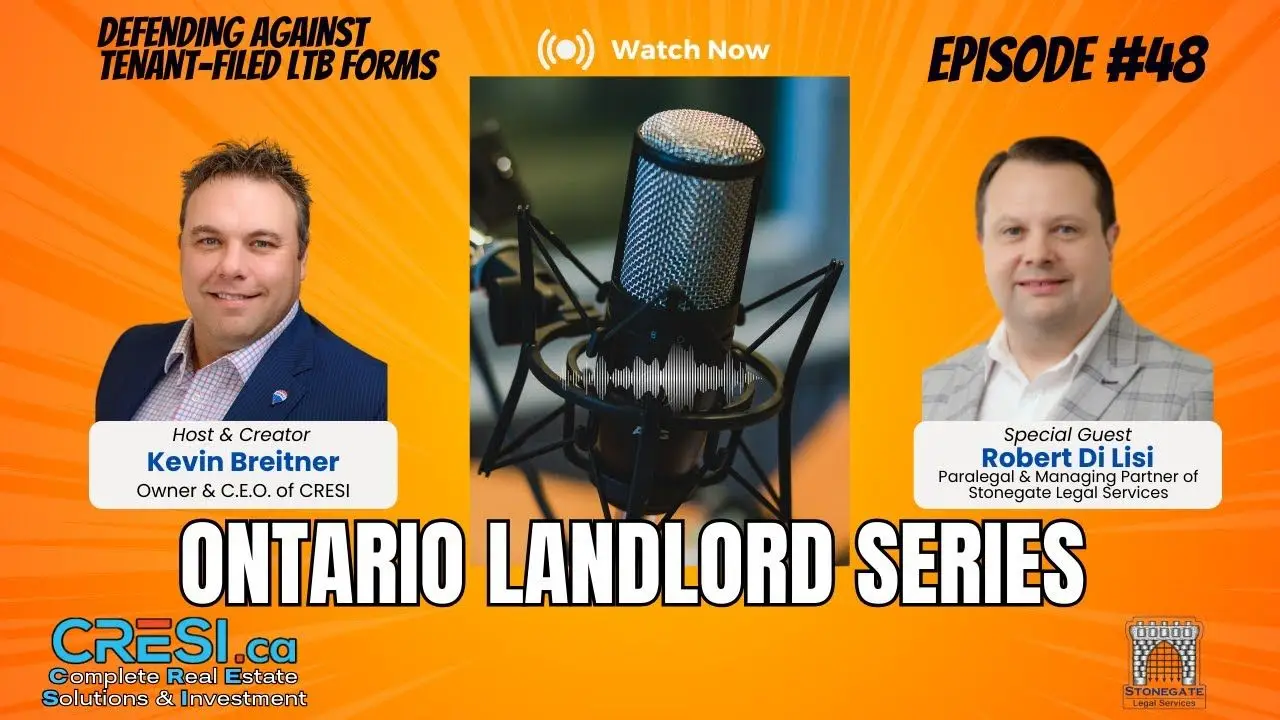
Episode 48 · with Robert Di Lisi
Defending T1, T2, T5 & T6 Applications at Ontario's LTB
Ontario tenants can file four LTB applications against landlords — T1 (illegal deposits), T2 (harassment), T5 (bad-faith N12 evictions), and T6 (maintenance) — each risking up to $50,000. Paralegal Robert Di Lisi tells Kevin Breitner that documentation, RTA Section 20 compliance, and treating rentals like a business are landlords' best defense.
Key takeaways
- Robert Di Lisi says a T2 application covers tenant harassment or interference with reasonable enjoyment, and tenants can claim up to $50,000 (up from $35,000); he advises landlords to send a rent reminder only once, then issue a formal N4, since repeated messages can be used as harassment evidence.
- T6 applications cover a landlord's maintenance duties under Section 20 of the Residential Tenancies Act — which Di Lisi says includes filters, light bulbs, and appliances — and landlords should document repairs and get contractor reports, since the LTB looks at what a landlord did to mitigate damages.
- T5 bad-faith applications typically follow an N12 personal-use eviction; Di Lisi says tenants can use Google Alerts on the property address to catch a landlord re-listing the unit at a higher rent, which becomes evidence of bad faith.
- T1 applications address illegal deposits; Di Lisi says landlords should only collect first and last month's rent plus a key deposit no higher than the cost of the key — anything more, like several months' prepaid rent or a $500–$1,200 'key deposit,' is illegal even if the tenant offers it voluntarily.
- Di Lisi notes that although Bill 60 has passed, the LTB has not yet issued updated forms, so landlords must still follow the old notice periods (for example, 14 days on an N4) until the new forms are released.
Frequently asked questions
What is a T2 application at Ontario's Landlord and Tenant Board?
How much can a tenant claim in a T2, T5, or T6 application?
What counts as a landlord's maintenance obligation under Section 20 of the RTA?
What is a T5 bad-faith application and how does it relate to the N12 notice?
How do tenants prove a landlord acted in bad faith after an N12 eviction?
What can a landlord legally collect as a deposit in Ontario?
Has Bill 60 changed the notice periods Ontario landlords must follow?
Guests
Robert Di Lisi — Licensed paralegal, Stonegate Legal Services
Ontario licensed paralegal at Stonegate Legal Services; landlord-tenant and LTB representation.
Chapters
- 0:00 Welcome to the Ontario Landlords Series
- 1:00 Why Real Estate is Still the Best Investment
- 2:05 T2 Applications: Harassment and Reasonable Enjoyment
- 3:10 The $50,000 Risk: Defending Tenant Claims
- 4:00 T6 Maintenance: Your Obligations Under Section 20
- 5:30 Protecting Yourself with Professional Reports & Documentation
- 6:30 T5 Bad Faith: The Risks of the N12 Notice
- 7:45 Google Alerts: How Tenants Track Bad Faith
- 10:00 Bill 60 and the Changing RTA Landscape
- 12:48 Surprising Maintenance Facts: Light Bulbs and Filters
- 14:00 Why You Should Consider Professional Property Management
- 16:13 Free Resources: Landlord Mastery Guide
- 17:47 T1 Applications: The Truth About Illegal Deposits
- 22:08 Real-World Case Study: Floor Repairs and Damage Claims
- 24:00 Final Thoughts and How to Get Help
Full transcript
Welcome & Why Real Estate Is Still the Best Investment
[00:00:05] Kevin Breitner: Welcome landlords to another episode of CRESI’s Ontario Landlords series, a podcast made for the Ontario investor and landlord to make sure you’re getting the proper information and education, always supplied by our professionals — like Mr. Rob Di Lisi from Stonegate Legal Services, our favorite paralegal, who’s joining us today. Rob, how are you? Welcome.
[00:00:30] Robert Di Lisi: Thank you for having me, Kevin. It’s always great to be talking to you and your audience about landlord-tenant matters.
[00:00:37] Kevin Breitner: I can’t tell you how many great comments I get about our conversations and everything we share. So as always, thank you for joining us — we’ll continue making sure people understand their rights, their options, their obligations, and everything that comes with being a landlord here in Ontario, because it’s the best investment in the world, I say that all the time. A lot of landlords get involved simply because they know it’s a better savings account than anything else out there, and it’s a great investment. But what they don’t know is what it actually means to be a landlord. Most of the people out there helping guide investors into buying are great at helping you acquire a property, but after you become a landlord, no one’s around to make sure you understand what you’re doing and how to navigate it. Today with Rob, we’re going to talk about tenant applications to the board against the landlord — T2, T5, and T6. And if we have time, I recently did one of my “landlord, don’t do that” videos about illegal deposits on the T1, so we can get into that too. Rob, why don’t we start with the T2 — what’s that for, and how does it work?
T2, T6 & T5 Applications: Harassment, Maintenance & Bad Faith
[00:02:05] Robert Di Lisi: Yeah, I’m glad you said real estate is still a great investment — I believe that too. There are companies and TV personalities who talk about buying real estate, but you said it exactly: acquiring it is the easy part. It’s actually keeping it going and making tenants happy that’s the work.
So, on the T2 and T6 — let’s start with the T2. A T2 is usually brought when a tenant feels they’re being harassed or their reasonable enjoyment of the property is being affected. That’s the most common reason. What landlords need to know is that under the law, tenants can come after you for up to $50,000 — it used to be $35,000. Does that mean they’ll get the $50,000? No, we don’t see many T2 applications awarded at that amount, but landlords still have to defend the application. That’s why it’s extremely important to be careful what you put in writing: if you keep messaging a tenant about rent over and over, that can be deemed harassment, and if it’s in writing, that’s now evidence against you. So landlords, if you’re going to send a message, send it once — “hey, rent has not been collected, please resend it” — and then send out an N4, because that’s your legal notice.
Now the big one: the T6. That’s for maintenance and repairs. Landlords need to realize that when you own rental property, you must upkeep and repair it, under Section 20 of the Residential Tenancies Act, which says the landlord must maintain and repair the property. That includes filters, light bulbs, cutting the grass, snow removal, mold, appliances — anything that needs repair, landlords need to get on it, even if they don’t think it’s important, because once a tenant’s emails are ignored, they’ll file a T6, possibly combined with a T2. Remember, each application can go after you for up to $50,000 — two applications is $100,000 of exposure. This is why, when you’re doing repairs, you need something in writing. If a tenant says the fridge isn’t working or there’s a leak, respond in writing: “I’m on it, my plumber is coming today or tomorrow.” When you go to the board, the adjudicator wants to see what you did to mitigate the damages. If you got a contractor out, get proof — a report. Say a toilet was clogged and you think the tenant caused it: get the plumber to write up a report with a receipt describing what they found, which gives you grounds to file an N5 against the tenant if needed. Treat this like a business — get repairs looked at by someone qualified, not your brother, sister, or cousin, so you have a proper report.
The next one, the most popular application we’re seeing right now, is the T5 — a bad-faith application. This most commonly comes up with the N12. If you tell a tenant you’re taking the property back for personal use, you must move in for at least a year, starting once the tenant moves out. Say you’re the tenant, Kevin: I give you an N12, you agree to move out by the end of February. You move out, and instead of moving in myself, I raise the rent to market value and list it on MLS or Marketplace. If you find out I didn’t move in and instead re-rented it for more, and you file a T5, you’ll show that I didn’t move in, that there’s an advertisement, and that the N12 was given in bad faith because I wanted to raise the rent, not move in.
There’s a tool I want to mention: Google Alerts. If you plug in a keyword — say, “123 Riverdale Street” — and that address shows up anywhere online, Google will email you. So whether it’s on Marketplace, MLS, or a personal website, tenants can screenshot that and use it as evidence in a T5 application. Again, the maximum for a T5 is $50,000, and even if the tenant doesn’t get that amount, the landlord still has to defend the T5 — possibly alongside a T2 and T6 — and if a legal rep is involved, there are legal fees too. What happens at the board depends on the adjudicator and the evidence presented, so landlords, please be extremely careful with your notices. Treat it like a business.
Bill 60 and Current Notice Periods
[00:10:01] Kevin Breitner: Very well said. I’ll stick with the T5 for a moment, because that’s been especially common right now with Bill 60, the whole rent-eviction and N13 conversation, and the changes to the N12. We’ve discussed that in other videos, and there’ll be more if you’re unsure about the changes going on with the RTA right now.
[00:10:27] Robert Di Lisi: Just so you know, Kevin — sorry to interrupt — Bill 60 has come into effect, but we don’t have the new forms yet, so we’re still reverting to the old forms. The old law is in place right now.
[00:10:47] Kevin Breitner: Yep, I have to file an N4 right now and I have to wait a couple more days because it hasn’t changed yet.
[00:10:53] Robert Di Lisi: It should be more than a couple — it’s going to be 14 days, unless you do it by mail, which is 20 days.
[00:10:58] Kevin Breitner: Right — what day is it today, the 13th?
[00:11:02] Robert Di Lisi: Right. But under the new rules, it would be seven days.
[00:11:06] Kevin Breitner: Right, which we can’t do yet because the form still says 14. With everything going on with rent evictions and the N12 — people moving in and so on — landlords have, in the past, been shady about this, and tenants have always had protection because it’s their home, not just an investment. Once a property becomes a rental, it’s someone else’s home, and we can’t uproot people for whatever reason we want as landlords. We have to do things properly. Over the years working with investors, and especially with the property management company, complaints about a T6 have been the biggest thing we’ve had to deal with — tenants saying things weren’t done properly. But the more we take care of a property properly over time, the less wear and tear and the fewer surprises down the road. You mentioned light bulbs — that’s something I didn’t know we had to take care of.
Light Bulbs, Filters & Section 20 Maintenance Duties
[00:12:48] Robert Di Lisi: Light bulbs, filters — anything under Section 20. Most people, if they give tenants a bunch of light bulbs and say “change it if it goes out,” think that’s fine, but under the law it still falls under Section 20.
[00:13:04] Kevin Breitner: I’ve never been asked to change a light bulb. We definitely take care of the filters — we drop them off, show tenants how to change them, and some ask us to come back because they’re nervous about touching it. Interesting about the light bulb — I talk to you multiple times a week and I’m still learning from you. I did not know that.
Why You Should Consider a Property Management Company
[00:13:26] Robert Di Lisi: Do you mind if I add something, Kevin? For most landlords — smaller landlords especially, and I’m not trying to insult anyone — many don’t understand how to be a landlord. There’s no license or course you have to take to learn how to be a landlord — well, actually, we do teach that. But if you don’t have the knowledge or the time, this is why you should hire a property management company. Most property management companies I know of — especially CRESI — have software, keep records, and keep documentation that can be used in court to show things have been done. So if a tenant says a maintenance concern was raised and no one acted, and the property manager has a record of it, you can use those records to defend a T2 or T6. So a heads-up for the mom-and-pop landlords out there: if you don’t know what you’re doing and don’t have the time, look into hiring a property management company such as CRESI.
Landlord Protection Program & the CRESI Investor Network
[00:14:53] Kevin Breitner: Thanks for the plug — I’ll take it one step further. Our landlord protection program was built for the everyday landlord, single-family to small multifamily, to make sure they’re getting the education and protection they need as they learn to be landlords. It’s affordable, and it’s a business expense, so it’s deductible, and it frees you up to do whatever you want — skiing, a cottage, traveling, or just staying home without worrying about day-to-day tenant communication. Another plug: with Stonegate Legal Services, us at CRESI Property Management, Shawn Quigg with Cardinal Law, Kayla Andrade with Front Lobby, and Ontario Landlord Watch, we’re creating the CRESI Investor Network — an online community to take this one step further and make sure everybody understands what it means to be a landlord. Another great tool, if you don’t want to involve us but just want to know more: Stonegate Legal Services put together a guide a couple of years ago, updated regularly. What’s it called — the Landlord Mastery guide?
Free Resource: The Landlord Mastery Guide
[00:16:13] Robert Di Lisi: Landlordmastery.ca. It’s a guide I created, since I also own a property management company for my own properties, and I give it to the property managers I hire. The guide itself isn’t earth-shattering, but it tells you the basics of being a landlord. Most importantly, on the last page there’s a link to my Google Drive with everything you need to help you be a landlord — forms, notices, grass-cutting agreements, and so on. It’s 100% free.
T1 Applications: Illegal Deposits
[00:16:49] Kevin Breitner: Yep, and it’s downloadable at Stonegate — landlordmastery.ca. We have it on our website too, in our downloadable section. If you still can’t find it, reach out and we’ll make sure you get it — it’s a good read with a lot of useful information. I mentioned at the top too — let’s get to the T1, since we recently started a “landlord, don’t do that” series of short clips, and one was about illegal deposits, holding more than last month’s rent, and so on. We see it all the time. So, T1, illegal deposit: say I’m a landlord and you’re the tenant. I ask you for four months’ deposit — last month’s rent plus a $500 key deposit because I gave you two fobs to my condo. Now you apply for a T1. I get this in the mail — what happens from there?
[00:17:47] Robert Di Lisi: It goes to the board, and the tenant has the right to speak about it. Something I hear a lot right now is that landlords and real estate agents are asking for more than first and last month’s rent, and you’re not supposed to do that. I know it’s common — tenants offering three, six, nine, even twelve months upfront. Speaking as both a landlord and a legal rep: yes, for that first year you can consider yourself guaranteed that money, but after the lease term it goes month to month anyway, and you cannot ask the tenant again for money upfront. Taking that upfront amount also disqualifies other, possibly more qualified, tenants, since money is only one part of qualifying someone. You should also ask how a tenant got that much money upfront, since sometimes it came from a cash-for-keys settlement with a previous landlord. Personally, as both a legal rep and a landlord, I only ask for first month’s rent, last month’s rent, and a key deposit — and for a house or condo, that deposit shouldn’t be more than the actual cost of the key. So when you see $500, $800, $1,200 — those are illegal deposits. Even if a landlord says the tenant voluntarily gave the money, you can’t contract out of the law: if the law says you can’t take illegal deposits, you shouldn’t be taking them. If a tenant files a T1, it goes to the board, an adjudicator reviews it, and if they find it was an illegal deposit, they’ll order the landlord to return the money and possibly award a rent abatement — anything can happen at the board, so be very careful.
[00:20:11] Kevin Breitner: You’re definitely right, it happens — I’ve been offered this and had to deal with it. If a tenant offers six months upfront, what protection do you have after those six months? None. We’ve structured it before as a last-month’s deposit that the landlord holds: whenever the tenant gives notice, if it’s the full 120 days most people don’t realize they need, they’d get their last four months free; if they only give the required 60 days, the landlord gives back the extra two months plus the tenant gets their next two months free. It’s not something we do often — I did this a couple of months ago for a tenant who was a professional newly arrived from Asia with no Canadian credit history, and everyone felt comfortable with that structure. But we made sure the landlord knew that if the tenant ever asked for that deposit back, they’d have to give it — they didn’t realize that going in.
[00:21:36] Robert Di Lisi: One final point, Kevin — people need to realize everything is fine until it becomes a problem. My dad always says a crime is only a crime when you get caught; otherwise it’s just everyday business. People get away with it until they run into a tenant who talks to a legal rep and says, “this is wrong, you can’t do this,” and then they file against you. And once you’re filed against, you have to incur the costs and time to defend it.
Real-World Case Study: Floor Repairs & Damage Claims
[00:22:08] Kevin Breitner: We talked about this the other day, so I’ll bring it onto the show — a floor issue where the adjudicator found against the landlord. The tenant had to pay about $1,000 in damages, but it’s going to cost the landlord about $4,000 to fix the floor properly. We discussed whether we could just patch the small area, but to do that we’d have to match the exact wood color, or the tenant could complain that it doesn’t look the same aesthetically. So cutting that corner made no sense — they’re doing the whole floor now. Even though the tenant paid for the damages, that payment doesn’t cover the landlord’s actual cost. That’s how the adjudicator ruled: the tenant paid the landlord, and now the landlord has to follow through and fix the floor. Again, keeping track of everything matters — our handyman had been trying to schedule the repair for a long time, and the tenant kept delaying, so we have messaging between the handyman and tenant, and between us and the tenant, documenting all of it. If anything comes up about a delay, we have it on record. My wife’s a nurse, and in the hospital they say if it’s not written down, it didn’t happen — that’s exactly how we operate here too.
Final Thoughts & How to Get Help
[00:24:39] Robert Di Lisi: No, I think we’ve covered everything. Again, treat it like a business — remember, tenants can come after you for up to $50,000, so stay on top of your maintenance obligations, watch how you communicate to avoid harassment claims, and hire a property management company if you can’t handle this yourself.
[00:24:58] Kevin Breitner: Awesome. One more plug for the CRESI Investor Network — look out for that. It’s going to be built on education, information, and advocacy for landlords with the provincial government, to help change things, and we’ll be providing opportunities you can’t find anywhere else. As always, Rob, thanks so much for your time — we’ll talk soon. And thanks for listening, everybody — share this with another landlord so we can keep getting this information out there. Thanks so much, bye for now.
Please remember, while we are professionals, this podcast is for informational and entertainment purposes only. The advice shared may not apply to your unique situation. Always seek personalized advice from a qualified professional before making any investment decisions.
Derived guide: read the full guide.