
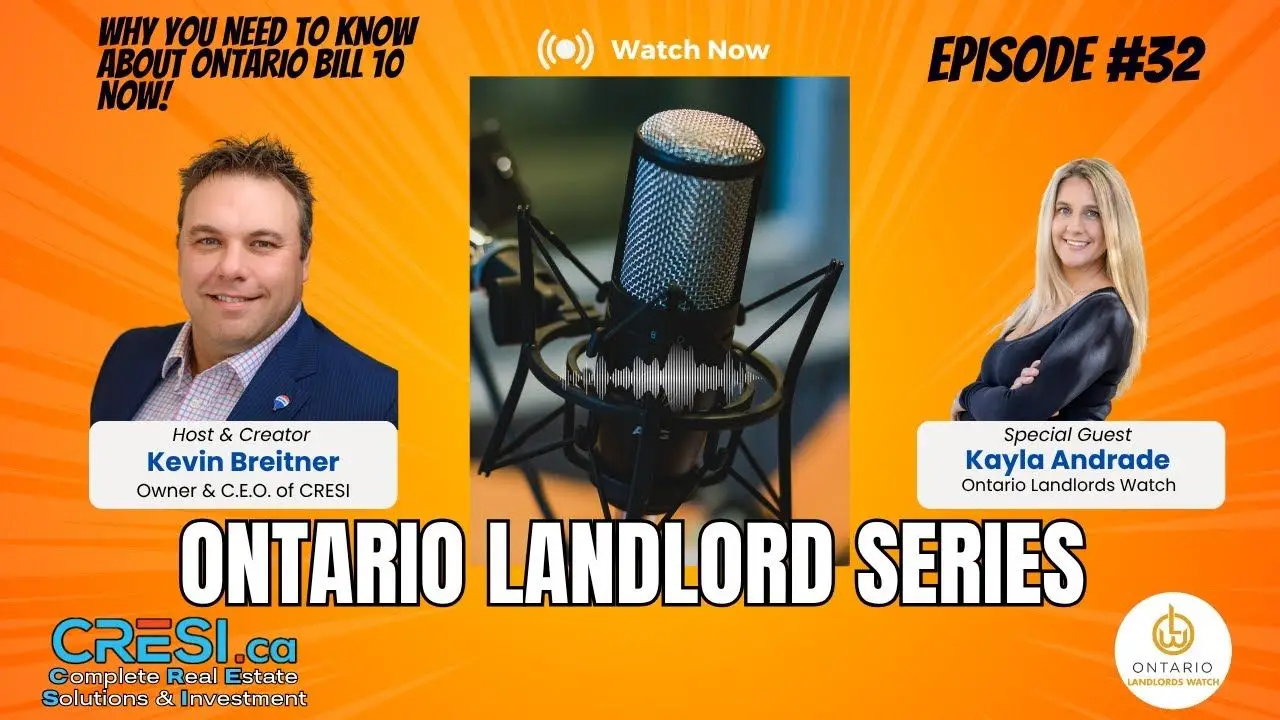
Episode 32 · with Kayla Andrade
Ontario's Bill 10: What It Means for Landlord Liability
Ontario's Bill 10 makes landlords legally responsible for tenants' illegal drug activity without defining the 'reasonable steps' landlords must take to prevent it, says landlord advocate Kayla Andrade. Combined with 24-hour entry-notice rules that limit what landlords can discover, and a backlogged LTB, Andrade says the bill is pushing small landlords out of Ontario entirely.
Key takeaways
- Kayla Andrade says Bill 10 can hold landlords responsible — through fines, property closure, or confiscation — for tenants' illegal drug activity like dealing or manufacturing, but the bill requires only 'reasonable steps' to prevent it without ever defining what that means; she says her organization has asked the Attorney General's office for clarification.
- Andrade argues the 24-hour written entry-notice requirement makes compliance nearly impossible, since a tenant has a full day's notice to hide anything before a landlord can inspect — she put it as being able to 'hide an elephant in 24 hours.'
- Andrade says Bill 10 moved unusually fast: it was introduced May 1 and reached Royal Assent before the end of that same month, without what she describes as consultation from the stakeholders involved.
- Andrade describes a landlord who has been trying to evict a tenant for five years and obtained three separate eviction orders from the Landlord and Tenant Board — originally issued under Section 78 for non-payment — but the tenant, backed by Waterloo Regional Community Services, has appealed each order, with a further court date in June over the alleged illegal activity.
- Andrade says landlords are already leaving Ontario for jurisdictions like Alberta, Texas, Florida, and Mexico rather than deal with what she calls this regulatory climate, and that even after a tenant is arrested, the landlord remains responsible for giving them continued access to the rental unit.
Frequently asked questions
What does Ontario's Bill 10 mean for landlords?
What are 'reasonable steps' landlords must take under Bill 10 to prevent illegal activity?
Can a landlord inspect a rental unit for illegal activity in Ontario?
How quickly did Bill 10 pass into law?
Is a landlord still responsible for a rental unit after a tenant is arrested for illegal activity?
How long can it take to evict a problem tenant through Ontario's Landlord and Tenant Board?
Are Ontario landlords leaving the province because of legislation like Bill 10?
Guests
Kayla Andrade — Landlord advocate, Ontario landlord advocacy
Ontario landlord advocate and community organizer focused on landlord rights and education; represents Ontario Landlords Watch.
Chapters
Full transcript
Bill 10 Bombshell Breakdown
Welcome back, landlords of Ontario, to another episode of CRESI’s Ontario Landlord Series podcast, where we’re here to educate and inform, making sure all of you landlords out there understand your obligations, your rights, and what’s going on in the world around us — which brings us to today’s episode and topic. I don’t know if any of you are familiar with what’s happened recently. This episode isn’t going to be evergreen —
it’s about what’s going on right now. But we should always know what’s happening in the political world surrounding the landlord and tenant situation. So, Bill 10 — have you heard of it? I have.
I’ve spoken to my friend Kayla Andrade, who’s here with us today to talk about this so everybody understands what’s going on, what’s changing. Sadly, we’re not talking about whether we can help stop this bill anymore — it’s going through, it’s happening here in Ontario. So it’s more about why this happened,
how we can maybe stop things like this from happening in the future, and how we can be more up to date and involved with what’s going on at all levels of government — federal, municipal, provincial. We’re focused more on the provincial side on this podcast, but we can get into the municipal side too. So without further ado — Ms.
Kayla Andrade from Ontario Landlords Watch, welcome. Thanks for joining us again. How are you today? Thank you so much, Kevin, for having me back.
It’s unfortunate we’re coming back so quickly regarding Bill 10. I think a lot of landlords are slowly going to find out about this. This bill came out on May 1st, and before the end of that month it was already in the Royal Assent stage, which means it’s a bill that’s going to be pushed through. People are probably wondering, what is Bill 10?
Normally, when you first look at it, you might think it sounds fine — every landlord and property manager in the province of Ontario should be careful about who they’re renting to and make sure tenants aren’t doing anything illegal. That could mean drug dealing, cooking drugs, even sex trafficking — there’s a range of criminal activities a tenant could engage in.
But now, with Bill 10, landlords are going to be asked to be held responsible in some way, which could result in landlords being fined, having their property closed, or even confiscated. And the bill uses the phrase “reasonable steps,” without defining what that means.
The definition isn’t in the bill. We’re communicating with the Attorney General’s office through our submissions, asking what the fine detail of “reasonable steps” actually is. Is it just doing normal inspections of the rental property? But we both know landlords have to give 24 hours’ written notice before entering, which gives tenants 24 hours to hide whatever they want to hide.
If there’s a situation where the police or a tactical team come in and it’s clearly a drug operation — how are they going to determine the landlord should be held responsible? What happens to landlords if tenants have a drug operation running in their property and police shut it down? We can’t re-rent it,
and even when tenants go to jail, landlords are still responsible for giving them continued access to their rental unit. Coming down to Section 8 of Bill 10 specifically, it’s disheartening to see our Conservative government — the ones we had hoped would look out for small landlords, that business mindset — being protective, but instead Doug Downey created a bill that makes it look like he’s doing something for the community, because everyone knows crime and drug activity are on the rise. Again, they just want to point the finger at private landlords and try to hold us accountable, as if we’re supposed to be the police or the cameras.
How many landlords are going to become paranoid about this now, and end up giving harsher treatment to their tenants because they’re nervous about the police coming after them or confiscating their properties?
The 24-Hour Notice Problem
There are lots of things I don’t like about this, but one of the main ones is the gray area — the unknown. How are we even supposed to get from one step to the next with only 24 hours’ notice? I can hide an elephant in 24 hours.
That’s crazy to me. How are we supposed to be held responsible? When we were discussing this a couple of weeks ago, I mentioned an appraisal I couldn’t get done — a mortgage appraisal to get inside a property for a client trying to refinance — because the tenant denied entrance. I can’t even get in for that, let alone know what’s going on inside that property 24/7. I don’t understand how they can hold us responsible.
There’s a landlord trying to evict their tenant for five years. They got three eviction orders from the Landlord and Tenant Board, but the tenant is now being protected by Waterloo Regional Community Services, who have appealed each of those eviction orders. The orders were originally based on Section 78, which stemmed from non-payment, but they’re going back to court in June over all of the illegal activity that’s been happening. If you want to make us responsible for this, that’s fine — I don’t want drugs in the community either.
I don’t want criminal activity in my community, but give me the proper tools I need to actually address it. Right now you’ve given landlords a broken, backlogged Landlord and Tenant Board system, overseen by Doug Downey, who is now also attached to this bill. You’re telling landlords to do one thing, but not giving them the tools to actually do it.
So the work isn’t going to get done, and how many properties are going to be confiscated in the meantime? It’s about pointing the finger, placing blame, shifting responsibility onto landlords instead of the government taking it on themselves. It’s smoke and mirrors. There’s a lot of criminal activity happening, and sometimes these people are making money and going to buy a house rather than continuing to operate out of a rental unit,
but there’s still a piece of that dynamic at play. The government keeps passing its responsibilities down to private citizens, private housing providers. That’s why landlords need to be part of the Ontario Landlords Watch group, to get all the notifications, because this bill moved very quickly and was effectively done by the end of the month it was introduced. I’ve never seen something move that fast,
implemented without what felt like real consultation of the stakeholders involved. I’ve done what I could, informing our members, writing letters to the Attorney General and to the Minister of Housing, because both offices play a strong role in how the housing industry is run. And then they wonder why landlords are running out the door when policies like this get created. And that’s not even half of what we have to worry about.
There are also other provincial rules and regulations, plus municipal government requirements — it’s hard to keep up with, but we’re trying to. If you’re listening and you know something going on in your municipality or in the province, please reach out, come into the group, send a direct message — let us know, because our community is what we make it, and we need to be there for each other.
Real Landlord Horror Stories
This community of landlords, of landlord advocates — there are a few of us out there now building and growing, but there’s power in numbers, and if we can all come together, support one another, we can make this better for everyone. Do we go on strike, like the post office? I want to go on strike.
Do we say we’re not doing any maintenance the tenants bring to us? But then property standards enforcement comes in. Where do our rights come in?
What union is going to represent us? We have to make sure we’re advocates for our own interests. And when some of these landlords are ready, they’re leaving — going to Alberta,
Texas, Florida, the Dominican Republic, even Mexico. They’re willing to take their chances elsewhere. We have to really ask ourselves, and ask our elected officials, what happens when landlords are pushed out of this industry — yes, some may sell to a developer, or sell to someone who puts their own family members in and doesn’t rent it out to the community.
What happens then? How much pressure is going to be on taxpayers to keep building, managing, maintaining, and subsidizing government housing, when the private sector that’s currently doing a lot of that work is being pushed out? Purpose-built rentals mostly aren’t being built by government anymore — it’s fallen on private landlords.
There have been some government incentives for developers and builders to build more purpose-built rentals instead of just condos, which is a positive step. But what a lot of the general public doesn’t realize is that when a previous provincial government first talked about an affordable-housing program back in 2017, it wasn’t until the fall of 2024 that the first project under that program started accepting tenant applications.
That’s how long these things take — going through municipal permits, planning, and zoning, no matter how many incentives the government offers big corporations to build. Most people watching this podcast can’t afford to build a multi-million-dollar apartment building — we’re the small landlords looking after single-family and small multi-family properties, while those big developers get the rebates and kickbacks.
We have to look out for ourselves, and the government has to realize we’re needed in this system, or the money and the housing supply will go elsewhere — out of country, out of province — and that’s already started. People are taking their investment dollars elsewhere, because real estate is a great investment, but
the problem is people are scared right now about what’s happening, especially in the province of Ontario, and they don’t want to stay as the balance keeps tilting further in favour of the tenant. That’s exactly it. People like myself are very frugal about it — when I bought my properties, I stayed within what cash-flows.
I’m not going to buy more here right now. I might buy elsewhere. Let’s put this in context — I’m working on an article right now about the type of crime happening in Toronto Community Housing, and finding that a large share of crime in the City of Toronto has actually happened on or near Toronto Community Housing properties. Their complaints run from bedbugs and cockroaches to roofs and elevators — the city’s enforcement programs come down hard on private investors, but are they coming down just as hard on Toronto Community Housing? How many buildings in Toronto have been boarded up because there isn’t the funding to maintain them?
Some public housing providers have started liquidating properties because they don’t have the money to maintain them, and nonprofits are struggling to find land or build anything. That’s the kind of mess we’re dealing with,
and yet the government acts as though everyone can just become a homeowner. But people need credit, a good job, a down payment — it’s not as easy as it’s made to sound. It’s a bit like the pot calling the kettle black, pointing the finger at private investors
while community housing itself hasn’t been well managed for years and has become a mess of its own problems. Small landlords, by comparison, generally do a good job managing their properties — they vet their tenants properly, and they’re on top of issues as they come up. So why does the private sector keep getting penalized and punished through every level of government policy?
Government Housing Hypocrisy
Because it’s the easiest way to point the finger. It’s the easiest thing for the government to deflect blame elsewhere rather than take it on themselves. It’s easy to defer to somebody else instead of taking responsibility.
They’re right about that — the call is incredible, and you have to call it out like it is. I’m following different local advocacy accounts and posts online where people are raising these same issues that landlords deal with in Toronto Community Housing, but when I raised the point that government can’t afford to keep building, managing, maintaining, and subsidizing these types of properties, they didn’t agree with that. We’re all taxed to the limit — look at our health care system,
look at our roads, look at everything we need in society, and it’s all stretched thin. So saying more government housing is the answer — it’s not, on its own.
There was a recent article in my local paper calling for more government housing, but it’s not just about the amount of housing — it’s the broken processes in between, even connecting the private sector to nonprofits and government, bringing the right stakeholders together. It’s not just about the salaries being paid to nonprofit organizations — it’s about whether the existing housing is being properly managed.
A lot of these situations are hard to keep up with, based on the stories our landlords are dealing with — but if you’re going to stay in this industry, you need to get educated, which means
making sure you’re at the upcoming event on June 26th, the Investor Summit, where a lot of this community will be connecting. But you also have to stay very involved. Add the Attorney General and the Minister of Housing’s office to your radar — it’s a quick search — and follow them on social media so you’re aware of what’s happening,
because otherwise it’s easy to miss. I can only imagine what would happen under a different provincial government.
How to Stay Informed & Fight Back
That’s it exactly — stay in the know, and understand the communities out there to guide, advise, and support you. Kayla just mentioned an event called the Investor Summit coming up on June 26th.
It’s right around the corner, and it’s an in-person event. There’s information about it out there,
and there are ways to get promo codes — you can reach out to us for the code CRESIFORTY. CRESI in capital letters, C-R-E-S-I, and “forty” spelled out, will get you a discount.
It’s about getting landlords back together, networking, staying informed, supporting each other, and having everyone as one team. Follow Ontario Landlords Watch — it’s a great place to connect through the Facebook group. Kayla, do you have anything else you want to leave our audience with today?
Thanks for asking, Kevin. Not many podcasts give me the chance to talk about this. Based on what’s happening at the Landlord and Tenant Board, and with Bill 10, and knowing the government has cycled through several ministers of housing over the years, the one constant has been Attorney General Doug Downey.
There’s a petition — you can find it through my Facebook page at Ontario Landlords Watch, or send me a direct message and I’ll share the petition calling for Doug Downey’s resignation. I’m not confident his approach has been about providing quicker, more timely access to justice, rather than potentially stockpiling the Landlord and Tenant Board with more adjudicators or giving more paralegals and lawyers more work representing landlords stuck in this broken system. I want change.
If you believe in what I’m telling you, you can sign that petition — just reach out and we’ll make sure you have access to it. As always, thanks so much for listening and being part of our group here. There’ll be a link for that petition somewhere in this episode,
or through Ontario Landlords Watch or Kayla Andrade’s Facebook page — you can find her there. Thanks so much for listening, and we’ll talk to you soon. Bye for now.
Please remember, while we are professionals, this podcast is for informational and entertainment purposes only. The advice shared may not apply to your unique situation. Always seek personalized advice from a qualified professional before making any investment decisions. Hey everybody, thanks so much for joining us this week.
I hope you enjoyed the episode. If you’re finding it informative and useful, make sure to like, subscribe, and share with a friend so that we can keep getting the information out there to Ontario landlords. Keep on joining us — we’ll see you next time.