
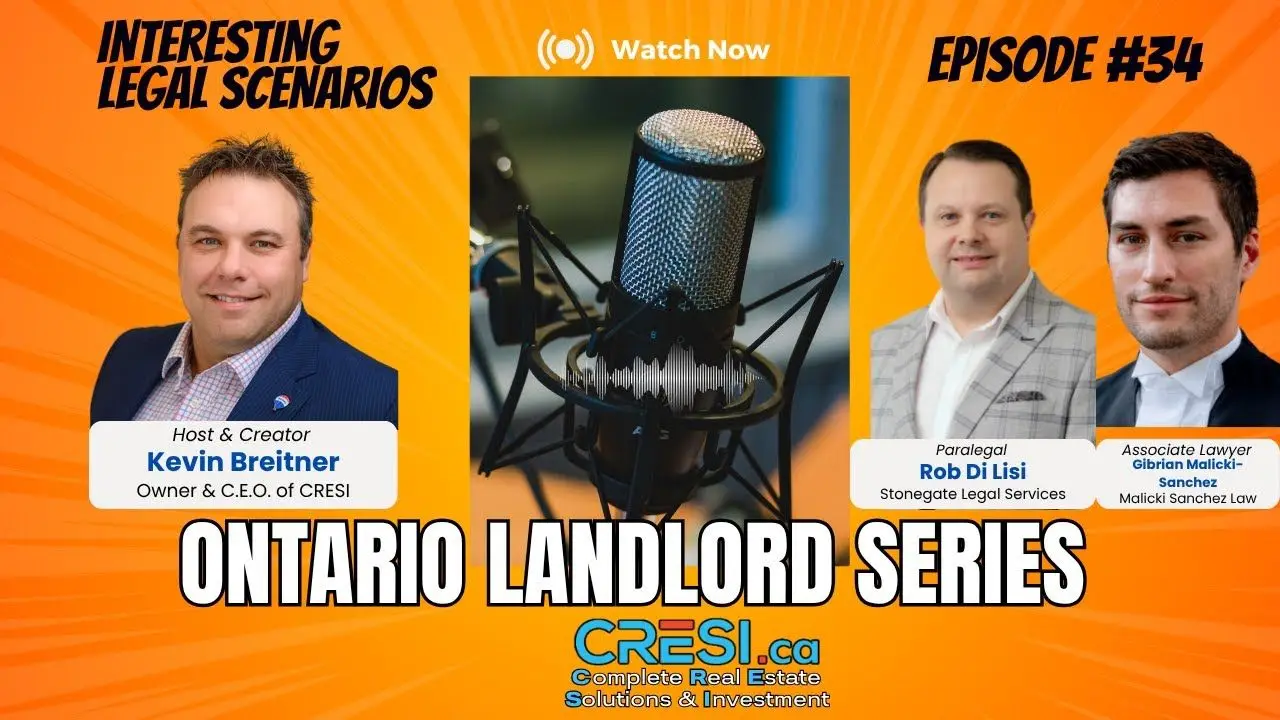
Episode 34 · with Robert Di Lisi, Gibrian Malicki-Sanchez
Ontario Landlord Legal Essentials: Evictions, Tenant Death, and Collecting on LTB Orders
There are only three legal ways to evict a tenant in Ontario — a notice from the tenant (N9), a mutual agreement (N11), or a court order — and police have no jurisdiction over non-payment disputes. This compilation episode also covers the 30-day rule when a tenant dies, the $35,000 cap on collecting an LTB order, and why 'no pets' clauses are unenforceable.
Key takeaways
- There are only three legal ways to evict a tenant in Ontario: the tenant giving notice (N9), a mutual agreement (N11), or a court order — and police have no jurisdiction to remove a tenant, even for non-payment of rent.
- Under section 91 of the Residential Tenancies Act, a tenancy automatically terminates 30 days after a landlord learns a tenant has died; within that window the landlord must secure the unit, involve police if they discover the body, and give the estate's authorized representative reasonable access to remove belongings.
- The Landlord and Tenant Board can order a tenant to pay a landlord money but has no power to enforce that order — a landlord must file it as a certificate of judgment at small claims court, whose jurisdictional limit caps what's collectible at $35,000.
- A blanket 'no pets' clause is unenforceable under Ontario's tenancy legislation and generally isn't grounds for eviction unless the animal is dangerous, though a documented medical allergy can sometimes be argued at the board, and condo weight limits (such as 25 pounds) can still apply.
- For a unit to be considered abandoned, a two-part test must be met: whether belongings remain and whether rent is still being paid. In a case discussed on the episode, rent kept coming in even though the named tenant no longer lived there, so it wasn't abandonment.
Frequently asked questions
How many legal ways are there to evict a tenant in Ontario?
Can I call the police to remove a tenant who isn't paying rent?
What happens to a rental unit if the tenant dies?
Can I collect money a tenant owes me after an LTB order?
How do I garnish a tenant who owes me money?
Can I enforce a 'no pets' clause in my Ontario lease?
Is a unit considered abandoned if the tenant on the lease doesn't live there anymore?
Guests
Robert Di Lisi — Licensed paralegal, Stonegate Legal Services
Ontario licensed paralegal at Stonegate Legal Services; landlord-tenant and LTB representation.
Gibrian Malicki-Sanchez — Real estate lawyer, Malicki Sanchez Law
Ontario real estate lawyer at Malicki Sanchez Law, focused on landlord-tenant litigation and court remedies beyond the Landlord and Tenant Board.
Chapters
- 0:07 Introduction & Disclaimer
- 0:18 The 3 ONLY Ways to Evict (Most Landlords Get This Wrong!)
- 2:10 What Happens When Your Tenant Dies (30-Day Rule)
- 5:14 Collecting Money After LTB Orders (The $35K Limit)
- 8:46 The "No Pets" Clause Myth (It's Actually Illegal!)
- 11:30 Property Abandonment Reality Check (2-Part Test)
- 13:36 Final Disclaimer
Full transcript
(Intro sound cues; no spoken content.)
Introduction & Disclaimer
Hey everybody, this week’s episode features a compilation of some interesting legal scenarios. Please remember none of this is legal advice, every situation is different. Enjoy.
The 3 ONLY Ways to Evict (Most Landlords Get This Wrong!)
Yeah, so people think that they can arbitrarily just evict someone. What you need to realize is that there is a process. This is Canada. There is a legal system in place.
So if you want to evict — and the most common way would be for non-payment of rent — you can’t just walk up to them and say, “I want you to leave or else I’m going to call the police.” Police have nothing to do with this. If you call the police and tell them that you have a tenant not paying rent, they will tell you this is out of their jurisdiction.
You need to go through the Landlord and Tenant Board. To do that, you have to give notice to the tenant and file an application to get to the board. You’re looking at, and I’ll be a little dramatic, but let’s say six to eight months to get to the board, another 30 to 60 days to get the order, and then three to six weeks, depending where you are in the city, to actually have the sheriff come out. So there are only three ways to evict a tenant.
Number one is when they give you notice, which is usually the N9. Number two is a mutual agreement, which is the N11. And number three is the court order. With the N9 and the N11, you can file for an ex parte order for the eviction.
But most of the people watching here, if they are doing it for non-payment of rent, have to wait for the court system, and then the sheriff is the one who carries out the eviction. The sheriff is the court-appointed officer for the court. They are not police. I want to make that very clear, okay?
What Happens When Your Tenant Dies (30-Day Rule)
Let’s say I’m a landlord. I have a property, a little condo that I rent out to Susan, and Susan passes away. As a landlord, what do I need to do?
What’s the process? In that unfortunate situation, this is governed by section 91 of the Residential Tenancies Act. And what that says is that the tenancy is automatically terminated after 30 days.
So the landlord has certain responsibilities that they must fulfill within that 30-day period. Once they discover that the tenant has passed away, the landlord is going to want to make sure that they contact — well, first of all, the police, if they’re the ones who discover the body, so that the police can contact the next of kin of the deceased. If somebody else reaches out to the landlord and lets them know that their family member has passed away, then the landlord should secure the property, because they’re responsible for everything that’s in it. And the most important thing first is what to do with the body, which must be treated with respect.
The next of kin will be responsible for disposing of the body and making the appropriate arrangements. If no next of kin is located, the police will deal with the body. The landlord is responsible for making sure the tenant’s property remains safe and secure — with an exception that they have to dispose of anything that’s unsafe or unhygienic immediately.
Otherwise, they must provide reasonable access to whoever is responsible for administering the estate to remove that property. And they need to ensure that the person coming into the rental unit has the appropriate authority. They can prove that a couple of ways. One, if there’s a will that names them as executor, they have the appropriate authority.
If there is no will, you’re going to want to verify their relationship — you’ll want to check their ID — and make sure that within the 30-day period, any property that has to go to the estate has been accounted for.
Collecting Money After LTB Orders (The $35K Limit)
Sadly, it’s something people are always curious about. Hopefully they never get into the situation where they have to get to this, but it is inevitable that landlords do have to collect rent, whether it was after an eviction for non-payment, unpaid utilities, or whatever — a landlord is owed money after a tenancy has been terminated. So what do we do once we have that order from the LTB? These Landlord and Tenant Board orders set out the money owed based on the application, plus the application fee, plus interest that accrues on the non-payment of the order.
The Landlord and Tenant Board actually doesn’t have the jurisdiction to enforce monetary orders. It can do everything else, like evictions. The jurisdiction to collect on monetary orders falls under the small claims court.
And that’s why the highest amount a landlord can collect from a tenant is $35,000, because that’s the jurisdictional limit of the small claims court. So hopefully no landlords are in a position where a tenant owes them over $35,000, because they’re not going to get an enforceable order for anything above that amount. Getting the order at the Landlord and Tenant Board is the first part — it’s the easy part. Now the heavy lifting begins.
The first thing you want to do, once you get the Landlord and Tenant Board order, is file it at small claims court with a small claims court form called the certificate of judgment. That puts in all the financial information from the Landlord and Tenant Board order, and then they give you a judgment back with a small claims court file number and the very important small claims court seal on it. Now you can take that small claims court order and enforce it. The small claims court offers four enforcement options.
The first is garnishment. The second is a writ of seizure and sale of personal property. The third is a writ of seizure and sale of land. And the fourth is a writ of delivery.
Practically, the only one landlords would use is garnishment, so I’m just going to focus on that. What is garnishment? It means that you serve a notice of garnishment on somebody who owes the debtor money.
In this case, the debtor is the tenant who owes you money — they become the judgment debtor. The people most often garnished are the employer or the bank; those are the two most common people who owe the debtor money, so you can garnish from them. To complete the process, you have to fill in a couple of forms — the affidavit of enforcement request and the notice of garnishment — and then file them at court. Once they’re approved, you have to serve them on the employer with a garnishee’s statement or order.
When you do that — let’s say you serve it on the bank — the bank will pay the money into court, and the court will hold it for 30 days and then pay it out to anybody who has registered a garnishment at the court, just like you did.
The “No Pets” Clause Myth (It’s Actually Illegal!)
We have on our leases “no pets,” but now we’re told that our tenants have a little puppy or a little cat. How does that work? What can we do? Here’s the thing: a “no pets” clause actually goes against the legislation.
You can put it in your lease. The question is, if a tenant brings in a pet, what can you do? Can you evict them? The answer is no.
Assuming this isn’t a dangerous pet — not a snake or some kind of venomous animal, so a legal pet, I guess you can say. The only caveat is, let’s say you’re renting a house with a basement, and you have allergies, and you’ve told the tenant, “Look, the reason I’m asking for no pets is because my child or I have allergies to dogs, cats, whatever the case is.” That’s something that could be argued at the board because of a medical condition. The same goes for smoking, by the way.
If you’re sharing, say, a basement and main floor, and there’s an allergy to cigarettes or whatever the case may be, as long as you can show that, you can fight it at the board. Other than that, you can ask if they have pets at the beginning, but if they bring pets in afterward, the only time it would be effective is in a condo, if it goes beyond the weight limits in the condo’s guidelines. For a condominium, I believe it’s usually around 25 pounds, which is like a small dog. Every condo is different depending on its condo board.
I’ve seen some that say no dogs at all, some with a weight limit — 25 pounds, 50 pounds — and some that say no more than one dog. It’s specific per condo and their condominium board rules.
But if you were renting out a basement, would that only matter if you lived upstairs? What if you had a fourplex, for example, and one of your tenants was allergic to dogs and now someone else got a dog? Same thing with an allergy — I’m going to say no, only because that tenant can change. So you can try to fight it at the board, but again, it does go against the legislation.
Property Abandonment Reality Check (2-Part Test)
The tenant on the lease is believed to have left the unit, but left behind her pregnant, underage granddaughter — 16 years old — and the granddaughter’s 15-year-old boyfriend. The rent is still getting paid, and the landlord sees the grandmother every once in a while, one or two times a month, coming in to check on them. The unit, though, has been destroyed. There are holes in the walls, what looks like dog feces on the glass, they’ve been smoking in the unit, breaking windows.
They’ve also unplugged all the smoke alarms. So now there’s a hazard issue as well, and supposedly they’re causing problems with other tenants in the building. What is this landlord to do?
What are her options, with the safety issues, the other tenants, and this one unit? Okay, so this is not abandonment, just so you know. And the first thing I’m going to say is occupancy has nothing to do with tenancy.
You said something important — that the rent is still being paid even though the person on the lease isn’t living there, and you believe the granddaughter is living there. Is that correct?
It was a granddaughter, but yeah, same idea. Someone who wasn’t originally on the lease is now staying there. So the people staying there are considered occupants, guests. There’s nothing illegal or wrong here from what you’re describing.
For abandonment, there’s a two-part test to consider. Number one, are there belongings there? And number two, is the rent being paid? In this situation, even though the tenant is not residing there, the rent is still being paid and there is someone occupying the property.
As for what the landlord can do, the options are quite limited. If they’re making a disturbance in the property, you can give a notice for disturbing the other tenants. But remember, to get to the board these days you’re looking at four to six months, and then another two months to get the order. So that may not be a plausible option — but again, this is not abandonment.
Abandonment would be something separate.
Final Disclaimer
Please remember, while we are professionals, this podcast is for informational and entertainment purposes only. The advice shared may not apply to your unique situation. Always seek personalized advice from a qualified professional before making any investment decisions.
Hey everybody, thanks so much for joining us this week. I hope you enjoyed the episode. If you’re finding it informative and useful, make sure to like, subscribe, and share with a friend so we can keep getting the information out there to Ontario landlords. Keep on joining us — we’ll see you next time.
Derived guide: read the full guide.