
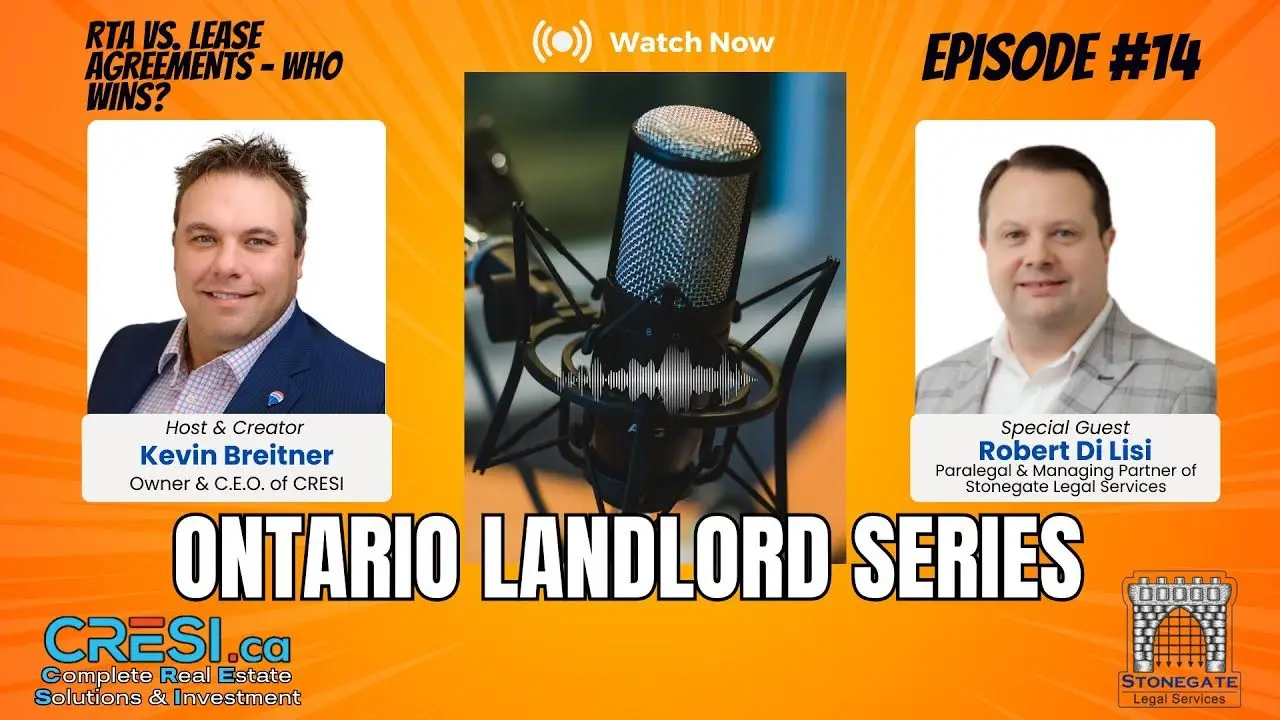
Episode 14 · with Robert Di Lisi
What Lease Clauses Can Ontario Landlords Actually Enforce?
Many clauses landlords put in an Ontario lease aren't enforceable. Paralegal Robert Di Lisi explains that maintenance and repair duties under Section 20 of the Residential Tenancies Act always belong to the landlord, that any deposit beyond first and last month's rent is illegal, and that tenants can add roommates or guests without permission.
Key takeaways
- Robert Di Lisi says any clause making a tenant responsible for property upkeep and repair — like snow removal or grass cutting — isn't enforceable, because Section 20 of the Residential Tenancies Act puts that duty on the landlord regardless of what the lease says.
- Di Lisi explains that any deposit beyond first and last month's rent — including pet deposits, key deposits beyond actual replacement cost, or 'kid deposits' — is an illegal deposit that a tenant can demand back through an application to the Landlord and Tenant Board.
- A landlord can only charge the actual cost of replacing a key, not a condo fob or garage door opener, since the Residential Tenancies Act only refers to the cost of the key itself, Di Lisi says.
- Tenants can add roommates, guests, or occupants without the landlord's permission, Di Lisi explains, and the rent is for the unit, not the number of people living in it — unless the occupancy violates a municipal bylaw.
- Clauses making tenants responsible for the first $100 or $200 of repair costs are illegal under Section 20, Di Lisi says, and are unenforceable if the tenant disputes them, even if they signed the lease.
Frequently asked questions
Can an Ontario landlord require a tenant to cut the grass or shovel snow?
Can a landlord charge a pet deposit in Ontario?
Can a landlord ask for more than first and last month's rent as a deposit?
How much can a landlord charge to replace a condo key or fob?
Does a tenant need the landlord's permission to have a roommate or guest move in?
Can a lease make a tenant pay the first $100 of any repair?
Guests
Robert Di Lisi — Licensed paralegal, Stonegate Legal Services
Ontario licensed paralegal at Stonegate Legal Services; landlord-tenant and LTB representation.
Chapters
Full transcript
Introduction to Lease Clauses
Hi everybody, welcome to another episode here for Ontario Landlords, where today we’re going to break down and explain what can actually be enforced of the clauses that people put into a lease. We get this asked by a lot of our new landlords all the time. They talk about things they want to have their tenants be responsible for — the most common one is grass cutting and snow removal that we deal with, right?
They say, well, I’m going to give them a lawn mower and I’m going to give them a shovel, and we want to get them to do that — and then find out some other things about it later on. Anyway, I want to break all these things down with you and discuss the different things in the lease that we can add and that can be enforced, and the things that people add that really might not be enforceable at the end of the day. Joining us today, our good friend and smart man when it comes to all this, Mr. Robert Di Lisi from Stonegate Legal Services. How are you doing today?
Good, Kevin, thank you for having me on. It’s a pleasure to help you and your audience.
Yeah, thanks. I appreciate the knowledge, experience, and expertise. Like I said, let’s start with what we were talking about there. We had a landlord the other day who was saying they wanted to get their tenant to take care of the snow removal and the grass, and wanted me to write that in a clause in the lease. Can that be enforced? What happens there?
Okay, so this is a very common question that we hear. What you need to understand is that what you have in your contract and what you have in the Residential Tenancies Act, which is legislation, are two separate things. Legally speaking, if you put a clause in the contract that says the tenant is responsible, that’s fine until the tenant says they no longer want to do it.
Property Maintenance: Who’s Really Responsible?
Any upkeep and repair is the duty of the landlord, not the tenant. The only way you should be doing this is actually contracting out to the tenant, just like you would a third party, in a separate agreement saying that they’re going to be responsible for the grass cutting and snow removal, but that should be a separate contract, and obviously there should be some monetary compensation. However, if the tenant stops doing their job, what would you usually do? You’d fire that person and find someone else — but remember, under Section 20, it still falls under the responsibility of the landlord. In fact, if the city ever sends out a fine for the grass not being cut, it goes to the landlord, not the tenant, because it’s the landlord’s property.
Yeah, that’s definitely exactly what we’re explaining to our landlords as well. We want them to do it — for example, we have a multiplex where we have a gentleman who helps with the garbage. We don’t have him under contract to do so, but we send him a $25 gift card every month that he gets to use for whatever he’s looking to do. It’s a great little agreement, and so far it’s working, and like you said, I guess at some point he just has to say he doesn’t want to do it anymore and then we’d have to figure out something else. Another one we get asked a lot about is deposits, right? Especially right now with people qualifying and screening tenants and being unsure — maybe it’s a new immigrant with no credit history, so people are asking to collect more deposit or last month’s rent instead of just one month, three months, whatever. How does that break down legally? Can we accept it?
So here’s the thing — that’s another thing we hear a lot, real estate agents asking for three months, six months, even one year in advance. Please note that any deposit that is not first and last month’s rent is considered an illegal deposit. Now, with that said, if the tenant voluntarily says, look, I know that one of the judging factors is that I don’t have credit, however I can give one year upfront, and they agree upon it, that’s fine — but if the tenant changes their mind, or later finds out that’s an illegal deposit, they can ask for that money to be returned. Something I always tell people is, for my own units, I don’t only look at credit — I look at what kind of job they’re doing, are they employed, I like to meet them just to see the kind of people they are, because a lot of times it goes on gut feeling. If you just focus on getting three, six, nine, twelve months in advance, remember after the first year it goes month to month anyway. So having that one year covered is great, but what about after the one year? If they stop paying rent, you’re in the same position as if you took on a tenant that wasn’t qualified.
Truth About Rental Deposits
Yes, and I like the way you said credit is just one piece of the puzzle. You have to look at the whole story of what people are going through — sometimes credit can be diminished because of a past relationship, or whatever, and there’s a reason they’re renting and not owning property right now, all different things. So it’s gut feeling, meeting them, getting to know them, understanding — that’s definitely one of the last determining factors we use with our landlords as well. If we’re stuck between one applicant and two, it’s like, hey, why don’t you have a conversation with each and figure out which one you feel more comfortable with. So a legal deposit is for rent, but what about — let’s say they have a dog. I don’t know what we do there. Why don’t we say give them a $500 pet deposit, so if they ruin my floors, my baseboards, punch through the screen door — I can use that $500 to fix it. Can we ask for that as a deposit?
No, you cannot. Remember, any deposit other than first and last month’s rent is an illegal deposit. I’ve seen pet deposits, light bulb deposits, damage deposits, kid deposits believe it or not, because they have kids and there’s a risk of more wear and tear. Unfortunately these are all illegal clauses. If you put them in a contract, and both parties agree, you don’t have a problem. The problem is if the tenant talks to a legal representative or finds out later this is illegal — they can demand that money back with an application to the board, and they will get it. It’s not a question of if they get it, they will get it back. It’s an illegal deposit.
Key and Fob Deposits Explained
So what about keys, for example, or condo fobs, garage door opener stuff like that — I’ve been asked to hold back $250 in key and fob deposit, and I know they’re more expensive than getting a key cut at Canadian Tire for a front door of a house. How does that break down?
So for a house, I don’t see why you’d be asking for $250. The problem with a condo is that they’re laser-engraved keys, and then there’s a fob, and some of the older ones also have a garage door opener. However, if you look at the Act, it doesn’t refer to any fobs or garage door openers — it only says the cost of replacing the key. From my experience dealing with condominiums, it does not cost $250 to replace a key. So technically, you can only charge the cost of replacing the key, not the fob, not the garage door opener. Now, a lot of people say, well, that’s not fair, I have to incur the cost — well, I hate to tell you this, but when you’re a landlord, you’re a real estate investor, you have to deal with expenses and income, good times and bad times. This is just the cost of doing business.
I’m going to circle back — you mentioned a kid deposit. I’ve never been asked for a kid deposit, but I did have a duplex where we had tenants upstairs and a tenant moving in downstairs. We were filling the basement unit, and they agreed to a 60/40 split on their utilities. That was their agreement, signed on the lease. The gentleman we leased to had one child a month later.
Managing Multiple Occupants
Two more children moved into this basement apartment. He now had three kids and one adult in a two-bedroom. They fit fine, but it was more the wear and tear than the utilities. The upstairs tenants were like, well, how are we knowing what’s happening — more baths, more water usage, right?
I’m glad you brought this up, because when you do a lease contract, your lease is with the tenant. However, that tenant is allowed to have guests, occupants, or roommates without the landlord’s permission. When you rent out a space, the rent is for the space, not for the amount of people there. The only time the people become a problem is if it goes against the bylaw — say, on a one-bedroom condo, if it only allows two people and you put fifteen people in there, that’s going to be a bylaw issue. But remember, they can correct their behavior, so it doesn’t become an evictable thing the landlord can use. Coming back to the water — unfortunately, as more people come in, more baths or showers means more cost, and the upstairs tenant will feel it because their percentage goes higher based on water usage.
Yeah, that’s where they got stuck too. In that situation, the upstairs tenants weren’t actually tenants — they were landlords too, just renting out their basement — so they understood it, but there was nothing we could do. That’s more of a conversation I would have had to have if I had two sets of tenants there. Think about that when you’re doing leases in the future, folks — if you have multiple properties or multiple families, these things will come into play and matter for whether utilities are included or how you’re dividing that up. If they’re not all metered separately, you’re going to have to figure out how to do these types of things. But that’s a conversation for another day. Can you think of anything else that comes up, Rob?
Repair Responsibilities & Costs
There’s one last thing I see a lot on leases, where a landlord or real estate agent will put in the contract that the tenant is responsible for the first $100 or $200 worth of repairs or damages to the property. And again, that is illegal under Section 20 — it is the landlord’s responsibility. So if an appliance breaks down, it is the landlord’s responsibility to upkeep and repair. The question you have to ask is, even if you put it in the contract, how do you enforce it? If the tenant agrees, you don’t have a problem — it’s when they don’t agree, and they talk to a legal rep and find out their rights. If they paid you that amount, they’re going to ask for it back, or they’ll threaten to take it off the next rent payment. So unfortunately, tenants are in control a lot of the time. Make sure no illegal clauses are in your contract, and if they are, know the tenant has the right to get information, know their rights, and demand any illegal deposits back.
We put in a lot of our agreements just that they notify us within 24 hours of anything breaking. I don’t know if that has any legal effect, but I just want them to tell me right away — communication-wise, that way I can get somebody out there to fix something as soon as possible, instead of finding out two days later when I’m already behind.
Right, and I think a lot of tenants will appreciate that you’re on top of it, because a lot of times landlords or property management companies are not.
Expert Tips & Closing Thoughts
I can’t say it enough how much I preach that it’s a relationship thing between landlords and tenants, or us and tenants as property managers. As a middleman, it makes such a difference so that people aren’t going back and forth with emotion involved between a tenant and a landlord — I can explain it from both sides. If you’re enjoying these episodes, share them with another Ontario landlord, like, subscribe, all that fun stuff. I appreciate you listening and I hope you’re enjoying what we’re putting out there for you. Thanks so much, Rob, for joining us as always.
My pleasure. All right, folks, talk to you soon. Bye for now.
Please remember, while we are professionals, this podcast is for informational and entertainment purposes only. The advice shared may not apply to your unique situation. Always seek personalized advice from a qualified professional before making any investment decisions. Hey everybody, thanks so much for joining us this week. I hope you enjoyed the episode.
If you’re finding it informative and useful, make sure to like, subscribe, share with a friend so that we can keep getting the information out there to Ontario landlords and keep on joining us. We’ll see you next time.
Derived guide: read the full guide.