
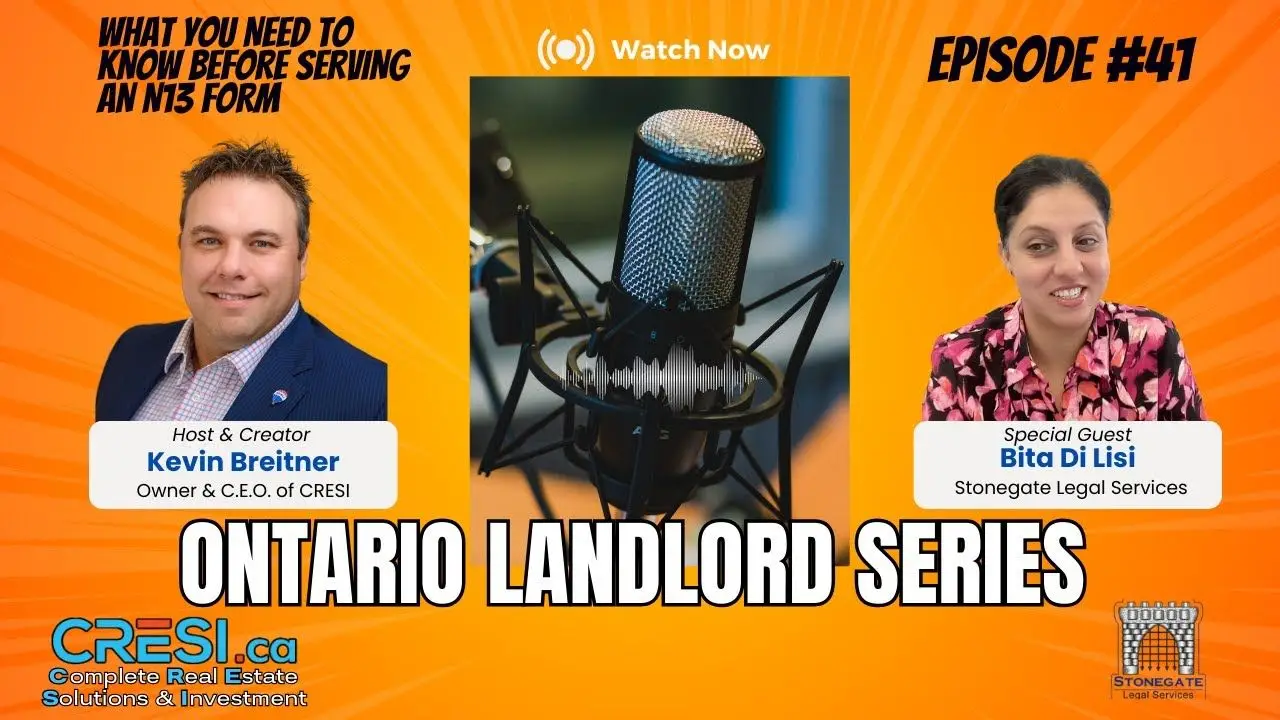
Episode 41 · with Bita Di Lisi
Ontario N13 Form Guide: Renovation Evictions and Tenant Rights
The N13 notice lets an Ontario landlord end a tenancy for demolition, extensive renovation, or conversion, but requires 120 days' notice, building permits at the hearing, and the tenant's right of first refusal at the same rent. Paralegal Bita Di Lisi says bad-faith N13s now carry a two-year window for tenants to sue for up to $35,000.
Key takeaways
- Paralegal Bita Di Lisi says the N13 is a no-fault eviction notice used when a landlord intends to demolish, extensively renovate, or convert a rental unit — 'extensive renovation' means work so disruptive the tenant cannot live there, not cosmetic work like new floors or paint.
- Landlords must give at least 120 days' notice on the official N13 form, and building permits must be presented to the Landlord and Tenant Board at the hearing, or the board will not hear the matter, Di Lisi says.
- As of July 31, 2025, Toronto's TRAP (tenant relocation and assistance plan) bylaw requires landlords to get a city-approved application before renovating, including up to $2,500 in moving costs and an extra four months' rent for tenants over 65 with a mental or physical health issue.
- Di Lisi says a tenant served an N13 has the right to stay, the right of first refusal to move back at the same rent once work is done, and the right to challenge the notice — including by arguing the landlord won't actually complete the renovation or that it could be done without vacating.
- Tenants now have two years (extended from one year, effective September 2021 per Di Lisi) to file a bad-faith application after an N13 eviction, versus one year for an N12 personal-use eviction, and bad-faith N13 claims can seek up to $35,000.
Frequently asked questions
What is the N13 form used for in Ontario?
What counts as an 'extensive renovation' under the N13?
Do I need permits before serving an N13 renovation eviction notice?
What is Toronto's TRAP bylaw and how does it affect landlords serving an N13?
Does a tenant get to move back in after an N13 renovation is complete?
How can a tenant challenge an N13 notice?
How long do tenants have to sue a landlord for a bad-faith N13 eviction?
What is 'bad faith' under Ontario's N13 renovation eviction rules?
Guests
Bita Di Lisi — Licensed paralegal, Stonegate Legal Services
Ontario licensed paralegal and co-head of Stonegate Legal Services alongside Rob Di Lisi; landlord-tenant law, with a focus on N12/N13 renovation and demolition evictions.
Chapters
- 0:00 Introduction with Bita Di Lisi
- 1:18 What is the N13 Form?
- 1:58 Extensive Renovation vs Regular Maintenance
- 3:08 Tenant's Right to Return at Same Rent
- 4:11 Key N13 Requirements for Landlords
- 6:57 Toronto's New TRAP Bylaw Explained
- 9:09 Why the City Implemented These Changes
- 12:57 What is "Bad Faith" in Legal Terms?
- 14:28 Tenant Rights That Landlords Must Know
- 17:05 Two-Year Limitation Period for Bad Faith Claims
- 19:49 Final Legal Advice and Warnings
Full transcript
Introduction with Bita Di Lisi
Hey everybody, welcome to another episode of CRESI’s Ontario Landlord Series, where we are here to educate and inform and keep landlords up to date about what’s going on in the province of Ontario so that they can always be in the know and understand their obligations, their options and how things are changing. So today we’re joined by Bita Di Lisi, one of the heads of Stonegate Legal Services. You may know her other half, Rob Di Lisi, and as he says all the time, Bita is the better half.
So welcome Bita. Thanks for joining us today. How are you? Good, Kevin.
Thank you so much for having me. How are you? I’m also doing well. It’s a sunny day today and we’re still holding on to this nice weather here in September, so it’s great.
But today we’re gonna talk about something with Bita that we’ve discussed a little bit before, but I do wanna talk about this again and make sure that everybody’s really understanding how this form works. So we’re gonna dive into the N13, and this is what, well, you know what? I’m not gonna explain it. Bita, why don’t you tell us
what the N13 is and how it’s used.
What is the N13 Form?
First, can I start off by saying this session is for information only and not to be taken as legal advice. So I will start off by telling you that the N13 is a landlord and tenant board notice in Ontario for ending a tenancy due to a landlord’s intention to demolish, repair, or convert a rental unit to non-residential use. That’s what the form is used for. How are the terms of this form laid out
when landlords are thinking about just saying, hey, I want to do a renovation, you have to leave?
Extensive Renovation vs Regular Maintenance
So it is when a landlord wants to either demolish, do an extensive renovation or repair, or conversion, they would use this form. Now, let me define extensive renovation. Extensive renovation is renovations that are so extensive that at the time the landlord is going to undertake these renos, the tenant cannot reside in the property. And I’m not talking about changing the floors.
I’m not talking about plastering the walls, doing some wall work. I’m not talking about painting. I’ll give you an example. If, for example, the landlord needs to remediate because there’s asbestos —
well, they can’t do that while the tenant is living there because that poses an issue with health and safety. So they would require the tenant to vacate. They would undergo these renovations. A unit would undergo these renovations.
And then the tenant has to be offered the first right of refusal, the opportunity to come back after the completion of the renos at the same amount of money.
Tenant’s Right to Return at Same Rent
The same amount. So even after the renovation is done, and intentionally a landlord should then be able to charge a little bit more rent to have a nicer property, let’s say they’re doing an improvement renovation, that tenant then still has to be offered first right of refusal to come back once it’s done, whether that renovation took one month, six months, one year. Interesting. It’s funny actually, I had a buddy that I golf with that called me the other day saying that he’s going through something similar on the tenant side.
He is leaving. Anyways, we had a conversation about it, and same type of thing. He’s very sure that they’re going to turn it into a duplex and they’ve asked him to leave, but he needs to go anyways. It makes sense for him.
So he doesn’t want to dispute or go through anything, but we did have a nice little conversation about some things. So as a landlord, when you’re giving this form, what are the key requirements that you’re going to need to be aware of as you’re giving this out, as you’re serving this notice?
Key N13 Requirements for Landlords
So you have to remember that the N13 form is a formal notice and landlords must always use the official Landlord and Tenant Board form N13. Now, what does this notice entail? Well, it requires a minimum 120-day notice. And that means that from the time that the notice is provided to the tenant, or served to the tenant, the landlord provides them with at least a 120-day termination period.
Now, depending on the type of renovation, building permits will be required to be presented to the landlord and tenant board at the time of the hearing. So no permits, the board will not hear the matter. This is very important. At the board hearing, the landlord cannot force a tenant out because of the N13 notice alone.
They must obtain an eviction order from the landlord and tenant board. You see, as landlords, we don’t determine whether or not the board will end the tenancy — the board does. We can’t undertake to change the law. That determination is made by the landlord and tenant board.
You just have to advocate that position at the board in order to persuade them to end the tenancy. We went through this with a demolition of a property a while ago where the tenant was disputing and it was happening, but we had permits in place to rebuild a different type of property and everything like that, and we went through it — the tenant fought it tooth and nail, but we had everything in order. Again, thanks to you and your team to make sure that that was all set up and in place as we disconnected the utilities, but not too early, and all this kind of fun stuff as that happened. But yeah, there is a process there that I have to go through
on the landlord side to make sure you’re doing everything properly, because you are displacing a tenant from their home. Yes, it is the landlord’s property. It is their investment, but it is the tenant’s home. And as housing providers, as landlords, we have to understand that’s what we’re doing.
We’re giving them a roof over their head, a place to sleep, a place to cook, a place for them to live, call their own, in a way. And we have to make sure that as landlords, again, we have our rights. There are ways to do things. There are ways to maintain and improve property.
But we have to do things in good faith, right? That’s the most important thing I think that sometimes people are not understanding or trying to get around. So the big news happened a little while ago. You and I talked about it before, and we’ve actually discussed it a little bit on a different episode or on a group conversation I have with Rob and Kayla.
But I want to get your take on what happened with the changes to the N13 in the greater Toronto area, the GTA.
Toronto’s New TRAP Bylaw Explained
Yes, so everybody knows this now. As of July 31st, 2025, the City of Toronto has now implemented a bylaw, which is kind of like a double-edged sword. And what that means is that landlords who want to renovate, do extensive renovations, are now having to apply — put in an application, have the City grant that application — and by doing so, then they can go ahead and start renovating. Now, guys, remember, we defined renovation, we defined what the extensive renovation is.
And the City of Toronto has implemented — I’m going to call it a tenant relocation and assistance plan, also known as TRAP. And what that is, is they want to make sure that before the landlord’s application gets approved, the landlord puts certain measures in place. One of the measures is that the landlord provides assistance in relocating that tenant.
If that tenant does not want to come back, then they don’t want to come back. But in order for the permits to be released by the city, you have to fulfill certain conditions or requirements. Another requirement is the landlord must pay up to — there’s up to a $2,500 cap for moving costs, moving expenses. If that tenant is over the age of 65 and they have a mental or physical health issue, then the landlord would have to pay an additional four months’ rent in order to help assist that tenant with moving.
So there are certain requirements that must be fulfilled by that landlord in order for the city to grant permits. Do you think this was to try to deter landlords from having that little bit of bad faith, or trying to push people around and do things — is this why the city did this, or was this just a cash grab for the city as well?
Why the City Implemented These Changes
I mean, that depends who you ask. I’m a landlord myself, so I do believe that this is a cash grab for the city. I don’t believe that the city really cares about landlords. They want landlords to upkeep the property and maintain the property, which I’m a firm believer in.
I believe that landlords should be upkeeping the property, but they don’t provide the support. When I say they don’t provide the support, I mean they come up with a system where they put something in place to line their pockets. And yes, there are — I agree — some bad landlords out there. Hopefully this deters them.
The thing is that they’ll find another way. The illegal lockout applications are going to increase because landlords will take matters into their own hands. Some landlords — we receive an overwhelming number of calls from landlords every day that say if we have to pay the tenant or pay the landlord and tenant board, we might as well take matters into our own hands and illegally lock out the tenant, which we always deter them from doing. Do not take the law into your own hands.
But sometimes that’s what they turn to because they feel helpless. I heard a story about a gentleman in his probably 70s who is a landlord and has a few different apartment buildings. And I heard the story from him. But anyways, his wife normally dealt with all of the tenants and arrears and any rent collection, stuff like that.
A tenant had started to avoid his wife, and he went to the house or to the apartment, knocked on the door, could hear the gentleman inside. Then called him and started yelling, “I can hear your phone ringing. I know you’re inside. Open the door.”
The gentleman — the landlord — had a hammer with him. He then opened the door, proceeded to then smash, as he said, his own cabinets and countertops and walls as he yelled at this tenant saying, “You have to pay me.” And he ended up getting charged. He ended up getting charged for breaking and entering and —
that’s all still going through. I think there’s another charge as well, something to do with threatening him and the hammer as a weapon. I don’t know the exact charges, and it doesn’t even matter. But to your point, do not take things into your own hands.
There are lots of ways to go around this — that is definitely not the answer. And even though, as he said, it’s his property or his cabinets — it isn’t, at that time, like you’re in somebody else’s home. That’s right. Every time you acquire rental properties for the purpose of income, for the purpose of having a tenant, you do give up some control.
You do give up some control. And you said it earlier, Kevin — as landlords, we think about the dollars, right? We think about the numbers. We look at the numbers.
But we have to remember, at the end of the day, this is somebody’s home. Right? What you’re trying to do is you’re trying to evict someone. You’re trying to move someone out of their home.
So yes, they’re going to get defensive. Yes, they’re going to try and stay there as long as they can. Maybe they can’t afford anything else, right?
But you have to work within the law. Find a solution, figure out the best way to move forward, and do it properly. So staying with that topic right there, why don’t you explain — because I said it earlier, and I think you used the term as well — bad faith. What is bad faith in the legal sense?
What is “Bad Faith” in Legal Terms?
So bad faith is not having the genuine intent to do what you say that you’re going to do. Right? Bad faith is trying to serve an N13 because you want to evict the tenant since their rent is way below market value. Bad faith is serving an N13 saying that you want to demolish and you really have no intentions of demolishing.
That’s bad faith — not having genuine intent. And the N13 is a no-fault eviction notice. And what that means is that the landlord is trying to evict that tenant because they require the property to do something to it. That eviction is not at the fault of the tenant.
And whenever a no-fault eviction notice is served, whether in good faith or bad faith, if the landlord doesn’t do what they say they’re going to do, then that notice has very strong cost consequences attached to it. Very strong cost consequences. Tenants can sue. Right now, they can sue for up to $35,000.
For bad faith. Interesting. Anybody can sue anybody, that’s for sure. And you want to weigh the time and the cost — whether it’s something we have to be aware of.
Also from the landlord’s point of view — as landlords, what rights do the tenants have that we have to be aware of, to make sure that we are, again, always operating properly?
Tenant Rights That Landlords Must Know
Well, first and foremost, they have the right to stay. They do not have to vacate because the landlord has an intent to renovate. It says so on the N13. “What if you disagree with this notice?”
And right beside it, it says you do not have to move out if you disagree with what the landlord has put in this notice. That’s number one. Number two, they have the right of first refusal. And what that means is that if the tenant moves out, they have the right to move back into the renovated unit at the same amount of rent that they were paying, once that work is finished.
This is right on the N13, reason two, in bold next to the checkbox. Number three, they have the right to challenge the notice. Any notice can be challenged.
A tenant can challenge the N13 notice at the hearing by showing, number one, that they don’t believe the landlord intends to complete the renovations. Number two, that the renovations can actually be done without the property being vacant. And number three, the landlord is not able to obtain permits. This is why, before an N13 is served, every single landlord out there — whether it’s us they reach out to, or somebody else they’re comfortable reaching out to — should get legal advice before serving the N13 notice to a tenant.
Because in order for the landlord to know how they can evict, they need to know what rights the tenant has. Remember the book The Art of War, Kevin? Have you read it?
Before you can evict thy enemy, so to speak — not quite, but you have to know what the other side’s rights are in order to be able to maneuver or be creative on how you can evict them. Yeah, no, 100%. We just had the same conversation about negotiation over purchase price the other day — when we’re buying and selling a property, where the power is, same type of stuff, right?
You have to know what you’re going to do and how you’re going to do it before you go in at it. So I have another question staying in this area. Let’s stay with this tenant who’s going to be challenging this, wanting to fight this — let’s say that tenant moves out. How long after that tenant moves out can they go back to the landlord if the landlord didn’t do as they said they were going to do, in the bad faith situation?
Two-Year Limitation Period for Bad Faith Claims
Well, interestingly enough, in Ontario, tenants have two years to file a bad faith application for an N13 eviction. Okay, so for an N13-related reason. They have one year to file a bad faith application for an N12, but the N13 works a little differently, because sometimes extensive renovations can go well over the one-year period. What does the law say now?
The law and the guidelines say that tenants have two years to file a bad faith application for an N13. The landlord and tenant board requires this two-year period if the tenants gave written notice of their intention to move back in and the landlord failed to provide them that opportunity. Now, the deadlines for filing a T5 bad faith application are different, as I mentioned, depending on the reason for the eviction. I’m going to say it again — two years — this applies to former tenants who have moved out due to an N13 notice for repairs or renovations and requested the right of first refusal to move back in, but were denied.
One year — this is the time limit for most other types of bad faith evictions, such as those related to a personal use notice, like the N12 notice. That two-year window for N13-related applications came into effect on September 1st, I believe it was 2021. So that limitation period flows for two years. It’s a long time, a very long time.
Yeah, just the other day, again this week, we had a landlord looking to sell one of their properties that has tenants in it. They were going through all their options — should it be an N12, and how are we going to do it? And I said, if you give an N12 and you turn around and sell, you can’t do that.
We were talking about all this and I said, your only way to do this is to have a conversation with them. Maybe if they know that the place has a chance of being bought by somebody who’s going to want to move in, they’re not going to want to be inconvenienced, so I can help encourage them and help them find their new home so that you can then do this. And that’s our best course of action, right?
A lot of times landlords — N13, N12, whatever it is — they don’t understand exactly what it is. They just kind of think, well, that’s my home, I want to do what I want to do with it. Or, that’s my home, I want it back.
And they have to realize that although it is their property, it is not their home, as we said before. So I think we look great today.
Final Legal Advice and Warnings
If you’re watching this on YouTube, you get to see Bita and I in our matching outfits. But if you’re listening to us on Spotify, Amazon, or all the other channels that Jason has us out there on, you should check us out on YouTube so you can see how good Bita looks today. Do you have anything else that you wanted to add to this conversation before we sign off, just to make sure landlords are understanding about the N13? And of course, as Bita said at the start of this, this is not legal advice.
This is a conversation between two people trying to make sure you landlords out there understand what’s going on. But if you did need legal advice, Bita and her team are always here to help you out at Stonegate Legal Services. I’m sure that number and contact information has already flown across the screen multiple times throughout this. But if you’re listening again and not watching, I’ll let Bita also sign off with how you can get a hold of her.
You can always get to me, and I can get you to her team as well. Anything else you want to say before we say bye today? You just took those words out of my mouth. Landlords, get legal advice.
Get legal advice prior to serving any legal notice, especially no-fault eviction notices. N-12 and N-13, these two notices come with very strong cost consequences and limitation periods that are very long. So you never want to undertake this process and navigate it on your own. Bang on, love it.
Yes, get the advice, get the guidance from the professionals. That’s what we’re here to do. Thanks so much for everything today, Bita.
Your expertise, information, and knowledge is always appreciated. We’ll have to have you back on. Maybe we’ll get Rob a little bit less and we’ll have you more. Let’s do it.
Thank you so much for having me, Kevin. Thanks for coming and we’ll —
Please remember, while we are professionals, this podcast is for informational and entertainment purposes only. The advice shared may not apply to your unique situation. Always seek personalized advice from a qualified professional before making any investment decisions.
Hey everybody, thanks so much for joining us this week. I hope you enjoyed the episode. If you’re finding it informative and useful, make sure to like, subscribe, and share with a friend so we can keep getting the information out there to Ontario landlords. Keep on joining us — we’ll see you next time.
Derived guide: read the full guide.