
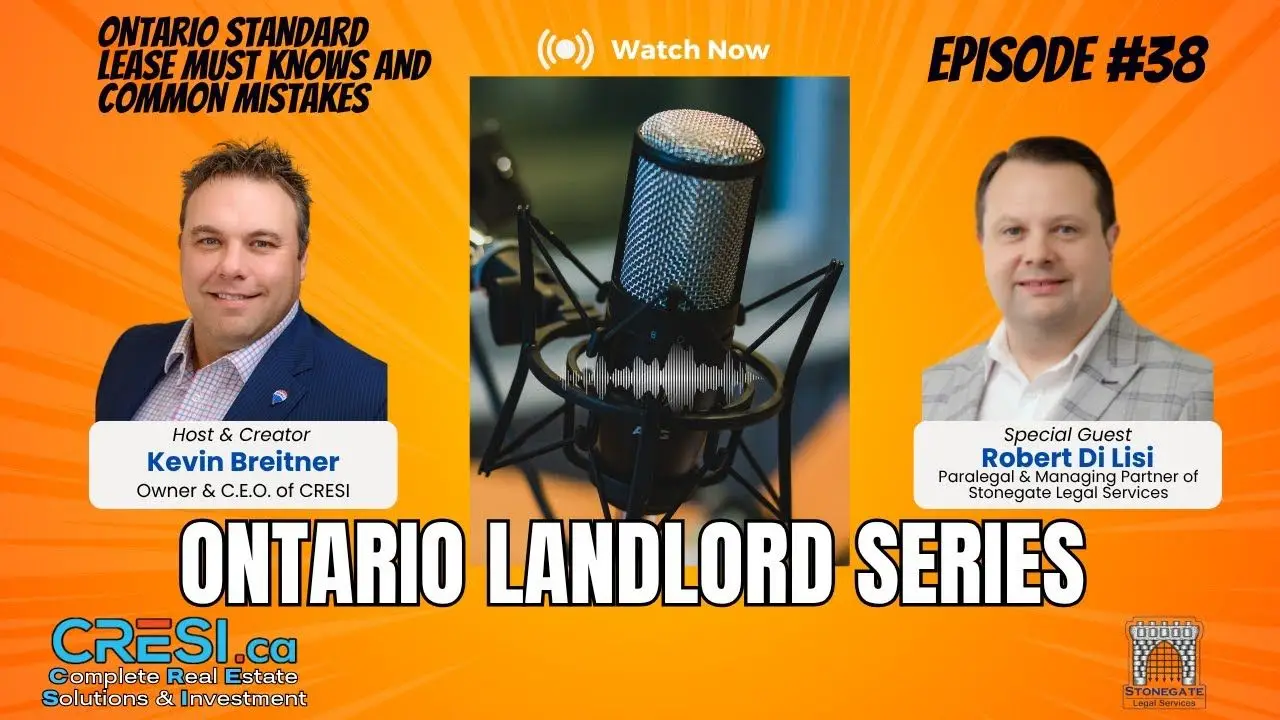
Episode 38 · with Robert Di Lisi
Ontario Standard Lease: Common Mistakes That Cost Landlords Money
Rob Di Lisi says the Ontario Standard Lease's biggest landlord mistake is the utility section, where check marks contradict the stated terms. He also covers the 21-day filing deadline that lets tenants withhold a month's rent, correct key deposit amounts, and why guarantors should sometimes be added to the lease as tenants instead.
Key takeaways
- Rob Di Lisi says missing the Ontario Standard Lease's 21-day filing deadline lets a tenant withhold or get a rebate of one month's rent.
- Di Lisi identifies the utility section (Section 6) as the biggest lease mistake landlords and agents make — checking a box that contradicts what the lease actually says utilities include.
- A key deposit for a standard house key is capped at the cost of replacement — Di Lisi says that's typically around $50, not the $300-$1,000 some landlords charge.
- Tenant insurance is not mandatory under the Residential Tenancies Act, Di Lisi says, though landlords can ask for proof of insurance at key transfer even though they can't require the tenant to keep it.
- Di Lisi warns landlords never to accept rent from anyone other than the named tenant, since doing so can create an 'implied tenancy' with a guest or occupant who was never on the lease.
Frequently asked questions
What happens if a landlord doesn't complete the Ontario Standard Lease within 21 days?
What's the biggest mistake landlords make on the Ontario Standard Lease?
How much can a landlord charge for a key deposit in Ontario?
Is tenant insurance mandatory in Ontario?
Can a landlord control who else lives with their tenant?
What is 'implied tenancy' and how can a landlord accidentally create one?
Can a lease clause requiring a damage deposit be enforced in Ontario?
Does a lease end automatically at the end of its term in Ontario?
Guests
Robert Di Lisi — Licensed paralegal, Stonegate Legal Services
Ontario licensed paralegal at Stonegate Legal Services; landlord-tenant and LTB representation.
Chapters
- 0:00 Intro: 21-Day Ontario Standard Lease Deadline Shock
- 2:31 What Changed in 2018: From Form 400 to Ontario Standard Lease
- 4:59 Security of Tenure: Why Leases Always Go Month-to-Month
- 6:04 Tenants vs Occupants vs Guarantors: Critical Differences
- 8:38 Smart Strategy: Making Guarantors into Tenants
- 10:05 Biggest Mistake: Getting the Utility Section Wrong
- 11:43 Key Deposit Rules: What You Can Actually Charge
- 12:23 The Truth About Mandatory Tenant Insurance
- 14:30 Guests, Visitors & Roommates: What Landlords Can't Control
- 18:14 Implied Tenancy Risks When Accepting Payments
- 19:25 Unenforceable Clauses That Waste Your Time
- 20:32 Wrap-up & Key Takeaways
Full transcript
Intro: 21-Day Ontario Standard Lease Deadline Shock
Hey everybody, welcome to another episode here of CRESI’s Ontario Landlord Series, where we’re talking to one of our most popular guests, our most knowledgeable guest, one of our favourite guests, Rob Di Lisi from Stonegate Legal Services. How you doing today? Kevin, it’s always good to be back, and thank you for having me on. Yeah, today we’re going to get into one of Rob’s specialties, obviously, when we’re dealing with landlord and tenant issues.
This one is going to be about the Ontario Standard Lease. There’s always a lot of questions about this. There are also several mistakes that can get made through this. So we want to make sure that you guys understand the process, what it is, how it breaks down, what you can enforce, and what you can agree to is always something that’s possible.
It doesn’t mean that what you agree to can also be enforced by law. So we have what we know in the realtor world as the Agreement to Lease, Form 400, which is what we put together to bring a deal together between tenant and landlord. But to make it official in the province of Ontario as of 2018, the first one that came out is the Ontario Standard Lease that we’re going to break down today.
We’ll pop that one up on screen, but that’s the 2018 version. The next one you should be using is the one that was rewritten with an appendix added in 2021. That’s the form you want to be using going forward to make sure your lease is legitimate, enforceable, and everything else. And something I was just told offline that we’re going to start this show off with, really quickly before we get into Rob: if you don’t fill out the Ontario Standard Lease within 21 days of the tenant moving in, they can actually get a rebate of one month’s rent or withhold one month’s rent — which I did not know. That was news to me.
So I thought I’d start off there and make sure everybody knows that’s something that’s out there. Anyway, I did not know that — it’s something that sometimes we don’t always do right away. As agents, we let it lag a day or two or three, whatever, but there is a deadline there that does need to get done.
Anyways, Rob, let’s bring you in here and let’s get you to start off with the Ontario Standard Lease.
What Changed in 2018: From Form 400 to Ontario Standard Lease
As you said, prior to April 30th, 2018, people used Form 400 as a lease. Form 400 is no longer a lease — it’s an agreement to lease. In the real estate industry, it’s still very common that agents use Form 400 and then, after everything has been executed, do the Ontario Standard Lease. It’s very, very important that people understand that.
The reason the Ontario Standard Lease came into effect is that before it, people had different agreements — every lease was different. So the goal was to standardize. It’s also important to note that anything you add to your lease, you can add — you just have to know that if it goes against the Residential Tenancies Act, which is the legislation, it will not be enforceable.
Things like maintenance fees, or a clause saying the lease will come to an end at the end of the term — you can’t arbitrarily make that decision. So let’s go through this step by step; chime in as I speak if you want to ask questions. Number one, when you sign a lease, it automatically goes month-to-month. The term for this is “security of tenure.” What that means is that tenants are entitled to occupy the rental unit even after the initial term specified in the rental agreement.
In fact, there are only three ways to terminate a tenancy. Number one is if a tenant gives you notice, which is an N9, a minimum 60 days’ notice. Number two would be a mutual agreement, which is the N11. And number three would be a court order — meaning you take them to the board, get the order, and take it to the sheriff, and then they evict.
It’s important to note that the police have nothing to do with this. When I say a sheriff, I don’t mean a cowboy sheriff — I mean a court-appointed officer who comes and carries out the order.
Security of Tenure: Why Leases Always Go Month-to-Month
I think that’s something we’ve talked about before, right? The three ways to get people out. So that’s security of tenure — it always turns into month-to-month after the term.
I just had that conversation with a gentleman yesterday. He was like, well, what if we want it back in a year or two years? Can we sign an N11 in advance and mutually agree that in two years… as I see you shaking your head, no — that’s the same thing I said to him.
Can’t be done, because things can change in a tenant’s world. Even though they thought that was going to be a good thing for them, once that time comes, because of security of tenure, they don’t have to vacate even though they agreed to it. So with that lease, we have our tenants’ names on there, our names on there as well, but the other people who can occupy a unit are occupants, right? That’s something we want to discuss — occupants and guarantors within the Ontario Standard Lease.
Tenants vs Occupants vs Guarantors: Critical Differences
On page one, where the tenant’s name is, nowhere will you see a section for occupants or guarantors. The reason is that your tenants are the ones protected under the Residential Tenancies Act. Occupants, or children, are not protected under the Residential Tenancies Act. If you want to add an occupant, which you don’t really have to do, what I’ve seen people do is add the name of their child, but then in brackets put “occupant.”
That’s fine — it’s just, I don’t think it’s even necessary. You need to be aware that whoever’s on the lease is your tenant. So if you ever need to do a notice, you only put the names of the tenants, not the names of occupants, roommates, or guests.
Another thing people ask me about is guarantors. You’ve got to be careful when you say guarantor, because people think that if they get a guarantor, they’re guaranteed to get paid because they can just go after the guarantor. There are a few things to note. Number one, guarantors don’t need to be on the lease.
There should be a separate agreement. Usually — not always — the guarantor agreement is for one year, meant to get that tenant secured so they’re going to be able to pay the rent for a year. But here’s the thing: it has nothing to do with the tenancy.
What it has to do with is the money. So if you’re a tenant and you don’t pay me rent, I don’t go yelling at the guarantor, even though you can. What I would have to do is wait to get an order. Once I get that order, I can take it to small claims and go after the guarantor — assuming the guarantor agreement is still in effect.
As I said earlier, most guarantor agreements are for the first year. After the first year, the guarantor is usually indemnified, meaning they’re released from their obligation to guarantee the contract. Even if you get a small claims verdict against the guarantor, you still need to collect it — that would be through garnishment or through freezing their bank account. Either way, even if you do, you can only collect 20% per paycheque. It’s important to note.
Smart Strategy: Making Guarantors into Tenants
What about adding that guarantor as a tenant and using the tenants as occupants instead? Yeah, you can do that, and it’s really common in student housing. Let’s say you’re going to university and your parents are going to be the tenants, and the kids will be the occupants.
You can do that, but at that point it’s no longer a guarantor arrangement — it’s just a tenancy. It’s a way of securing a better profile for someone to be confident that rent is going to be paid when renting to somebody who maybe has poor credit or doesn’t support the income properly, but has somebody who wants to guarantee that payments are made.
It’s better to have them as the tenant, with the people occupying the unit as occupants. But it won’t happen in every case.
Biggest Mistake: Getting the Utility Section Wrong
If it’s a basement unit, make sure you say it’s a basement, and if there are separate units, make sure it’s labeled — basement unit one, basement unit two. The reason is that if the sheriff ever comes to evict, they’ll look at the order, and if it just says “basement” and there are two units down there, there’s a chance they will not evict, because it’s not clear who they’re evicting. So it’s very important to outline what the unit is. If you don’t mind, I’m going to talk about the biggest mistake I see on the Ontario Standard Lease from agents and landlords: the utility section, which is Section 6.
There are check marks, and where people make the mistake is saying that utilities are not included, but then checking the box on the Ontario Standard Lease that says they are. So you need to be extremely careful filling this out. As an agent, you’re opening yourself up to liability if you make those mistakes.
Take your time. As we were talking about off camera, as a listing agent, it’s the listing agent who should be filling out the Ontario Standard Lease with the landlord — don’t rely on the buyer’s agent, because the buyer’s agent can also make mistakes. If you accept it and that becomes the lease going forward, you’re opening yourself up to the liability of it not being filled out correctly.
Key Deposit Rules: What You Can Actually Charge
Once the lease is signed, it’s signed. If it was a mistake, it’s still there — it’s not going to correct itself. Another thing we’ve talked about many times that a lot of people do wrong is charging an improper key deposit.
A key to a front door can cost about five or six dollars to make; a fob at some buildings might cost seventy-five dollars, maybe fifty. Landlords can verify that as the actual cost. But for a regular house with just a regular key lock, the key deposit has to be —
The Truth About Mandatory Tenant Insurance
— about $50. For a condominium, I know the argument is that there are special keys or a fob, but you can only charge the cost of replacement. Sometimes I see people charging $300, $500, or $1,000 for a key deposit.
You can get away with it until the tenant realizes it’s not fine and files against the landlord for an illegal deposit. On that same page — which we didn’t talk about yet — is tenant insurance. Many people think it’s mandatory for a tenant to get insurance. I hate to tell people it is not mandatory.
Nor does the Residential Tenancies Act say tenants have to get insurance. It’s in their benefit to get tenant insurance, because it covers their belongings. If there’s a flood — like in Toronto, where a lot of Kitec plumbing is failing and units are flooding — tenant insurance will cover their furniture. Some policies, not all, will also cover a stay at a hotel or an Airbnb for a period of time.
Just to note: the tenant does not have to get liability insurance. In Ontario, if you have a mortgage on your property, by law you must have liability insurance. So you don’t need to double up on liability insurance. For what it’s worth, we always ask tenants to get insurance right as they’re moving in, so we can confirm it on transfer of keys.
I know we’ve talked about this before, maybe even on a previous episode — if they ever cancel it, there’s nothing we can do, right? Once they choose to, we can ask for proof of insurance at transfer of keys, but after that we have no control.
Guests, Visitors & Roommates: What Landlords Can’t Control
It’s good to have it in writing, because if they cancel it and something goes wrong — like a flood — at least you can show that you asked them to have tenant insurance. Really, there’s no prejudice to the landlord whether the tenant has contents insurance or not; it’s for the tenant’s own benefit and belongings. If they have fancy furniture or TVs they don’t want destroyed, they should get tenant insurance. The other thing we wanted to bring up today is guests and visitors to the property.
We have a situation right now at a property where somebody allowed another mother and son to move in, and we had no idea they were there until recently. They weren’t on the lease, so there’s nothing we can do — but they do live there, and supposedly they’ve been paying rent to the other tenants as well.
Let me give the best example I can think of. Say my wife and I rent a four-bedroom house from you, Kevin. You’re the landlord. My wife, my child, and I are going to be moving in.
We move in, but then my parents decide they want to move in with us and occupy one bedroom. And my sister is having a hard time in life, so she wants to move in too.
Under the law, the landlord cannot say you can’t have occupants, roommates, or guests. And nowhere in the law does it say how long a guest can stay. So the question is: what prejudice is the landlord facing by having more people in the property? The only time it’s a problem is if it goes over the municipal bylaw.
On a four-bedroom house — and I’m just throwing numbers around, you’d have to check the municipality — it’s not unusual to be able to have eight, even possibly ten, people living in the house. That’s extreme, but if I have three extra people living with me and my family, that’s a total of six, which is below probably the bylaw limit, and they’re paying me a portion of the rent. As long as they’re not paying me more than what I’m paying you, there’s no prejudice.
Number two: if the utilities are in my name, it’s not affecting you at all, because I pay for the water and electricity. So a lot of landlords get their — I’ll just say — get all upset because there are more people there than they think should be.
And I always tell them: what’s the problem? Another example: if I rent a one-bedroom condominium and I have a different girlfriend visiting me every night, do I need to get the landlord’s permission? No, I do not.
In fact, if I fall in love with one of these women and she moves in with me, I do not need the landlord’s permission. If the guest wants to pay me rent, that’s not a problem either — but the landlord should never accept rent from anyone other than their tenant. That is the key: you should never accept rent from anyone other than your tenant.
If you do, you need to be extremely careful, because what could happen is something called implied tenancy — the person can argue, “I’ve been paying you rent, you’ve been accepting rent, therefore I am your tenant.” That’s basically the situation with guests, occupants, and visitors.
Implied Tenancy Risks When Accepting Payments
Just to touch on that — the tracing of the rent, how it comes around. Say the landlord knows that guest Sam is paying tenant Frank to be there, but all the funds are coming from Frank’s bank account. But the landlord is aware that Sam is paying some money to Frank — could that be implied tenancy?
It could be. The way it should happen is that if I’m the tenant and, say, I have a girlfriend who wants to pay rent, she should be paying me the rent, and I pay the rent. But if the landlord knows that’s happening, does it become implied tenancy just because there’s no direct paper trail from the girlfriend?
No, because she’s not a tenant. If she’s paying me, she’s paying me as a guest. In fact, if my girlfriend and I break up and I get a new girlfriend with the same arrangement, the payments are always coming from the tenant, not from the occupant, roommate, or guest.
Unenforceable Clauses That Waste Your Time
Is there anything else we want to touch on about the OSL? All the appendices and everything at the back end are what people have to abide by and follow. Moving into a condominium, there are always condominium rules that tenants have to follow as well. But I guess we can talk about some clauses that people put in that are great when tenants agree to them, but aren’t enforceable — because they go against the Residential Tenancies Act — and are void.
So if you’re asking for a damage deposit, a maintenance deposit, or a clause that says the tenant will be responsible for the first $100, $400, whatever it is, for maintenance, you can put it in the lease, but it’s not enforceable. Just a little recap about the OSL: it should be done by the listing agent if possible.
If you don’t give the tenant a copy within 21 days, they can withhold rent. Other than that — I could talk about this for another hour. I just wanted to give you the main points of what you need to know about the Ontario Standard Lease.
Wrap-up & Key Takeaways
Well, maybe we’ll come back and get another 20-minute chunk of that hour and share it with everybody then. But I guess that wraps this one up for today. If you have any questions about the Ontario Standard Lease, always reach out to our friends at Stonegate Legal Services — they’ll help guide, advise, and consult you through the process.
And obviously we’re here to help as well with anything on the real estate or property management side of your property. So bye for now — thanks so much, and we’ll talk to you soon.
Please remember, while we are professionals, this podcast is for informational and entertainment purposes only. The advice shared may not apply to your unique situation. Always seek personalized advice from a qualified professional before making any investment decisions.
Hey everybody, thanks so much for joining us this week. I hope you enjoyed the episode. If you’re finding it informative and useful, make sure to like, subscribe, and share with a friend so we can keep getting the information out there to Ontario landlords. Keep on joining us — we’ll see you next time.
Derived guide: read the full guide.