
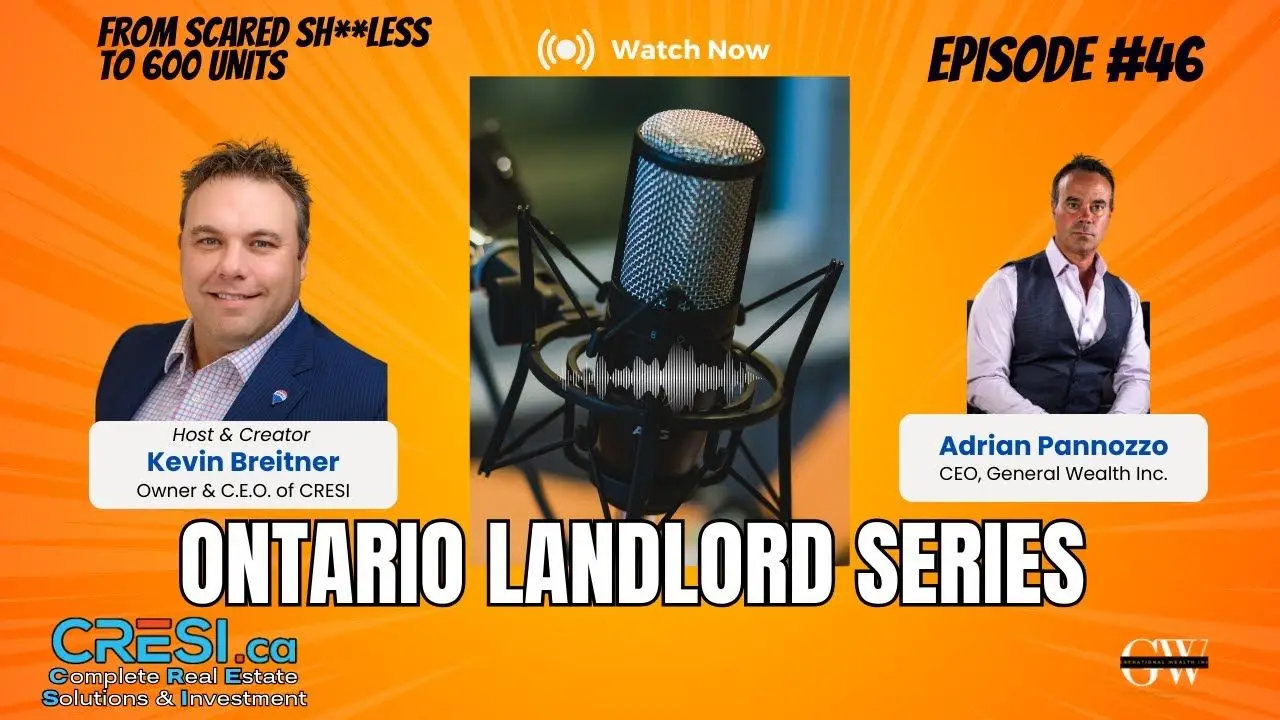
Episode 46 · with Adrian Pannozzo
From Police Officer to 600+ Rental Units: Scaling with Joint Ventures
Adrian Pannozzo, a former 21-year police officer, built a 600+ unit multifamily portfolio starting from one duplex bought with a home equity line of credit. He explains the buy-renovate-refinance-rent cycle, why joint-venture investors want their capital recycled quickly, and how CMHC's MLI Select program lets new-build apartments close with as little as 5% down.
Key takeaways
- Adrian Pannozzo financed his first rental — a duplex in York Region — almost entirely with a roughly $100,000 home equity line of credit on his own house, about 16 years before this episode, while still working full-time as a police officer.
- Pannozzo's 'vintage building' strategy is buy-renovate-refinance-rent: he targets buildings (from 6 units up to a 47-unit purpose-built property) with room for a rent and value 'lift,' so joint-venture investors can get most of their capital back out to redeploy into the next deal rather than leaving it tied up.
- Under CMHC's MLI Select program, Pannozzo says his company achieves up to 95% loan-to-cost financing on new multifamily builds by earning points across energy efficiency, affordability, and accessibility — sometimes hitting the threshold through energy efficiency alone, depending on the project.
- All of Generational Wealth's roughly 65 joint-venture partners are accredited investors; Pannozzo says the company typically holds properties at least 10-15 years and prefers to refinance and pull out equity rather than sell and trigger capital gains.
- Pannozzo's single biggest piece of advice for new investors: surround yourself with people who've already done what you want to do and learn from them — 'your network is your net worth.'
Frequently asked questions
How did Adrian Pannozzo buy his first rental property?
What is the buy-renovate-refinance-rent (BRRR) strategy, according to Adrian Pannozzo?
What is CMHC's MLI Select program and how much financing does it allow?
Do I need to be an accredited investor to joint-venture with a syndicator like Generational Wealth?
How long does Adrian Pannozzo typically hold a rental property before selling?
Guests
Adrian Pannozzo — Founder & CEO, Generational Wealth Inc.
Former police officer of more than two decades turned real estate investor; founder of Generational Wealth Inc., which has grown to 90+ multifamily properties and 600+ units across the GTA through joint-venture partnerships, renovation, and new development.
Full transcript
Kevin Breitner (00:00)
Hi everybody, and welcome to another episode of CRESI’s Ontario Landlord Series, where we’re here to educate and inform landlords across Ontario about different things they need to know, whether that’s an investment strategy or what’s happening within our government, like the Bill 60 rule changes we just talked about recently.
But today we’re bringing on a gentleman named Adrian Pannozzo, who’s going to talk about a different way of investing in real estate in Ontario — joint ventures — alongside what he’s been doing for about 16 years now. Adrian, good morning, welcome, thank you.
Adrian Pannozzo (00:47)
Hey, good morning, Kevin. Thanks for having me.
Kevin Breitner (00:49)
Adrian is the CEO and founder of Generational Wealth Incorporated and its group of companies. He was a police officer for over two decades before retiring in 2017, thanks to his investing through real estate, which gave him the freedom to do so. He started out buying smaller multi-residential properties — duplexes, triplexes, quads — honing his renovation and operations skills from the ground up, and over the past several years has scaled aggressively into apartment buildings and new development, establishing himself as a major force in Ontario investment real estate. Generational Wealth Incorporated raises capital through joint-venture partnerships to acquire and reposition investment properties. Today, Adrian’s portfolio includes over 90 multifamily properties, totaling over 600 units, and it continues to grow year over year. In recent years, he’s moved beyond acquisition and management into development, with active builds and redevelopment projects across the west and north GTA. He’s also the owner of Investors Edge Construction Management, a full-service construction company specializing in multifamily conversions and large-scale renovations throughout the Hamilton region, and he co-founded Rise Property Solutions, a full-service property management company servicing the west side of the GTA. At his core, Adrian is driven by helping ordinary people create extraordinary generational wealth. That’s a mouthful, but a lot of things you’ve got your hands into — let’s start with why this all started for you, back when you were still policing.
Adrian Pannozzo (03:01)
I was probably 10 years into my career — I did 22 years on the police department in the GTA. Around that 10-year mark, I started thinking: when I put in my full 30 and I’m on pension, I’m going to need a bit of extra income to fill the gap between pension and full salary. I thought one of the safest ways to do that would be a rental property — maybe just one or two, enough that the cash flow would bridge that gap and let me keep the same lifestyle. That’s really all it was; the light bulb went off, and I pulled a home equity line of credit on my house. I had no money, but I had equity — I think I started with just over $100,000 on that line, about 16 years ago now, 10 years into my career. My down payment on the first rental property came entirely from that line of credit, and honestly, I was scared shitless. For anyone hesitant to take that first step and borrow to get into the game — that was me. But I convinced my wife to do it, and we bought the first one: a little duplex, a bungalow with one unit up and one down, in York Region. It went well — we got tenants in, everything was paying, and we still had money left on the line, so we bought a second one, and convinced my wife to get even further into debt to do it. That one went well too — tenants in, cash flowing — and I was still a full-time police officer managing both rentals and my tenants. Then, just a couple of years later, my mortgage broker told me the first property had gone up around $200,000 in equity, and suggested we refinance it, pull some of that equity out, get another line of credit, and buy another one.
Kevin Breitner (06:00)
I’ll pause you right there, because what you’re touching on is important. One, the fear of actually doing something — that’s the hardest part. They say everything you want is just on the other side of fear, so actually taking that step is commendable, because a lot of people talk about doing it for a long time and never take that first step. And two, when you say you convinced your wife to go further into debt — that’s what real estate investing is about: leveraging one property into the next, because it’s good debt, not like buying a car. It’s debt you can roll over, the way you just did with that first property’s appreciation, pulling it from an investment property rather than your primary residence. So, back to the story — you pulled money out of that first duplex.
Adrian Pannozzo (07:30)
Right — I refinanced the first one, got another line of credit, and bought a third. By about the fourth rental property, what started as “I just want two properties to subsidize my pension” had grown, and I was managing all of them myself, with a newborn daughter at home, still working as a police officer, and my wife working full-time. I don’t have much sympathy for people who say they don’t have the time — there’s always time if you want something badly enough, you make the time. There are sacrifices along the way, you don’t sleep nine hours a night, but there are sacrifices behind every success. That momentum built, and around four properties in, we started to partner — a joint venture with investors who wanted to invest in real estate but didn’t know the first thing about it. Mostly successful professionals — doctors, lawyers, other police officers, some higher-net-worth people — who didn’t have the time because they were focused on their own careers and didn’t want to deal with tenants and toilets. We became the sweat-equity partners: we’d find the deal, underwrite it, run the renovations, manage the property, deal with tenants, everything from step one to step ten, and provide strong returns on their capital. That took off — by around 2015 to 2017, this partnership model with like-minded investors really accelerated, mostly because we delivered, and people kept coming back to reinvest, the same way you’d keep going back to a restaurant with great food and service.
Financially, that let me retire early after 22 years of service, and I decided to turn the partnership model into a full-time business, putting all my time and energy into growing it. Stepping outside your comfort zone is something I can’t say enough about — I was scared shitless leaving a good job; I was making around $130,000 a year on the force with pension and benefits, and I loved being a cop, but I walked away to be an entrepreneur. A lot of people thought I was crazy, but I did it anyway, with my wife’s support. Since then, the portfolio has grown to over 600 units — what started as wanting one or two rental properties is now, 16 years later, over 600 units across the GTA, with a full-scale property management team taking care of everything for our partners, who never deal with a tenant or a leaky tap. We have a full-scale construction team handling renovations and new builds, in-house accounting — a complete real estate investment company that finds the deal, underwrites it, builds or renovates the buildings, and manages tenants year-round. That’s my story.
Kevin Breitner (13:35)
It’s amazing how things change — from wanting a bit of extra income to building three companies that all work together, similar to what we do here with real estate and property management, to make clients as hands-off as they want to be. Some people want to be more involved than others — we’re as individual as our fingerprints — but a lot of people just want their money to make them money without having to do anything themselves. When you first started looking for larger-scale properties, what were you looking for in a deal — something with forced-appreciation potential through renovation, the buy-renovate-refinance approach, or something already tenanted and profitable?
Adrian Pannozzo (14:59)
Great question. What I call our vintage buildings are the ones we’ve historically bought, renovated, refinanced, and rented — we’ve taken over buildings as small as six units, and our biggest is 47 units, purpose-built. We look for lift — we don’t buy turnkey, because our investors want their capital back as fast as possible, so they can redeploy it and build a real estate portfolio again and again. There’s nothing wrong with buying turnkey, you’re just leaving that capital in the deal longer instead of recycling it through buy-renovate-refinance. So we look for deals with room to improve rents through strategic renovation, extract most of the capital we put in, and get it back to the investors — and usually the first reaction is, “I got all my money back and I still own a cash-flowing building — can you find me another one?” We’ve also pivoted into new development over the last several years, because under CMHC’s MLI Select program, we’re able to get financing you can’t get on the residential side — up to 95% loan-to-cost on new builds, essentially like a first-time homebuyer’s 5% down program, but for multi-million-dollar apartment buildings. And commercial interest rates are actually better than residential — we’re around 3.5% on a 20, 30, or 40-unit building, leveraged at 95%. The numbers make sense.
Kevin Breitner (17:48)
Are you building affordable housing as well, or is that separate?
Adrian Pannozzo (17:53)
We do build affordable units — it’s project-specific. The CMHC MLI Select pillars are energy efficiency, affordability, and accessibility, and every deal is different. Our commercial underwriters review each project and tell us what’s needed to hit 100 points for that 95% loan-to-value — sometimes energy efficiency alone gets us there without needing the affordability or accessibility components, sometimes a project needs a different mix.
Kevin Breitner (18:44)
Being able to build at 95% financing is unreal — that’s a huge amount of leverage compared to the 35-40% down you’d typically need for something of that size, on top of the government incentives and mortgage benefits CMHC offers, and we need all this purpose-built rental supply, since for a long time nobody was building it because selling individual condo units to investors was more profitable. I think what you’re doing has a good decade-plus runway ahead, with more purpose-built rentals coming. We’re at nearly 40% of the country renting now, and that number keeps growing. A lot of the condo units sitting vacant right now are the tiny one-bedrooms and one-bedroom-plus-dens — but two-bedroom-plus units, ones that can fit a small family, are still moving. That’s where we need to focus over the next while, especially since we can only densify by going up. When you’re bringing on investors, does it have to be accredited investors, or how does that work?
Adrian Pannozzo (20:32)
They’re all accredited investors, for liability reasons and Securities Commission requirements. We’re over 65 joint-venture partners total at this point, and a lot of them rinse and repeat — doing at least two projects with us. Many are other police officers or high-net-worth entrepreneurs focused on their own businesses who just want to put their money in and let us handle it, which ties back to the name of my company, Generational Wealth — we typically hold properties 10, 15 years, creating passive income as tenants pay down our debt and the property appreciates, and then we offload it, or if investors don’t want to cash out, we keep holding, since it’s managed by our company either way. We usually wait at least 10 years before cashing in, because as soon as we sell we’re paying capital gains — if we hold for 10 years and the value’s gone up $3 million, we’d rather refinance, pull the money out tax-free, and build another building.
Kevin Breitner (22:23)
With real estate prices continually rising over the last decade or so here in Ontario, especially the run from around 2017 to 2022 — a lot of investors I talk to are chasing an immediate, fast payoff, which was more of a false expectation from that period. I remember a house in Brampton that closed in October, was relisted, and sold for $400,000 more by January without anyone even painting it — that’s how crazy the market was climbing, and people got used to thinking that was normal. What you’re describing — refinancing, holding for 15 years — is a get-wealthy-slow approach, not get-rich-quick, but it’s actually the fastest way to recycle your capital tax-free, through the buy-renovate-refinance strategy. We’re pitching small multifamily more and more, especially now that triplex conversions are allowed almost everywhere — it’s a great entry point for new and experienced investors alike, because it’s hard to cash flow a single-family home where, if the one tenant loses their job, you’re out the whole rent, versus a triplex where if one unit stops paying, you’re only out a third while the government sorts out its non-payment delays.
Adrian Pannozzo (24:24)
That’s exactly why I bought a duplex when I started 16 years ago — I figured if one unit stopped paying, the other unit could at least help offset it until I got the non-paying tenant out. That was my mindset for going multifamily instead of a single condo or single-family home from the start.
Kevin Breitner (24:50)
If I wanted to invest alongside your company, how would I find you, and what would that look like?
Adrian Pannozzo (25:00)
Follow us on social media — Instagram, Facebook, LinkedIn, just search Generational Wealth, we’re very searchable across all platforms. Send me a message and we can have a chat.
Kevin Breitner (25:22)
I’ll make sure all of Adrian’s and the company’s links — email, cell phone, everything — are included wherever this gets published, so you can reach out to them directly, or reach out to us at CRESI and we’ll connect you. This has been a great conversation — is there anything you want to leave people with today?
Adrian Pannozzo (26:05)
The biggest piece of advice that really worked for me: surround yourself with people who have done this before, whether or not you end up partnering with them. Get into groups, communicate with people who’ve already done what you want to do, and learn from them — it saved me a lot of time, mistakes, and money. Mistakes aren’t all bad, we learn from them, but take action, guys. Surround yourself with people you aspire to be like and learn as much as you can. That’s my biggest piece of advice — it was a game changer for me.
Kevin Breitner (27:18)
I love that, Adrian — we learn from our peers and colleagues, and from their mistakes as well as our own. Have those conversations, learn from professionals, and use professionals for what they’re worth — Shawn Quigg from Cardinal Law, for instance, is a joint-venture specialist lawyer who can help structure something if you’re looking to partner with someone. I’ll wrap up with this: in-person connections matter, and it’s something we haven’t done enough of since COVID — we’re going to start hosting an in-person investors meetup here in Halton region, so people can network in person again and figure out their own path forward, because we’re all as individual as our fingerprints.
Adrian Pannozzo (28:23)
Your network is your net worth — the connections you make at these in-person meetups can change a lot in your business. I always tell people to shake as many hands as possible and introduce themselves to as many people as they can, because you never know who in that room could help you. Get to as many of those meetups as you can — it did wonders for me.
Kevin Breitner (28:59)
When we run ours, we’ll have you out to speak in person about what you’re doing now, so people can learn from you directly. Thanks so much for joining us today, Adrian — I really appreciate your time and expertise. We’ll talk again soon.
Adrian Pannozzo (29:16)
Cheers, thank you.
Kevin Breitner (29:18)
Bye for now, folks, enjoy your day. Please remember, while we are professionals, this podcast is for informational and entertainment purposes only. The advice shared may not apply to your unique situation. Always seek personalized advice from a qualified professional before making any investment decisions. Hey everybody, thanks so much for joining us this week. I hope you enjoyed the episode. If you’re finding it informative and useful, make sure to like, subscribe, and share with a friend so that we can keep getting the information out there to Ontario landlords, and keep on joining us — we’ll see you next time.
Derived guide: read the full guide.