
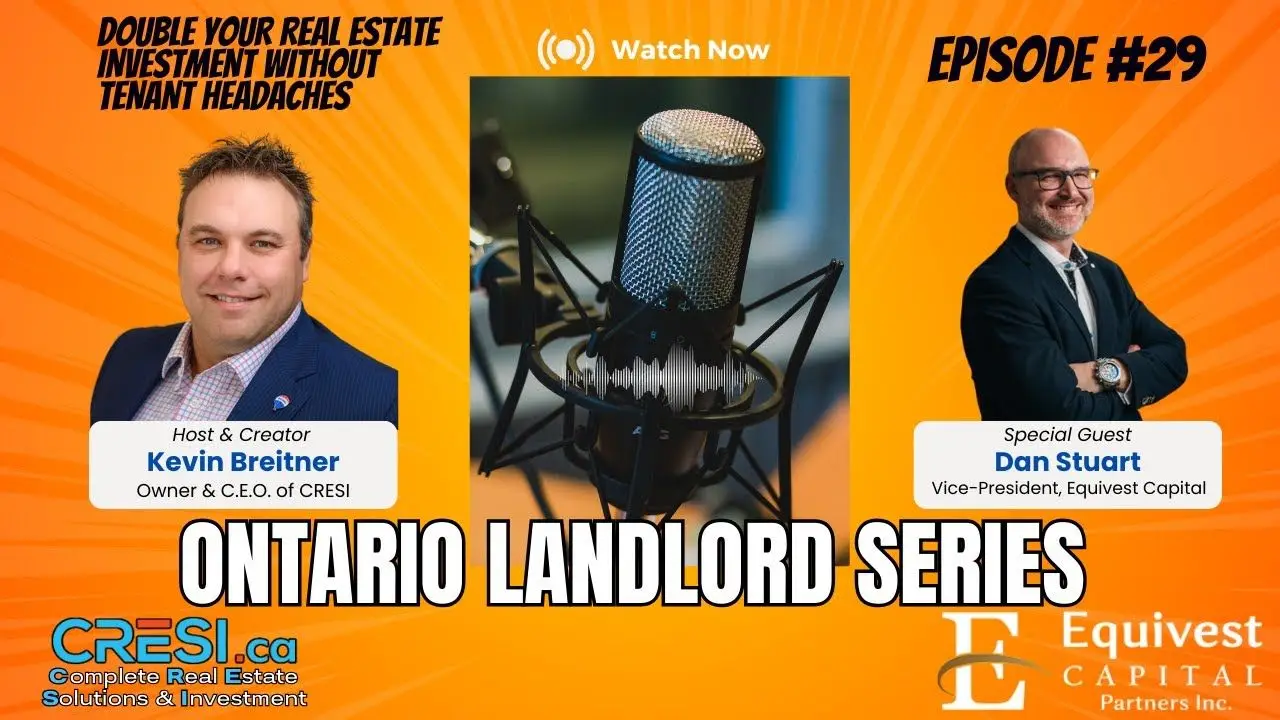
Episode 29 · with Dan Stuart
Private Equity Real Estate Funds: An Alternative to Direct Landlording
Ontario landlords can diversify beyond rental ownership through private equity real estate funds. Dan Stuart of Equivest Capital Partners explains a development fund targeting 16-20% annual returns and an income fund targeting 8-12% monthly distributions, both usable with registered funds like RSPs and TFSAs, offering passive exposure to real estate without tenant management.
Key takeaways
- Dan Stuart of Equivest Capital Partners says the firm's development fund targets 16-20% annual returns by acting as equity partner in two to four rental-building developments in secondary markets like Cambridge and Brantford, typically doubling investor capital over five to six years.
- The income fund, Stuart explains, lets investors become passive private lenders earning 8-12% annual average returns paid out monthly, with a three-year holding period and no due-diligence work required from the investor, since the capital is deployed into opportunities like bridge loans and second mortgages.
- Both funds can be held inside registered accounts such as RSPs and TFSAs, or through a numbered company or by cheque, because Equivest is structured as a mutual fund trust with unit holdings administered by Olympia Trust.
- On the development fund, Stuart describes an 80/20 ownership split in which limited partners own 80% of each property; on payout, limited partners receive the first 8% of return, Equivest takes a 2% catch-up between 8% and 10%, and everything beyond 10% is then split 80/20 in the limited partners' favour.
- Kevin Breitner says this is more passive than direct landlording, even with CRESI's Landlord Protection Program in place, since a private equity investor just waits for a monthly distribution or an exit payout rather than fielding day-to-day tenant issues.
Frequently asked questions
What is private equity real estate investing?
What returns does Equivest Capital Partners' development fund target?
Can I invest in private equity real estate using my RSP or TFSA?
What is Equivest's income fund and how does it pay out?
What's the difference between Equivest's development fund and income fund?
Is private equity real estate investing risky?
How do I learn more about investing with Equivest Capital Partners?
Guests
Represents Equivest Capital Partners, a Burlington-area private equity real estate firm offering a development fund and an income fund to passive investors, including through registered accounts.
Chapters
- 0:00 Welcome to CRESI's Ontario Landlord Podcast
- 1:21 What is Private Equity Real Estate Investing?
- 5:40 Development vs. Income Funds Explained
- 9:18 Using Registered Funds for Passive Real Estate Income
- 10:49 Current Development Projects in Secondary Markets
- 13:43 Visual Comparison of Investment Returns
- 16:12 Why Choose Equivest Capital Partners?
- 19:11 How to Learn More (15-Min No-Pressure Info Session)
- 21:44 Disclaimer and Closing Thoughts
Full transcript
Welcome to CRESI’s Ontario Landlord Podcast
Hey everybody, welcome to another episode of CRESI’s Ontario Landlord podcast. Today we’re going to talk to you landlords about a little bit of diversification and another investment strategy or vehicle that’s involved with real estate, but just a little bit different than your traditional buy a house and rent it, or even buy a pre-construction property and wait for it to be built. There’s always many different ways and many different experts and professionals to talk about how you can best invest your money, or what is looking right for you.
Again, we’re always talking about diversification. We don’t think you should have all your money in one bucket. You should spread things out in different ways. So today we’re going to go through a different type of investing, where we can use registered funds instead of just straight cash or extra cash, and get into more of the different options about how you can do that.
This is Dan Stuart from Equivest Capital Partners, a firm just outside here in Burlington, so local to all of us. They are here to talk to us today and educate and inform you guys about something that maybe you might not be aware of, another way we can continue investing in different strategies in real estate.
So, Dan, welcome. How are you doing today?
What is Private Equity Real Estate Investing?
I’m doing very well. Thank you so much for asking. So let’s be straight to the point here with what we’re going to share with these guys today. Why don’t you explain what private equity investing is?
Excellent. You’ve got the investment banking space, which is something that’s not offered from the big five banks. And if you know the right person and are introduced to investment banking, you can have access to incredible opportunities that are equity placements in real estate development. And then there are also opportunities with private lending.
The best part about this is that our structure is a mutual fund trust. That means people can just passively participate with their RSP, with their TFSA, and use their registered funds toward something more fruitful. At the end of the day, everyone should have excellent diversification within their portfolio. Having a hard asset of real estate with a rental property is great.
Having some stocks, having some bonds — this is all great. But then having something like 10% of your portfolio invested in private equity is a really excellent way to get some more meaningful returns in your portfolio. As an example, our development fund invests in between two and four different real estate developments. We focus on some of these secondary and tertiary markets like Bradford, Cambridge, and Niagara, where there’s high population growth and a shortage of housing. This might not necessarily be a build-to-sell strategy — we’ve got a lot of demand for rent right now.
That means we can do a rental building, a build-to-rent strategy, and do something like a hundred-unit building in one of these markets. Then you fully tenant the building and can sell it to a pension fund, an institution, or simply refinance investors out. The returns are strong, with a return threshold of about 16 to 20% annually. But we view it as an equity multiple, because when you’re coming into this fund, you’re going in as an equity partner on day one on the property — we’re executing directly with builders and financing.
Then we go through full fruition with the build project completion. Then we can execute our exit strategy and everyone gets paid out. So essentially it’s about a five- to six-year type of turnaround typically. And because the fund is investing in two to four different properties, it gives us the opportunity for diversification within this style of investing as well.
So you’re not just tied to the success of one single property, but rather multiple different properties right away. Then the other fund that we have operates a little differently, because it allows you to become a private lender without having to do any of the heavy lifting of due diligence on who you’re lending the money to and how that all works. We take care of that part for you. As a result, you can get monthly cash distributions that are quite strong relative to other investments.
This one will fetch anywhere between 8 and 12% as an annual average return on a consistent monthly basis. We have a three-year holding period for this. Essentially, we’ll deploy your capital into multiple different opportunities. Sometimes it’s a bridge loan, sometimes it’s a second mortgage.
It depends on what opportunity comes up, but the best part is that instead of paying a mortgage, you’re actually receiving one, and your account just naturally grows on a monthly basis. So it’s a really great way to passively build wealth on autopilot — you become a private lender with your registered funds without having to do any of the heavy lifting. So basically those are the two funds that we’re raising capital for the most.
What we’re doing is getting out there, educating people, showing them what’s available, and going to some of these networking events and meeting like-minded investors who like this type of strategy and are interested in learning more.
Development vs. Income Funds Explained
You guys are probably some of the only ones doing this, but I want to thank you for talking through the generalities of this type of investing. If you are looking to get more information from Dan and their group over at Equivest Capital, we can definitely connect you. Reach out, let us know, and we’ll get you in touch with them.
As always, contact information will pop across the screen throughout this. But circling back — I just want people to understand that there are basically two different types of funds here: one where projects are being built, and the other where there’s constant money coming in every month because there’s rental income coming in, whether from residential units — like a big hundred-unit building with a whole bunch of tenants across multiple buildings in that fund — or even commercial ones where they’re getting monthly rents and paying investors out monthly. That might be something great for someone later in life who has some savings sitting away that they’re able to put into this and just have it spit back out some money every month, rather than investing it here or there. And on the development side, that’s more of a growth play, right?
With everything comes risk. That’s the whole point of these podcasts — to educate and inform so you guys can mitigate your risk and understand what to look for and how to best invest in any type of strategy or vehicle you want to use. So that development fund is more of a growth vehicle — someone looking to use capital to grow it at a faster rate. The number you shared really is going to double your money in about five years, right?
That’s kind of the idea there. The only real risks with this one are time and illiquidity.
Once we take your capital, we’re putting it toward the acquisition of these properties. We can’t pay out the returns until we exit those properties, but this is what we always describe as the best downside protection you could possibly get in any sort of investment. Instead of investing in some prospective stock, where maybe one out of a hundred becomes a huge winner but the rest could fold and you lose all your money —
In this fund, at least you have the downside protection of the ownership of the property, because when we invest in a property, we don’t personally own it — it’s the fund that owns the property, and the split is 80-20. Equivest is the general partner and owns 20% of the properties we invest in.
The limited partners, who are the passive investors, own 80%. And we have a preferred return structure, meaning that once the projects come to fruition and we exit, the first entire 8% of return goes to our limited partners. Then in private equity there’s something called a 2% catch-up, which is basically the distance between 8 and 10%.
That’s Equivest’s profit. Everything beyond 10% is split 80-20. So we prioritize the profits for the limited partners and give them the opportunity to invest passively, essentially as if they were a real estate developer themselves.
So instead of owning one small condo unit in a development, you’re actually on the other side, partnering with the builder and sharing in the profits of hundreds of different units. It’s an amazing opportunity to build wealth.
Using Registered Funds for Passive Real Estate Income
I definitely agree this makes a lot of sense for a lot of people who have the ability to do this. And registered funds are a big one you guys can put in here rather than doing something else with them. RRSPs and TFSAs are something we’re all trying to constantly build, and why not use them for something other than that first home purchase you get to take advantage of once, and after you’ve paid that all down, you’re looking to invest that money into your future.
This makes a lot of sense for people. And again, like Dan said, it’s passive. I think that’s the ultimate thing people try to get with their investment — to just have their money make them money. As a real estate investor, sometimes it doesn’t feel that way.
That’s one of the reasons we built the Landlord Protection Program with CRESI Property Management, to make sure all our landlords can have that traditional landlord-style investment — the brick and mortar, the condo unit, the house — and we manage it so it becomes as passive as possible. But it’ll never be as passive as this. At the end of the day, we’re still going to have to talk to you if something’s going wrong, whereas here you’re basically placing your money and either getting a monthly return, or waiting five to six years to get paid out and then reinvesting. How many projects do you guys have currently on the go?
I know of the big one out in Welland, but I’m sure there are others. Why don’t you share what’s going on with you guys?
Current Development Projects in Secondary Markets
We’ve got about $15 million worth of properties in the pipeline to be put into our fund. One site is located in Cambridge and the other in Brantford, but we’re not stopping there. We know that over the next 18 months there are going to be some distress-sale opportunities. We’ve already seen some, and we know that’s going to provide a huge opportunity because we’re not at the peak of the real estate market.
We’re actually in a trough. That means getting into this space right now is one of the greatest opportunities, because you’re not getting in at the top when everything’s piping hot — you’re getting in near the bottom and able to maximize your returns. Even if we’re not in a better market five or six years from now, the build-to-rent strategy is still going to be robust. If you look at market trends, demographics, and what’s happening with immigration, there’s forecasted to be even more demand for rentals, not just in Ontario but Canada-wide.
I think that trend is going to keep marching forward. So even if the real estate market isn’t more robust five or six years from now, this is still going to pay off fruitfully as a result of engaging now in real estate development with rentals. We’ve talked throughout a couple of different podcasts about the rental market and what’s going on with it in Ontario and Canada.
But more than a third of our country right now pays rent, and that number is going to continue to grow. The rental space stopped being built for so long because there weren’t incentives for builders to do it, so they leaned more on condominiums and relied on everyday people to buy condos and rent them out to help with that rental demand.
Our government has definitely made it harder on our everyday landlords, our housing providers, to continue providing that service. And now the government is incentivizing developers and builders to get back into building rental buildings, because there’s going to be more demand — as baby boomers, the biggest generation, start to downsize into different living situations.
They’re going to want to liquidate and start renting, plus everybody coming up behind them — housing is becoming more expensive, and it’s going to take longer for people to buy that first home. We won’t see as many people in their early twenties buying real estate like we did over the last decade. But that rental demand is never going to go away.
Everybody needs a roof over their head. Being able to keep providing that, I think, helps protect the investment and the money that’s in there.
Visual Comparison of Investment Returns
That’s exactly right. What I can do now is share my screen just to show a comparison of what I’m referring to, because it’s important to take a look. If we look at a normal investment with just a 5% annual growth rate, compounded, over a five-year period starting with $50,000, that would grow to about $63,000.
With our income fund — the bar in the middle here — this is a 10% growth rate. If you’re doing a dividend reinvestment plan on the income fund, you can fairly easily achieve a 10% annual average return over as little as a three-year period. So instead of going from $50,000 to $63,000, you’re actually going all the way up to $80,000 over a five-year period. This bar at the bottom represents the development fund.
This is a non-compounding fund, because you’re going in as an equity partner, the same as when you’re buying a piece of real estate, and then you’re realizing the profits once you exit that project or property. We aim to double your capital in a period of about five to six years in this fund. So that’s a good way to visually see: if you walk into a bank you could probably get maybe 5%, and these days that’s generous because GICs are only three or four percent. You can find 5% in stocks too, but you might have crazy volatility along the way. Beyond that, when you’re looking at ten and twenty percent type of growth, it’s a really excellent way to diversify your portfolio and get at some strong returns.
If you’re watching on YouTube, you’ll get to see the graphic Dan shared. If you’re listening on Spotify, Amazon, or wherever else, flip over to the YouTube channel to see it and understand a little more of what Dan was talking about. Thanks, that was great to share. Now I’ll let you have a bit of a plug.
Why should someone invest with you at Equivest, instead of with another firm out there that offers a similar product?
Why Choose Equivest Capital Partners?
That’s actually a great question. Our team is comprised of 55 years of combined experience in real estate development, project management, and finance. The CEO of our company, Ali Napoor,
has transacted on more than a billion dollars’ worth of real estate. He’s worked with some of the biggest real estate developers in all of Southern Ontario. As a result, he’s seen how the other side of this business works. And it’s incredible how you can invest in this space in a passive fashion and receive such incredible returns.
He’s done this on a syndication basis many different times, on multiple different properties, with great success. But how do you grow from that? You grow by building a private equity firm with a mutual fund. And you can have not just hundreds, but thousands of people participate and get involved in these types of returns.
It’s an amazing space. But why should you choose our company? We’re definitely a smaller team — we have a team of five executives here. Now, why is that great?
I’d argue that the smaller team aspect allows us to be more dynamic, agile, and flexible, making decisions quicker on the fly and adapting to market conditions. We’re not going up some big massive chain of command because it’s a huge company. We’re able to take a very hands-on approach with everything we do. And if a certain headwind comes our way, we adapt immediately.
That’s something this team is really good at, because every executive brings something totally different to the table. Our CFO, Paul Mills, has worked on and built more than 10 different investment funds encompassing in excess of $300 million. So he has all the expertise with the numbers and the know-how.
My other two business partners have been in the space very successfully, just without a fund involved, for about 13 years now. Again, the only way to scale and grow is by doing it together as a team instead of with just a handful of guys. We’re really excited to educate people about this space, introduce them to our team, show them how we work, and have investors come on board and join us on this type of journey toward some serious returns.
I think what you just said rings true to so many different things we do. It’s about the team you’re working with, who you’re surrounding yourself with, and having the support and the knowledge of somebody who’s been there and done it before, guiding, advising, and consulting you to make sure you’re doing whatever is best for you. Do you want to finish off with anything at all — one last tidbit we can share with anybody?
Do you have anything you want to send out, Dan?
How to Learn More (15-Min No-Pressure Info Session)
Yes, if anyone is interested in learning more, I actually have a 15-minute Zoom presentation where I walk them through exactly how this space works. Again, this isn’t a sales pitch — it’s just education. We give people the opportunity to see what’s out there.
It might not be right now that you have the funds or you’re ready to go. But if you know this option is out there, you’ll have it in mind for when you are ready. That’s kind of how we built our business. We constantly have people coming to us asking, what is it exactly you do again?
How does this work? Because it’s just not widely known — you can’t put a TV advertisement out there for something like this. So please feel free to reach out.
We’ll put the links up there, and I’m more than happy to take a phone call, do a Zoom, and just tell people exactly how it works, because it’s actually a pretty easy process. We work with one of the biggest mutual fund trusts in all of Canada,
Olympia Trust, and they take care of all of the unit holdings for our exempt market securities. So instead of buying 100 shares of Google stock, you’re actually buying 100 units of the development fund with Equivest. So I think people should know they can take their registered funds to the next level.
But even if you don’t have a registered fund, you can invest through an entity like a numbered company, or simply write a cheque. Some people don’t believe in registered funds for one reason or another, but we get all sorts of different walks of life here. So I’m happy to chat, introduce our company, and show them exactly what we can do for them.
Excellent, I love it. So the 15-minute information session, no selling, just straight information, as Dan said. If you’re looking for it, there will be a link below for you to get notified and set that up. Again, CRESI is an acronym for Complete Real Estate Solutions and Investments, and we’re here always trying to be your complete solution for anything real estate or investment related. Dan and Equivest Capital Partners are great to talk to, great to work with.
There are other firms out there too, so if you don’t want to work with these guys, I’m sure you can find someone else if you’re liking this strategy. Thanks for listening. I hope you learned something today, and if you’re not ready for this type of investment now but you are in the future, there will always be opportunities. Reach out and we’ll connect you with the right people.
Thanks so much as always for listening, and we’ll talk to you soon. Bye for now.
Disclaimer and Closing Thoughts
Please remember, while we are professionals, this podcast is for informational and entertainment purposes only. The advice shared may not apply to your unique situation. Always seek personalized advice from a qualified professional before making any investment decisions. Hey everybody, thanks so much for joining us this week.
I hope you enjoyed the episode. If you’re finding it informative and useful, make sure to like, subscribe, and share with a friend so that we can keep getting the information out there to Ontario landlords. Keep on joining us — we’ll see you next time.
Derived guide: read the full guide.