
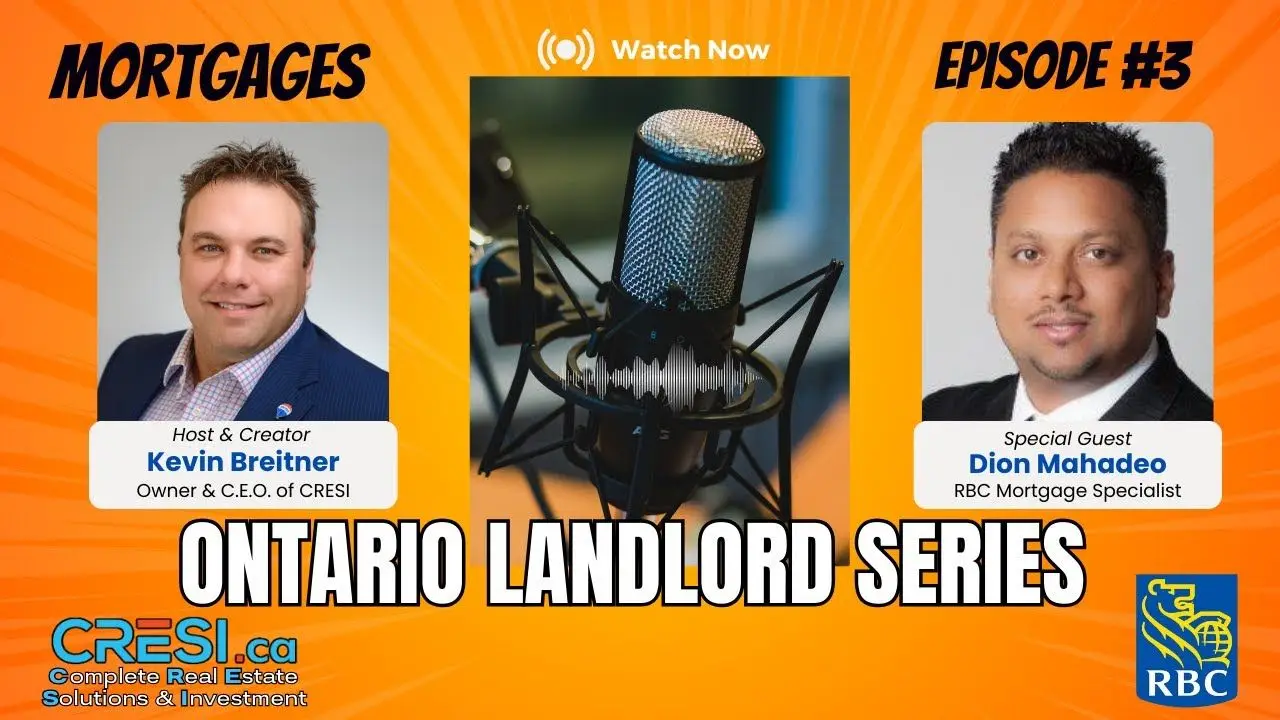
Episode 3 · with Dion Mahadeo
RBC Mortgage Advantages for Ontario Investment Property Buyers
RBC offers investment-property buyers a firm, multi-year pre-construction rate hold that's honoured even if a buyer's job situation changes, says mortgage specialist Dion Mahadeo. RBC also uses 80-100% of market rent toward mortgage qualification and allows up to six residential units at 20% down, versus a commercial mortgage above five units elsewhere.
Key takeaways
- Dion Mahadeo says RBC's firm approval or agreement-in-principle on pre-construction purchases can hold a rate for up to four or five years, and RBC honours that approval even if the buyer's employment situation changes before closing, for example going self-employed.
- Mahadeo describes a client who locked a 2.99% five-year fixed rate on a pre-construction investment property around 2019-2020, held it for about three years, and closed at that rate in 2023 even though market rates were then in the 5-6% range.
- For resale purchases, Mahadeo says RBC will count 80% of an appraiser's market-rent assessment toward mortgage qualification, or up to 100% of the rent if the existing tenant is confirmed to be staying on with the new owner, whichever is better for the buyer.
- RBC treats up to six residential units (a sixplex) as a residential mortgage rather than commercial, meaning a 20% down payment instead of the 35-40% typically required commercially, a difference of roughly $40,000 on a $2 million purchase, as long as there's no commercial component like a retail unit.
- Mahadeo notes RBC doesn't charge a rate premium for investment properties versus owner-occupied homes, unlike some other lenders.
Frequently asked questions
What is a pre-construction rate hold and how does it help investment property buyers?
Will my mortgage approval still be valid if my job situation changes before my pre-construction condo closes?
How much of my rental income can I use to qualify for a mortgage on an investment property?
Can I get a residential mortgage on a sixplex in Ontario?
Does RBC charge higher mortgage rates for investment properties than for a primary residence?
Should I buy a car before or after getting my mortgage approved for an investment property?
Guests
Dion Mahadeo — Mortgage Specialist, RBC
RBC mortgage specialist with over a decade financing pre-construction and investment properties for Ontario landlords and investors. (Not yet on the canonical roster — flagged for Kevin/Jason to confirm bio details.)
Chapters
Full transcript
Introduction & Background
Landlords, how are you doing today? Welcome back for another episode of the Ontario Landlord Series, information landlords need to know. Joining today is a good friend and colleague I’ve worked alongside for my entire career in real estate, coming up on 13 years now — Dion Mahadeo from RBC. Welcome, thanks for joining us today.
Dion and I have been working together for 13 years, and as everybody in the finance world knows, when it comes to financing investment properties there are different options people use — a lot of times people end up in the private sector, but there are also mortgage brokers out there. One thing that separates RBC from everybody else is that you can only get an RBC mortgage from an RBC broker like Dion. And when you’re comparing mortgages, there are always specific factors, situations, and sections of the contract and agreement to understand — it’s not just always about the rate. One thing that’s especially relevant right now is RBC’s pre-construction rate hold.
Pre-Construction Rate Hold Program
RBC has seen a lot of market changes over the years, and there are a few things RBC does that are a great advantage to clients beyond just the rate. With respect to pre-construction — condos, freehold townhouses, detached, semis — RBC has a strong pulse on a lot of projects in Ontario and is a proud partner with many of the province’s major builders. That means advantages on pre-construction sites: preferred rates, and, because a pre-construction closing date can be years out and can slip further, RBC wants to make sure the client is protected all the way through.
RBC does this through what’s called a firm approval or agreement-in-principle approval. If a project is set to be built in three years, RBC can do rate holds of up to four or five years on certain projects. The key thing isn’t just the rate — it’s that the rate-hold timeframe is honoured for the full period. As long as the purchase price and borrowers don’t change, and there are no other major changes, RBC will honour that approval regardless of the client’s situation years down the road — even if they change jobs, go self-employed, or are between jobs by the time the building closes, because the mortgage was already approved years earlier.
Firm Approval Benefits
A real-life example: someone purchases an investment property, and during the closing period decides to go out and buy a family car. One client did exactly that a few years ago — the lender did a final check about two weeks before closing and found their GDS/TDS ratios were no longer in line because of the new car payment, and everyone had to scramble to fix it. With RBC, once a buyer has a firm approval in place, that second check doesn’t happen the same way, so a client wouldn’t run into that problem after approval.
Whether it’s pre-construction or a resale property closing in 60 to 90 days, the advice is: get the RBC approval done first, ideally near the start of the process. Once firm-approved, a buyer can then go out and make a purchase like a car without jeopardizing the mortgage — don’t get the car first and then try to get approved, since that can cause issues. With pre-construction timelines stretching years out, nobody knows what will happen with their career, so having that confidence that the approval already happened while employed, and will be honoured regardless of what comes later, is the bigger advantage.
Rate Hold Example & Success Story
Circling back to the pre-construction rate hold: it mattered a lot given the recent rise in both fixed and variable rates. Someone who signed a contract with a builder three or four years ago, before rates went up, would still be holding that earlier rate today.
A recent example: clients who bought pre-construction before the pandemic, around 2019-2020, closed about 18 months to two years ago. On top of the firm approval, Dion was able to hold their rate — a five-year fixed at 2.99% — for the full three years until they closed in 2023, even though market rates in 2023 were in the 5-6% range on an investment property. Because the rate was approved and held ahead of time, they were spared the ballooned payments other buyers faced who only got their approval a few months before closing.
By contrast, roughly a decade ago some pre-construction approvals were as loose as “just a letter saying they’ll be able to afford it when it’s built in five years.” A firm approval today is far more protective, avoiding the scramble to requalify once things have changed years later.
Rental Income Qualification (80-100%)
For a resale property with an existing tenant, some lenders will only use 50% of the lease’s rental income toward qualification, and some want the buyer to qualify entirely on their own income. RBC uses 80% or even 100% of the rent. When buying a resale rental property, RBC has an appraiser provide a market-rent assessment for the area — typically a range, for example $3,500 to $4,000 a month for a one-bedroom condo downtown. RBC will use 80% of the lower number of that range in the TDS calculation — conservative, but still a meaningful 80%, not 50% or nothing.
A client can’t get a full pre-approval on an investment purchase in advance, but RBC can run scenarios based on current income and a market rent estimate at 80% to show what they’d likely qualify for, so buyers can shop with confidence rather than hoping it works out. In cases where a landlord is buying a property from another landlord and the existing tenant is staying on with the new owner as landlord, RBC can use up to 100% of that rent if it works out better than 80% of a possibly lower locked-in rent — whichever is more advantageous is used.
Six-Unit Residential Mortgage Advantage
Once a property has more than five units, it’s typically classified as a commercial mortgage; anything from two to five units is a residential mortgage requiring only 20% down. RBC, uniquely, allows six units to qualify as residential — meaning 20% down instead of the 35-40% commercial mortgages typically require. On a $2 million purchase, that difference is roughly $40,000, letting a buyer get into a purchase without needing the full commercial down payment.
RBC can do anywhere from micro-condos up to a sixplex as residential, with residential rates and a 20% down payment — a key differentiator versus lenders who cap at four or five units and require bigger down payments and higher rates at six. The one exception: if the property has any commercial component, like an apartment above a convenience store, that falls under commercial financing at RBC and isn’t something Dion finances. As long as a sixplex has no commercial units mixed in — no hair salon, for example — it qualifies as residential. This is a notable plus in older cities with more multiplex properties, since most lenders only go up to four units.
RBC’s Investment Property Benefits
It’s good to shop around and speak with multiple lenders and brokers to compare options, but a few things stand out about RBC specifically. Working with an experienced broker matters — Dion and Kevin have worked together 13 years and have seen most scenarios that come up. RBC doesn’t charge a premium for investment properties, unlike some other lenders — an investment property gets the same rate as a home you’d live in, which is a real advantage.
Beyond the transaction itself, the approach is about understanding a client’s overall plans — whether buying investment properties for retirement or to pass on to family — and providing advice tailored to those goals rather than treating each purchase in isolation.
Closing Thoughts
As investors, everyone’s situation is as individual as a fingerprint — what’s right for one buyer isn’t necessarily right for another, so it’s about breaking down the options and figuring out the best path forward. To recap: using 80% or up to 100% of a lease’s rent for qualification, firm approvals that hold regardless of future life changes, the pre-construction rate hold (builders no longer accept just a letter saying a buyer can afford it — a firm, held approval is what’s needed for four or five years out), and the option of six doors instead of five on a residential mortgage. Thanks so much, Dion, for joining us today — our landlords appreciate you sharing your knowledge, and we’ll talk to you again soon.
Derived guide: read the full guide.