
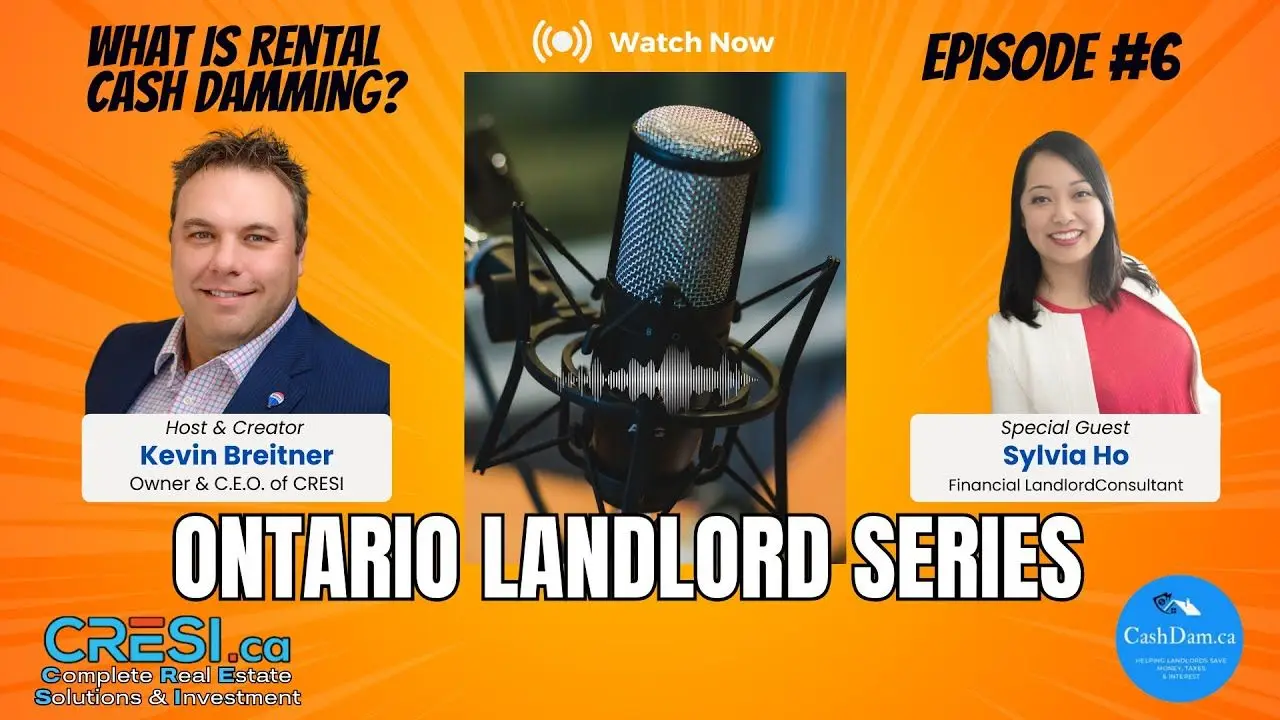
Episode 6 · with Sylvia Ho
Rental Cash Damming Explained: A Tax Strategy for Ontario Landlords
Rental cash damming is a CRA-approved strategy, approved over 20 years ago, that helps landlords reduce bank interest and income tax, resulting in tax refunds, says mortgage agent Sylvia Ho. She describes a $300,000-income client with a $1 million mortgage on track to pay it off in 18 years instead of 30 after applying the strategy.
Key takeaways
- Sylvia Ho says rental cash damming is a CRA-approved strategy — approved over 20 years ago — available to landlords who collect rent on a regular basis, and it works by reducing the interest landlords pay banks and the income tax they pay government, resulting in tax refunds.
- Ho describes a professional couple earning over $300,000 combined, in the highest tax bracket (paying roughly $150,000 in income tax), with a $1 million mortgage on a 30-year amortization; after applying rental cash damming, she says their mortgage is on pace to be paid off in 18 years instead of 30.
- Ho contrasts rental cash damming with typical debt-reduction habits like accelerated weekly or biweekly payments or dumping bonuses onto the mortgage — she says those approaches help, but don't meaningfully dent a $1 million mortgage the way the strategy she teaches does.
- Ho offers a free 45-minute Zoom consultation to review a landlord's goals, such as paying off an owner-occupied home mortgage early or reducing income tax, and a free guide to rental cash damming, both accessible through her website, cashdam.ca.
- Kevin Breitner frames the segment around treating landlording as a business, not just a retirement plan, and stresses working with a specialist, such as an accountant who deals with real estate investors regularly, rather than a general-purpose professional.
Frequently asked questions
What is rental cash damming?
Is rental cash damming a legitimate, CRA-approved strategy?
How much can a landlord save using rental cash damming?
Who qualifies for rental cash damming?
How do I learn more about rental cash damming?
Does accelerating regular mortgage payments save as much as rental cash damming?
Guests
Sylvia Ho — Mortgage Agent & Financial Landlord Consultant, Cash Dam
Toronto-based mortgage agent and landlord of over 20 years; financial landlord consultant specializing in rental cash damming and tax-reduction strategies for landlords. (Not yet on the canonical roster — flagged for Kevin/Jason to confirm bio details.)
Chapters
Full transcript
Introduction and Importance of Professional Expertise
Hi, landlords of Ontario. Welcome to another episode. Today we’re going to dive into something very important: treating landlording like a business, not just a retirement plan. It’s a business, like selling t-shirts or running any other company, with its own advantages, business credits, and tax considerations. A team of specialists who understand what a landlord is going through can help situate you properly for your individual situation.
As always, this is just a conversation to give you some information — you should talk to a specialist in their field, like an accountant who deals with real estate investors all the time, not just a generalist. In real estate, everybody knows a few realtors, but if you’re buying something specific like waterfront, rural, or pre-construction property, you want a specialist. It’s the same idea as needing a heart surgeon rather than asking a brilliant brain surgeon to operate on your heart — when it’s your money and your future on the line, too many people only know option A and don’t realize options B and C exist.
Today’s guest is Sylvia Ho, a mortgage agent and landlord for over 20 years, and a financial landlord consultant who combines her experience as a landlord and mortgage agent to help clients save money. She lives in Toronto with her husband Gary and their two kids, ages 13 and 11, and loves hockey, Disney, puzzles, and Lego.
What is a Financial Landlord Consultant?
A financial landlord consultant’s bottom line is saving clients money. As Canadians, most of our money goes to two places — income taxes paid to government, and interest paid to banks. The goal is to help landlord clients reduce both the interest they pay banks and the income taxes they pay government.
This isn’t about saving $10, $100, $1,000, or even $10,000 — it’s about saving hundreds of thousands of dollars. For example, take a client family making $300,000 combined, at the highest tax bracket, paying roughly $150,000 in income taxes. That’s a lot of money, and if some of it can go back into the client’s pocket, it lets them reach other goals. So the role of a financial landlord consultant is reducing the interest paid to banks and the income taxes paid to government — a point often illustrated by noting that once rental income is added to a landlord’s regular paycheque, the government simply sees total income, not separate streams.
Introduction to Rental Cash Damming
Rental cash damming is an advanced tax strategy that helps landlords get paid by the government, in the form of tax refunds. It’s a CRA-approved strategy — approved over 20 years ago — but it’s kept relatively quiet because the government loses money every time a landlord applies it.
This advanced tax strategy is specifically for landlords who collect rent on a regular basis. Most people simply don’t know to ask about it if they don’t know it exists, which is why part of the role here is telling landlords across Canada what the strategy is about. Just as RRSP contributions and TFSA savings are a norm for Canadians generally, the goal is for applying rental cash damming to become the norm for landlords specifically.
Client Success Story
One client story: a professional couple making over $300,000 combined — a doctor and another professional — with a $1 million mortgage on a 30-year plan. On a standard 30-year plan with a $1 million mortgage, a homeowner ends up paying over $2 million over the life of the mortgage. This client did everything typically recommended: switching from monthly to accelerated weekly or biweekly payments to bring the amortization down from 30 years to about 26, picking up extra income or a part-time job and dumping it toward the mortgage, and putting work bonuses toward the mortgage too.
Those things work, but they don’t meaningfully dent a $1 million mortgage. After being taught the rental cash damming strategy and applying it properly to their finances, this client is now watching their $1 million mortgage melt away — on track to pay it off in 18 years instead of 30.
Consultation Process
When a client first comes in wanting to understand rental cash damming, the process starts with a complimentary 45-minute Zoom chat. In that call, the discussion covers the client’s goals for their life, family, and finances — whether that’s paying off an owner-occupied home mortgage earlier than planned, or paying less income tax for someone in a higher bracket like the 50% tax bracket at $300,000 of income. That 45-minute conversation surfaces how much money a landlord is currently leaving on the table by running their landlord business less efficiently than they could — and applying the specific strategy can mean savings not just in the tens of thousands, but hundreds of thousands of dollars. As with any investment strategy, every landlord’s situation is different, so the plan is tailored to individual goals, whether that’s a single property or a growing portfolio.
How to Learn More and Free Resources
Landlords can learn more at Sylvia’s website, cashdam.ca, which includes access to a free one-hour training. There’s also a free gift for listeners: a free guide that gives the exact blueprint for how to implement rental cash damming, accessible through a link in the video description, or by reaching out and being connected through Kevin.
The bottom line is that if you’re a landlord, applying the strategy is strongly worth exploring — clients frequently say they wish they’d known about it sooner, and ask why no financial planner or accountant ever told them. As Sylvia puts it, you don’t know what you don’t know, so if you’re not aware of a strategy, you can’t ask about it — which is exactly why she’s telling landlords about it now. Not applying the strategy, in her view, means literally leaving hundreds of thousands of dollars on the table.
Closing Remarks
Landlords should reach out to Sylvia to explore this further, since — as she said — the potential is not just tens of thousands but hundreds of thousands of dollars. At the end of the day, paying taxes is a good sign because it means you’re making money, but the goal is to pay the least amount of tax legally possible and keep the most in your own pocket. Thanks so much for joining us today, Sylvia, and thanks for sharing your wisdom — we’ll definitely talk to you soon. Bye for now. Thanks so much for joining us this week — if you’re finding it informative and useful, make sure to like, subscribe, and share with a friend so we can keep getting the information out there to Ontario landlords. Keep on joining us; we’ll see you next time.
Derived guide: read the full guide.