
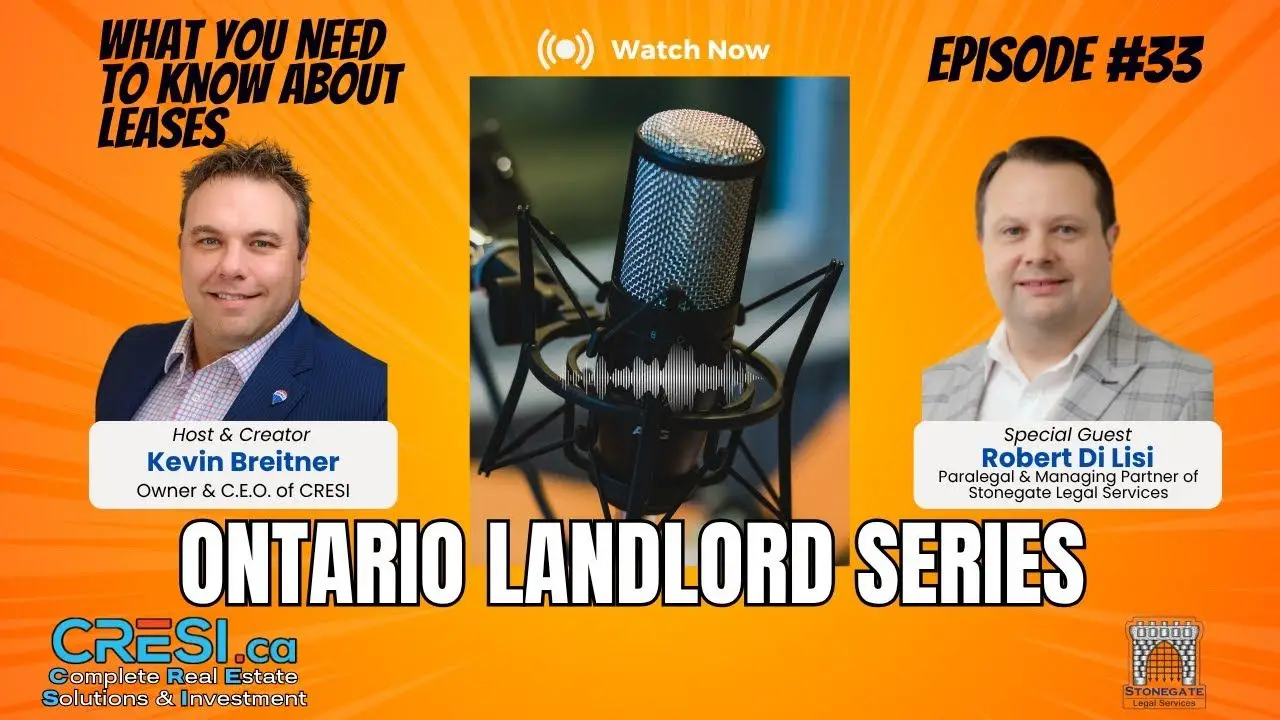
Episode 33 · with Robert Di Lisi
Schedule B Lease Clauses: What Ontario Landlords Can't Actually Enforce
Many standard Ontario lease 'Schedule B' clauses are unenforceable, says paralegal Robert Di Lisi reviewing a real addendum. Landlords can't require tenant insurance, charge pet deposits, cap NSF fees above $20, mandate professional carpet cleaning, or bill tenants for appliance repairs — RTA Section 20 puts maintenance, snow removal, and liability responsibility on the landlord regardless of lease wording.
Key takeaways
- Robert Di Lisi says a lease can request, but not require, tenant contents or liability insurance — a landlord already carries liability coverage on a mortgaged property, so asking a tenant for liability insurance amounts to double-dipping; he personally lets tenants decline contents insurance in writing so any later damage dispute is on record.
- Di Lisi says the maximum a landlord can charge for a bounced (NSF) cheque is $20, not the $50 written into the lease clause reviewed on the episode.
- Pet-related clauses that promise 'no pets' or make a tenant indemnify the landlord for pet damage aren't enforceable, Di Lisi explains, because the Residential Tenancies Act overrides them; the threshold for chargeable damage is high, and things like door scratches from a dog are typically wear and tear he simply sands and repaints as a landlord himself.
- On key and fob deposits, Di Lisi says a landlord can only recover the actual replacement cost — he estimates a fob at roughly $75 — so a $300 to $1,000 'key deposit' some agents write into condo rental deals is arguably an illegal deposit above replacement value.
- Snow removal and lawn care are the landlord's Section 20 responsibility unless a separate signed contract has the tenant agree to do it, Di Lisi says; if a tenant doesn't cut the grass, the city can fine the property and add the cost to the property taxes, which falls on the landlord regardless of what the lease says.
Frequently asked questions
Can a landlord require a tenant to get contents or liability insurance in Ontario?
Are pet deposits legal in Ontario?
How much can an Ontario landlord charge for a bounced (NSF) cheque?
Can a lease require a tenant to pay for professional carpet cleaning when they move out?
Who is responsible for snow removal and lawn care at an Ontario rental property?
Can a landlord charge a deposit that's more than the cost of replacing a lost key or fob?
Can a lease make a tenant responsible for minor appliance or plumbing repair costs?
Can a landlord stop a tenant from smoking cigarettes or cannabis in their unit?
Guests
Robert Di Lisi — Licensed paralegal, Stonegate Legal Services
Ontario licensed paralegal at Stonegate Legal Services; landlord-tenant and LTB representation.
Chapters
- 0:00 Introduction & Episode Overview
- 1:14 Rob Di Lisi Introduction
- 2:49 Tenant Information & Occupancy Rules
- 4:04 Payment Methods & NSF Fees
- 5:28 Insurance Requirements EXPOSED
- 7:45 Smoking Restrictions Reality Check
- 9:10 Pet Clauses & Damage Myths
- 10:27 Utility Responsibilities
- 11:54 Cleaning & Carpet Requirements
- 13:26 Snow Removal & Lawn Care Laws
- 15:06 Key Deposits & Replacement Costs
- 18:30 Condo Bylaws & Amenity Changes
- 22:02 Appliance Repair Cost Myths
- 23:56 Final Takeaways & Legal Reality
Full transcript
Introduction & Episode Overview
Hey landlords, welcome to another episode of CRESI’s Ontario Landlord Series podcast, where we’re here to educate and inform landlords in Ontario and make sure you understand each situation you could come across. Today we’re talking to our good friend Rob Di Lisi from Stonegate Legal Services again, as we break down a Schedule B that came to me through another agent at my office, whose client was looking to rent out a place. We’ve touched on this before, but today we’re actually going to go through some clauses landlords put in — whether they’re enforceable or not — one by one. Remember, this isn’t personal legal advice — this is general advice, but it’s meant to help you understand what you can and can’t do when adding certain clauses to a lease, keeping in mind that
it usually comes down to the OSL, the Ontario Standard Lease. But that’s my intro — let’s bring in our expert, Mr. Rob Di Lisi.
How are you doing today?
Rob Di Lisi Introduction
Thanks — I’m a little under the weather today, but hopefully you can hear me okay. This is what I love about Rob — even when he’s not feeling his best, he’s here to make sure our landlords are getting proper advice. Rob, thanks so much for doing this — we’ll try to make you talk less and me talk more, maybe. Let’s go through these.
I’ll read through the first few together, then we’ll break them down as we go, since they’re kind of connected. It starts off saying: “Tenant agrees to provide pertinent information from the tenant’s application form attached hereto to the landlord for the purpose of a credit check, if required.
Landlord shall be responsible for verification of information provided on the application form. Tenant shall submit herewith a pay stub for the landlord’s reference, unless the tenant is self-employed. Tenant and landlord agree that any accepted offer to lease shall be transcribed by the landlord onto the Ontario Standard Lease form, as required by the Residential Tenancies Act, prior to completion of this agreement. The said rental premises shall be tenanted only by the following persons” —
and then it looks like it wants you to write in your tenants’ names and have them initial it. So let’s start with that section, Rob — what would you like to share about that?
Tenant Information & Occupancy Rules
The part that really raises red flags is saying only certain people are allowed to live in the unit. When you sign the lease, the people who sign are the leaseholders or tenants, but they’re allowed to bring in occupants, roommates, or guests, and they don’t have to ask the landlord’s permission — even if the lease says otherwise. The first three parts are basically things that happen anyway when applying for the lease — once you sign a rental application, it says right on there that they’re giving permission for a credit check, and a pay stub is something they look at to confirm you’ll qualify as a tenant. I’ll move on to the next couple: “The tenant voluntarily agrees to submit to the landlord post-dated cheques for the stated
rent, payable to the landlord at the beginning of each yearly term, to cover the months not provided for by the deposit. The tenant agrees to pay the landlord a service charge of $50 for each and every cheque which the tenant’s bank or depository refuses to honour.”
Payment Methods & NSF Fees
A couple of comments there. First, you can request a method of payment, but you cannot require one. So if the lease says tenants must give post-dated cheques, that’s fine if the tenant agrees, but what if they want to pay by e-transfer instead?
On top of that, for post-dated cheques, you cannot charge more than $20 for an NSF cheque, not $50. With our property management company, we run rent through an online payment portal, and we have three tenants who choose not to pay through the portal, so we deposit cheques for them — one gentleman still pays cash. But no, you’re right — we can’t force anyone to pay a certain way,
as long as they’re paying us, they can choose how. There’s no prejudice to the landlord based on how they get paid. Here’s another one we require of all our tenants as well: “Tenant agrees to acquire contents and personal liability insurance to cover the term of the lease and any extension thereof, and shall provide the landlord or their agent with the name of the insurance company along with the policy number prior to the keys being released to the tenant for the said property.”
Insurance Requirements EXPOSED
You cannot make that mandatory or tell the tenant they must get contents insurance. Contents insurance is for the tenant’s own use and benefit. As for liability, you shouldn’t be asking a tenant to get liability insurance, because if you have a mortgaged property in Ontario, you’re already required to have liability coverage on it — you can’t double-dip
on a property. You can ask the tenant if they want tenant insurance — in my own leases, I ask them, and if they say no, I cross it out so it’s on record that they declined, and if something gets damaged later and they didn’t have tenant insurance, that’s on them, not me. Interesting — I’ve always required it before turning over keys, knowing that once they’re in, I can’t enforce it anymore.
But we always put it in there that we’d like it before move-in, and whether they cancel it afterward, there’s nothing we can do. You can request it, but there’s no prejudice to the landlord — it’s the tenant who’s at risk if they don’t have insurance and something gets damaged later, like the Kitec plumbing situation that’s come up in some buildings, where it’s had to be removed from as many buildings as possible.
I know that’s been a whole process for people dealing with it. Let me move on with another one to stay on topic, because this next section is probably the longest I’ve come across, and we’re getting into some more interesting ones. The clause reads: “The tenant agrees that neither the tenant nor the tenant’s guests will smoke in the rented premises.
In the event this stipulation is breached, the tenant agrees to indemnify the landlord from any and all damages and losses suffered as a consequence.” And then there’s a spot for the tenant’s initials.
Smoking Restrictions Reality Check
You can’t arbitrarily make that decision — that would be up to the Landlord and Tenant Board. Smoking cannabis and cigarettes is legal, so if a tenant is in their own dwelling, they have the right to smoke marijuana or cigarettes.
The only time it could be a problem is if a landlord and tenant are sharing a house — say the landlord lives upstairs and has a smoke allergy. As long as you can document the allergy, yes,
you can pursue the tenant over the smoking. Would that apply the same way in a mixed multi-family building?
As long as one of the tenants has a documented allergy, essentially yes. The complication is if there are kids involved and marijuana smoke is passing through the building — they’ll be affected by it, but smoking itself is still legal. One of our tenants has three young kids and is the one smoking marijuana in that case,
but that’s a conversation for another day. Next clause: “The tenant acknowledges they have no pets and no intention of obtaining a pet during the term of this agreement or any extension thereof. In the event the tenant acquires a pet during the term of this agreement or any extension thereof, the tenant agrees to indemnify the landlord from any and all damages and losses suffered.”
Pet Clauses & Damage Myths
No — under the Residential Tenancies Act, pets are allowed, so you can’t contract out of the law. Any damage they cause has to meet a high threshold to count as damage at all —
a lot of what people flag is really wear and tear. A common example is dogs scratching a bedroom door, which some landlords consider damage. From my own experience owning rental property,
I just sand it down, paint it, and it’s fine. Mostly wear and tear, and part of the cost of doing business as you turn the unit over for those small things — major damage is where a landlord could actually pursue a claim. Here’s another one: “The tenant covenants and agrees that cable television, internet, and telephone utilities are the responsibility of the tenant, and warrants that any of the above utility accounts
due for a period will be paid in full on or before vacating the said premises. The tenant agrees to have all utilities transferred to their name by the respective service providers prior to completion of this agreement, unless otherwise specified in this agreement.”
Utility Responsibilities
No problem with that one — everybody should have their name on their own utility accounts. Next: “Tenant agrees not to make any changes or alterations to the property without the written permission of the landlord.”
Fairly normal — the one we get asked about most is paint, and we usually just ask for approval on the colour. That’s about as far as it goes, because if a tenant changes the colour and the landlord has to repaint, it’s not a huge cost — a couple of gallons of paint. Personally, as a landlord, I don’t really care about paint colour, other than not loving darker colours because they’re more of a pain to cover, but I don’t mind tenants painting, and I usually offer to do it myself if needed. Tenants are generally allowed to paint inside their unit, but not make major alterations or structural changes to the property,
with or without permission — though with permission, it’s a different conversation. Next: “Tenant shall leave the premises, including appliances, in a clean and move-out-ready condition, and have the broadloom carpet shampooed by a professional carpet-cleaning company at the end of the term of the lease or any extension thereof.”
Cleaning & Carpet Requirements
It’s great if the tenant agrees to do it and does it, but you can’t contractually require it. What’s the landlord’s remedy if the tenant doesn’t do it — chase them down? Under the law, that requirement isn’t accurate.
The tenant doesn’t have to do that. Next: “Tenant covenants to maintain, keep, and leave the premises in an orderly state of cleanliness, and to repair any damage caused to the premises by their willful or negligent conduct, or that of persons permitted on the premises by the tenant, except reasonable wear and tear.” The threshold for damage keeps coming up — how do you determine what counts as damage versus wear and tear?
Damage has to be significant — a few small nail holes from hanging photos, for example, is wear and tear, not damage. Real damage is something major and intentional —
taking a hammer to the cabinets and counters, for example, that’s damage. But if someone slips, falls, and puts their head through a wall by accident, that’s not damage in the same sense. Next clause: “The tenant shall be responsible for the removal of snow from the property and sidewalks, and the cutting and maintenance of the lawn.”
Snow Removal & Lawn Care Laws
This one I see a lot. Under Section 20 of the Residential Tenancies Act, the landlord is required to maintain and repair the property. What you can do is create a separate contract where the tenant agrees to handle snow removal or lawn cutting, but if the tenant stops doing it, that responsibility still falls back on the landlord.
In fact, if the grass isn’t cut, the city will usually add a fine to the property taxes for that property. So that lands on the landlord, not the tenant. The property owner is the one who gets the city fine and the notice if the grass is unruly, but
it’s still the landlord’s responsibility to maintain the exterior of the property, including snow and grass — unless there’s a separate signed agreement outside the lease itself where the tenant takes it on. That’s different from just putting it in the lease, because a tenant can’t be held responsible for it unless they’re willingly doing it — some tenants like doing it and keep up with it themselves. Next: “Tenant shall not assign or sublet the premises without the landlord’s written permission — such permission shall not be arbitrarily or unreasonably withheld.”
That one’s fine — you do need the landlord’s permission before assigning or subletting, but you don’t necessarily need to put it in the contract, since it’s already part of the law.
Key Deposits & Replacement Costs
Next: “Tenant is responsible for the total replacement cost of keys, entrance cards, and any electronic devices or garage door openers during the lease term or any extension thereof. In the event the said items are lost, stolen, or damaged, and for any additional related costs as deemed by the landlord or management office, where applicable.” This one’s tricky — the idea is that if a tenant loses a key or fob, it’s their responsibility. It makes sense logically to put that on the tenant, but the way I’d say it is: the landlord replaces the key or fob first, and can then file against the tenant to recover the cost.
Here’s one that’s related — we could’ve grouped these together: “Tenant agrees to pay a refundable deposit of $300 for the items stated below, and covenants with the landlord that upon termination of the lease, pursuant to the terms of the Residential Tenancies Act, to deliver up possession of the premises to the landlord or their authorized agent, and further to surrender all keys and entrance devices relating to the premises” — entrance doors or other building doors, mailbox keys, electric garage door cards, and any other entrance devices for the rental property.
Again, you can only charge for the actual cost of replacing the key. A friend of mine just rented out his house a few weeks ago, and the amount charged was over $50. I’ve seen agents on condo deals put in $300, $500, $800, even $1,000 key deposits.
That could be argued as an illegal deposit, because it’s above the actual replacement cost. Fobs are normally around $75 each, so if you’re taking two of them, you’re looking at a deposit of about $150, maybe $200.
Anything above that is above replacement cost, and, like you said, an illegal deposit. Right — you can only legally collect a deposit for last month’s rent and the replacement cost of keys.
Right. I’ve also seen “pet damage deposits,” light-bulb deposits — that’s a good one, LED light bulb deposits. Next: “Where the rental premises are part of a condominium, tenants shall comply with all bylaws of the condominium corporation.
Tenants shall be responsible for any fines or assessments levied against the landlord by the condominium corporation due to the tenant’s or their guests’ violations of the said bylaws. Tenant acknowledges the condominium corporation can and may eliminate any recreational facility or part thereof at any time without notice to the tenant, and in such circumstances, the tenant will not claim or receive a rent reduction or abatement for the same.”
Condo Bylaws & Amenity Changes
You can’t contract that out. If amenities are being taken away and the rent includes those amenities, there could be a rent abatement, but that’s not for the landlord or the tenant to decide unilaterally — that’s for the Landlord and Tenant Board. The same would apply if, say, a microwave included in the lease stopped working — the landlord would have to replace it, even something that simple. A bigger one would be air conditioning — even if a tenant isn’t paying rent, the landlord still has to maintain and upkeep the property, and if it was rented with air conditioning, that air conditioner has to keep working.
That’s correct. Here’s another one: “Either party shall notify the other party in writing of their intention to renew or not, no later than 60 days prior to the termination of the lease.” We know the actual ways a lease can end — the tenant giving notice, an eviction process, a mutual release, or an N-12 for the landlord moving in — but we’ve covered those in other episodes.
One last thing on this: tenants have security of tenure — the lease continues automatically month to month. Even though it’s nice if they give notice about staying or not, they don’t have to. Only when they decide to leave do they need to give notice.
So a landlord should just assume the tenant is staying until told otherwise. Next: “Landlord shall pay real estate taxes, condominium common maintenance fees where applicable, and maintain fire insurance on the premises. Tenant acknowledges that the landlord’s fire insurance on the premises provides no coverage for the tenant’s property” — that would be contents insurance.
That’s just restating what we already covered. Next: “Landlord shall provide for the use by the tenant during the lease term the following appliances: fridge, stove, dishwasher, clothes washer, clothes dryer, and window coverings, if and where applicable.” That “if and where applicable” phrasing is odd — are these appliances there or aren’t they?
Right, exactly — if they’re there, they’re included, same with window coverings. If they’re there, they’re included in the lease. I’d tighten that clause to state clearly what’s actually in the property, if I were writing it. A couple more here, just to touch on: “The landlord represents and warrants that the appliances listed will be in good working order at the commencement of the lease term,” and that it should also stay maintained throughout — obviously that’s the landlord’s responsibility.
“The tenant agrees to maintain said appliances in a clean and good state of repair. The tenant agrees to pay up to $50 on each occurrence for any minor repairs required to the landlord’s appliances, plumbing, or electrical equipment through normal usage or accidental damage, commencing 20 days after the occupancy date.”
Appliance Repair Cost Myths
I see this a lot — you cannot put a cost of maintenance and repairs onto the tenant. Under Section 20, that’s the landlord’s responsibility. Collecting that kind of money from a tenant is illegal.
Here’s an interesting one that I don’t think should even be on this agreement — it should really just be on a listing agreement between the landlord and the agent, but I’ll read it anyway, because I don’t know why it’s here: “Should the tenant at any time purchase the property, the landlord agrees to pay the agents named in this agreement, or their successor companies, a fee of 4% of the purchase price plus applicable taxes. This fee will be split equally among the agents named in this agreement. The total fee will be payable to the brokerage by bank draft or certified cheque.” They’re putting their expected commission
into a rental agreement, in case the tenant eventually buys the property, but this is an agreement to lease.
Exactly — it shouldn’t be in here at all. Last one: “The landlord shall not in any event whatsoever be liable for or responsible for any personal injury or death that may be suffered or sustained by the tenant, any member of the tenant’s family, their guests, or any other person while on the rented premises.”
Unfortunately, you can’t do that — you can’t contract out of that kind of liability. If someone is seriously injured or dies because something on the property wasn’t properly maintained, the landlord can’t contract their way out of that liability.
Final Takeaways & Legal Reality
I think the key takeaway from today is that what matters is what the law actually says — what’s stated in the RTA, or what’s actual law. All the decisions we talked through today would ultimately be decided by the Landlord and Tenant Board if there were ever a complaint and a hearing. Rob, is there anything you want to add before we wrap up?
You’ve covered most of the clauses we see regularly. I’m glad — a lot of them here are pretty normal, and a few are unnecessary or off. I hope everybody got some good information today, just understanding a bit more about what to put in a lease. If you have any questions, or there’s something you’d like us to discuss, let us know — comment, send an email, reach out however works. Please like, subscribe, and continue to share this with landlord friends, so we can keep bringing
some great information to you on a weekly basis. Rob, thanks so much again for doing this, even under the weather. Next time we talk, I’m sure you’ll be back to your regular self. Talk to you soon, everybody.
Bye for now. Please remember, while we are professionals, this podcast is for informational and entertainment purposes only. The advice shared may not apply to your unique situation. Always seek personalized advice from a qualified professional before making any investment decisions.
Hey everybody, thanks so much for joining us this week. I hope you enjoyed the episode. If you’re finding it informative and useful, make sure to like, subscribe, and share with a friend so that we can keep getting the information out there to Ontario landlords. Keep on joining us — we’ll see you next time.
Derived guide: read the full guide.