
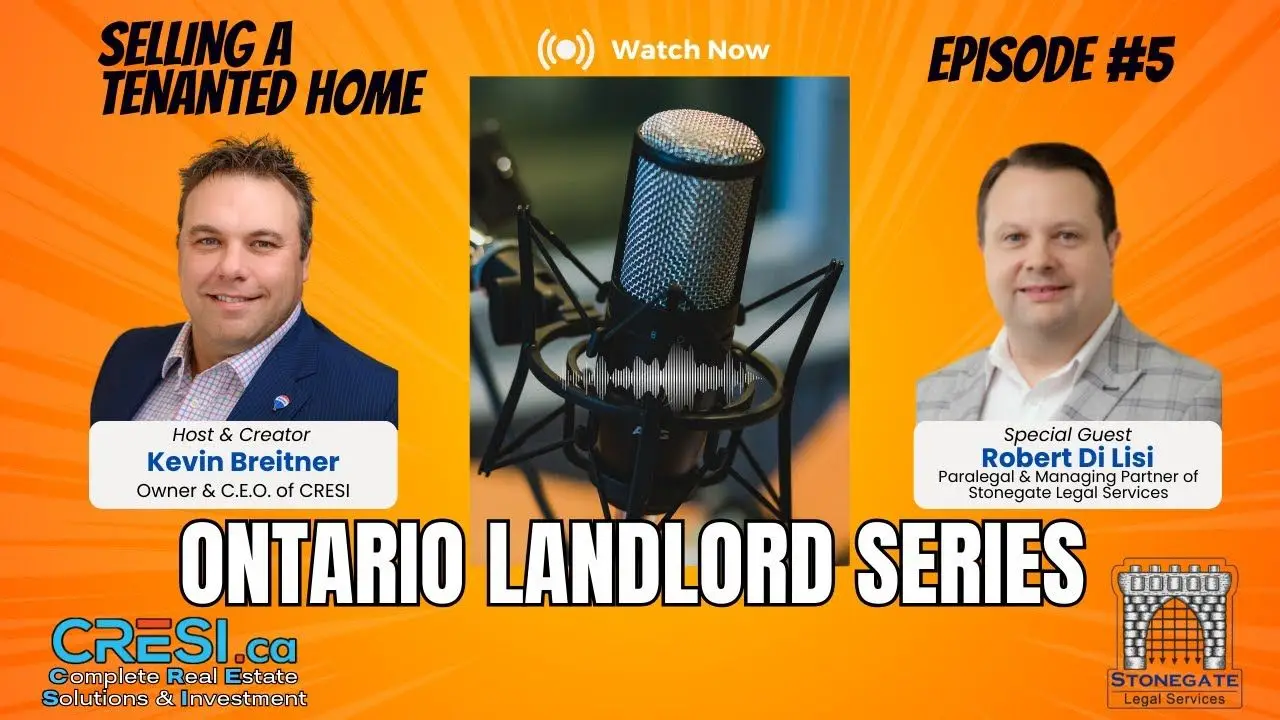
Episode 5 · with Robert Di Lisi
Selling a Tenanted Property in Ontario: How to Deliver Vacant Possession
To sell a tenanted property in Ontario you either sell with the tenant in place — adding a clause so the buyer assumes the tenancy — or use cash for keys to deliver vacant possession, because clause two of the agreement of purchase and sale guarantees it and a tenant with security of tenure can only be removed three ways.
Key takeaways
- Clause two of the agreement of purchase and sale has the seller guarantee vacant possession, Rob Di Lisi explains; to sell with a tenant still in place you must add a Schedule A clause stating the buyer assumes the tenant and the seller is only responsible for serving the N12 and compensation.
- There are two primary ways to sell: sell with the tenant in place (where buyers often demand a steep discount, because an N12 can take six to eight months to reach the board plus 30 to 60 days for an order, and the buyer must then occupy for a year), or approach the tenant for cash for keys — an N11 — to deliver vacant possession.
- A tenant controls the sale experience while in place: they must consent to showings, photos, and video, and Di Lisi and Breitner note tenants have denied showings; selling vacant lets a landlord touch up and photograph the property and usually command a higher price.
- Security of tenure means a lease ending or a sale does not force a tenant out — there are only three ways to end a tenancy: the tenant leaves (N9), the landlord and tenant mutually agree (N11), or the LTB issues an order.
- For a sale to a builder who will demolish and redevelop, the buyer uses an N13 — a minimum 90 days' notice with one month's rent — but must bring permits and architectural plans to the board to prove intent, still roughly a year, so cash for keys is often used to guarantee vacant possession.
Frequently asked questions
Can I sell my rental property with a tenant still living in it?
What does 'vacant possession' mean when selling a tenanted property?
Can I evict a tenant just because I'm selling the property?
How long does an N12 take when the buyer wants to move in?
What is an N13, and when is it used to sell a property?
Guests
Robert Di Lisi — Licensed paralegal, Stonegate Legal Services
Ontario licensed paralegal at Stonegate Legal Services; landlord-tenant and LTB representation.
Chapters
Full transcript
Introduction
Welcome back to the Ontario Landlord Series. This week we’re talking about selling your tenanted property — one of the questions landlords ask most — with our paralegal friend Rob Di Lisi of Stonegate Legal Services.
Vacant Possession Requirements
As a realtor, landlords ask us to sell their properties all the time, and the most important question is almost always: can we get the tenant out so we can sell with vacant possession? It matters because clause two of the agreement of purchase and sale has the seller guarantee vacant possession. There is a way to change that, but by default that’s how it’s written and how it should be handled.
Options for Selling Tenanted Properties
There are two primary ways to approach this. The first is to sell with the tenant in place. Clause two says the seller shall guarantee vacant possession unless stated otherwise in the agreement — so in Schedule A you can add a clause that the buyer will assume the tenant, and that the seller is only responsible for serving the requisite N12 notice and compensation. The catch: buyers often ask for a steep discount, because getting to the board on an N12 is a minimum of six to eight months, then 30 to 60 days for the order, and then the buyer must move in for one year.
The second option is to approach the tenant and work out a settlement — enticing them with money to leave, documented through an N11. That’s the process people know as cash for keys.
Challenges with Tenant-Occupied Sales
Selling vacant makes everything easier and gives the seller full control. While a tenant is in the property they hold the power over showings, and they must consent to photos and video, because their possessions are inside and those images go online. Tenants have denied showings for all kinds of reasons — “it’s my dinner time,” which somehow always fell during showing hours — often because they didn’t want to leave and knew a buyer planned to move in.
Selling vacant also lets you do touch-ups to maximize value: repaint, present the property at its best, and capture proper photos and video. If you can’t time the tenant’s departure, an N11 cash-for-keys arrangement is the tool to regain control of the sale.
Legal Rights and Security of Tenure
You do have the legal right to sell — but the tenant controls showings and must consent to photos and video. The key is whether you can guarantee vacant possession: if you’re not certain, don’t guarantee it. The trade-off is that a buyer might then wait six, eight, even ten months before taking possession, which is why approaching the tenant about cash for keys is often the practical alternative.
A lease coming to an end, or a decision to sell, does not mean the tenant has to move out. This is security of tenure, and there are only three ways to terminate a tenancy: the tenant decides to leave (an N9), the landlord and tenant mutually agree (an N11), or there’s an order. Cash for keys results in an N11, but note that cash for keys is the process of getting the tenant out; the N11 is the document that makes it official.
Demolition Sales and N13 Notices
Sometimes a property with tenants is run down or dilapidated, with little value left to renovate, and the seller sells to a builder who will demolish and rebuild — a bigger home or a multi-family building on the same lot. Even with a demolition sale, the seller isn’t guaranteeing vacant possession, so a builder-buyer will still negotiate a lower price because they have to run their own process: the N13.
The N13 is a notice like the others — a minimum 90 days’ notice with one month’s rent. The difference is the builder must have the permits and architectural plans ready for the board, and must prove to the board that demolition or redevelopment is the genuine intent. With six to eight months just to reach the board, that’s at least a year-long process — or the builder can revisit cash for keys if the tenant is willing.
Final Thoughts and Best Practices
It comes down to simple math: what am I paying to sell for more, get it done faster, and move on? The best way to sell is with vacant possession — time it to when the tenant is moving out if you can, or use cash for keys to put the control and power of the sale back in the landlord’s hands rather than leaving the tenant to dictate showings, photos, and whether they even leave by the closing date. If you have questions about selling a tenanted property, the CRESI team can help. Thanks, Rob, and thanks to Ontario landlords for joining us.
Derived guide: read the full guide.