
Episode 10 · with Robert Di Lisi
Should Ontario Landlords Hire a Property Manager?
Yes — even landlords with a single rental benefit from hiring a property manager. Paralegal Robert Di Lisi and broker Kevin Breitner say the top reasons are specialized RTA knowledge, reduced legal liability on notices, and peace of mind, plus vetted trades, automated payment systems, and buffered tenant communication.
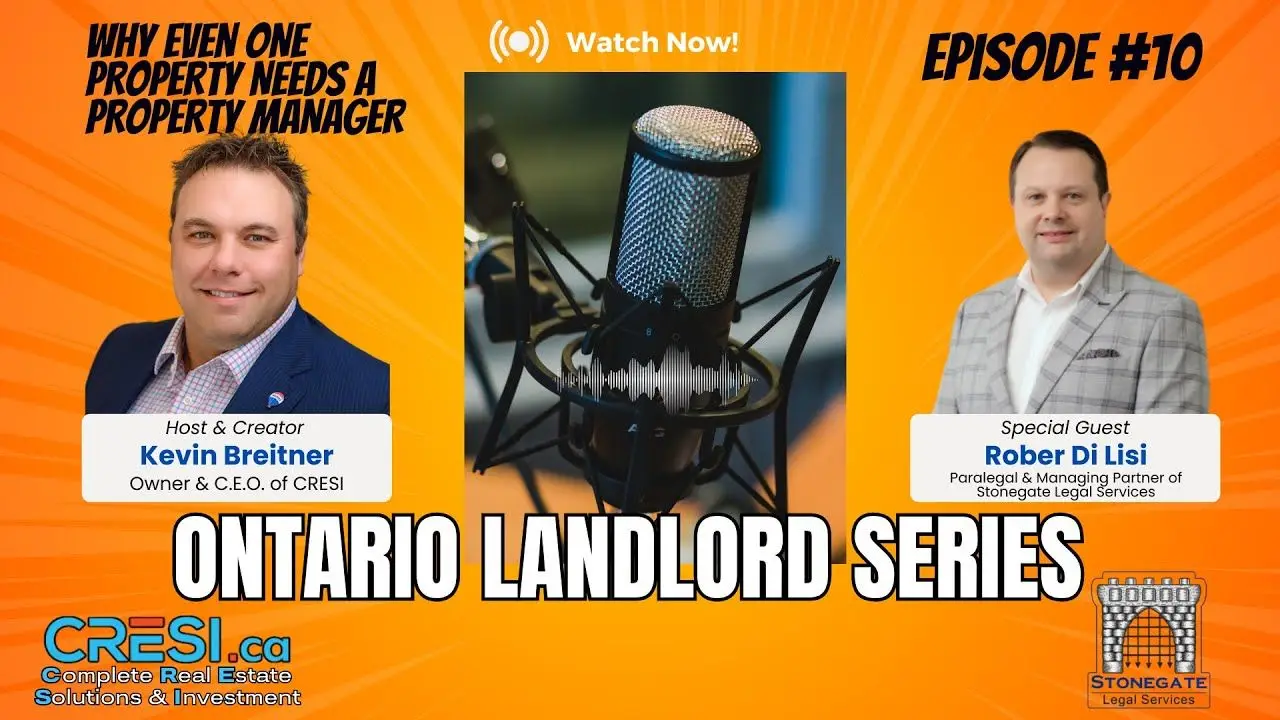
Key takeaways
- Rob Di Lisi says a property manager's number-one value is specialized knowledge, and under the Residential Tenancies Act's Section 20 a landlord must keep the property repaired, so that knowledge matters.
- A property manager can fill out LTB notices but cannot advocate at the board, and takes on liability if a notice is filled out incorrectly — a costly mistake since cases can take six to eight months to reach the board.
- Kevin Breitner says even landlords with just one property benefit from hiring a property manager, since it still frees up day-to-day time and provides peace of mind.
- In a real case Di Lisi describes, a tenant's washing machine took nearly a week to replace; he mediated between the frustrated tenant and confused landlord and resolved it with a Visa gift card as an apology, billed to the landlord as a business write-off.
- Both hosts note property management fees, and trades costs billed through a manager, are a deductible business expense for landlords.
Frequently asked questions
Should I hire a property manager if I only have one rental property?
What's the number one reason to hire a property manager?
Can a property manager represent me at the Landlord and Tenant Board?
What should I look for when choosing a property management company?
What are the legal risks of a landlord or realtor acting as their own property manager?
Are property management fees tax deductible in Ontario?
Can a property manager handle a condo rental?
Guests
Robert Di Lisi — Licensed paralegal, Stonegate Legal Services
Ontario licensed paralegal at Stonegate Legal Services; landlord-tenant and LTB representation.
Chapters
- 0:00 Introduction & Why Property Management Matters
- 1:50 1 Reason to Hire a Property Manager
- 3:42 Common Mistakes & Legal Risks
- 6:21 What to Look for in a Property Manager
- 9:09 Handling Condominiums
- 10:00 Real-World Case Study: Tenant Communication
- 12:07 Property Management Knowledge & Legal Support
- 14:46 Making the Right Choice for Your Investment
Full transcript
Introduction & Why Property Management Matters
Hello out there to all you Ontario landlords. Thanks for joining in on our conversation today with Robert Di Lisi of Stonegate Legal Services. I’m sure you’ve heard me say this before, and if you haven’t, this definitely won’t be the last time you hear me say this: landlords, you are a business owner.
It is not just an investment or retirement plan. Yes, this is a great investment if you ask me — the best investment you can make long term — but I’m always talking with landlords about this topic, about how they should look and think with regards to the rental property. Simply put, it’s a business. That’s how we have to think about things. Too many times we’re also concentrating on the wrong number — how much does something cost — when what we really need to be concentrating on is what do I net by doing this. It doesn’t matter how much you save or how much you spend, it’s what you’re going to net. Now, don’t get me wrong, cost is always a factor, but it shouldn’t be your main focus.
As you know, I’m a real estate broker with RE/MAX, and I started specializing in pre-construction and investing in real estate almost a decade ago. I absolutely love the conversation of how we can make money with our money, and how I can help you do so. One cost that I believe is very beneficial to landlords is property management. There are many companies out there that provide all different types of services, cover a whole bunch of different areas, and have different price points as well. So our conversation today is going to be on that topic — property management, and why it’s something a landlord should consider. Rob, how are you?
Thanks for joining us today. What is your number one reason a landlord should hire a property manager?
1 Reason to Hire a Property Manager
So I’ll start off by saying that I also have a property management company, but it’s for my own properties. I can say that the number one reason is the specialized knowledge that a good property manager will be able to bring to the table. There are a lot of people out there who claim to be property managers — they try to do it on the side — but you need to find someone who is dedicated and has the specialized knowledge. Someone like you, who has real estate experience behind them, is always going to be a plus.
But the biggest thing I’m going to say is peace of mind. That would be the number one thing.
I’m with you there for sure. I think as a landlord, knowing that you don’t have to deal with tenant communications and the hands-on side of things, it can be a little bit passive — like you said, you’re with a trusted source looking after your property, which is in your best interest. I too have a property management company — CRESI Property Management — and we specialize in the everyday landlord: single family and small multi-family buildings.
It’s about helping the everyday landlord. As a realtor, when we started working with more investors, I decided to try to help some of my realtor clients with their rental properties, probably about seven or eight years ago now, and I learned very quickly that I wasn’t ready. I didn’t have the systems in place. I didn’t have the time. I didn’t really know what I was getting myself into — I was just trying to help my clients out. And I learned from that, so we figured everything out and launched CRESI Property Management. That’s one of the things I still talk to a lot of realtors about — why, as realtors, should we not try to assist our clients? How much trouble can we get into, or how much trouble can we cost our landlords, if we’re doing something incorrectly?
Common Mistakes & Legal Risks
Right. I hear this all the time, because real estate agents call us all the time and claim to be the property managers of the property — most of the time they do it because they want to do a favour for their clients who are overseas.
The thing is, you need to understand what property management is. In regards to notices, a property manager can fill them out, but they cannot advocate at the board. So here’s the problem: if a property manager is filling it out, they’re taking on the liability of that form not being done correctly, and we’ve had many conversations about this. We’re looking at about six to eight months before you even get to the board, and if there are any incorrections in the notice, it can be dismissed. So the number one thing is going to be the liability, then the knowledge, then the time — a lot of real estate agents don’t have the time, and they think property management is just a passive job to do for their clients.
And the last thing I’ll say is that if there are any maintenance or repair issues — and you said it earlier — there should be a system in place to take care of those problems before they become a problem, because under the Residential Tenancies Act, under Section 20, the landlord must upkeep and repair the property. So it’s very important that if you’re going to hire a property manager, it’s not a part-timer — not someone doing it just to get extra income. It should be someone dedicated, with a system in place, maybe even a team, to help them.
We learned very quickly, when we tried it, that we weren’t ready. It takes a lot — it’s very time-consuming. As a realtor helping one client, you might think it’s okay, but once you start getting into multiple properties, it’s very time-consuming, and you don’t want to make a small error because of something going on, or not doing something properly — and have that cost your landlord. At the end of the day, it’s their money, it’s their tenant, it’s their property that they’re trying to collect on and deal with.
So when you’re looking for a property manager — there’s a whole bunch of different companies, a ton of different price points, and different services included — if you were to guide a landlord as to what they should be looking for, what would you say? What should they look into?
What to Look for in a Property Manager
Yeah, so first of all, I would say a referral to a property manager would probably be the best thing — make sure they’re reputable, make sure they have systems in place, maybe even look at some reviews. There are some property management companies we deal with, and some are horrible — they just want to collect the money and bill their clients whatever. So I’m going to say: have systems. And like I said earlier, I know you have a team — having a team in place is important because you can’t do everything. You need someone to be able to follow up and make sure things are being done properly.
Agreed. It takes a team to do everything — you have to have a Rolodex of tradespeople in different areas, wherever you’re servicing, because you never know what’s going to happen on a property and who’s going to be needed, and you really want to have somebody who’s going to get there quickly, and who you have a good working relationship with.
Some of the things I’ve heard tradespeople say is that they don’t like working with property management companies because landlords take forever to pay, and they want to get paid right away. So one of the things we’ve done and corrected is we make sure they’re paid right away, and then we’ll collect from the landlord if we have to. We don’t white-label or upcharge anything from what our trades charge — they’re billed directly to the landlord so they can expense it and write it off as a business expense come year end.
What we’ve done — I’m biased, obviously, with our own program — but there’s lots of different things out there. For us, maintenance is all-inclusive, whereas some property management companies charge more on a monthly basis for maintenance, or include it in the low-end stuff, however they word it. So when you’re looking at something, make sure you understand what’s being included and what you’ll be billed extra for.
And when Rob mentioned having that team in place to do different things — the systems — if you’re running around collecting cheques from everybody, or managing e-transfers, or trying to collect from your landlords, that’s going to be a big headache as well. So having an automated payment system, a portal — the larger property management companies have something like that, so you can monitor and track everything.
But really, like we said originally, it’s the peace of mind. That’s what you’re looking for — you want somebody looking after your property who you’re confident is going to do what’s in your best interest, so that you don’t have to think about it day to day, and you can go out and do whatever it is you want to do.
Handling Condominiums
I want to add something — I’m not sure, do you ever do condominiums?
We can’t do full condominiums — we do single units. As we’re continuing to grow, we’re getting into commercial spaces now, but to manage an actual condominium corporation, you need a specific license. We’re not there yet, but we do take care of single units inside a condominium. What we built — the landlord protection program — is meant to protect our landlords and make sure they understand what they’re going through, so they don’t have to deal with the day-to-day.
Real-World Case Study: Tenant Communication
I’ll share one example where it really mattered that I was involved, because when you’re dealing with the tenant and the landlord, they’re each seeing it from their own eyes.
Here’s the example: we had a single mother with three kids renting a house, and the washing machine broke. She called me in the afternoon. I was able to get a tech over the next day. Then I found out from the tech what the problem was and how much it would cost, and I relayed that to our landlord. The landlord took about a day to decide, and he decided he’d rather buy a brand new machine than pay a few hundred dollars to fix it. So we ordered a new machine, and it was delivered and installed. From the time she called me to the time she was able to do her first load of laundry again at home was almost a week, so she was furious — for those seven days she had to take her three kids and their clothes to a laundromat, dealing with the time, the energy, the headaches. She was not happy that it took seven days, but we did it as quickly as we could.
The landlord, meanwhile, couldn’t understand why she was mad — he’d bought her a brand new machine. So it was about making them both understand that we did everything we could. She was upset because of the seven days without laundry, and we had to have that conversation with both sides so they understood each other. Having me in the middle kept both of them from getting emotional, frustrated, or angry. The simple fix was that we gave her a Visa gift card as an apology for the inconvenience — it’s a business write-off for our landlord — and she was happy, and the problem was solved. That was our most recent example of a situation where being in the middle really helped defuse something that could have gone badly.
Property Management Knowledge & Legal Support
You also have the specialized knowledge. Most landlords don’t have the knowledge of being a landlord — they watch reality TV shows, and I’m not going to say who, but there’s a guy on TV who sells real estate courses and makes it seem like all you have to do is buy real estate and you’ll become a billionaire. You need someone who understands, number one, the RTA, and number two, the property management side. It’s not just about buying properties — it’s about keeping the properties and keeping and getting good tenants.
And knowledge — another plug here for Stonegate Legal Services. They’re our affiliated paralegals, so our landlords, when they have questions, Rob and Bita and their team are here to help. They answer all of our landlords’ questions and have consultation calls for any landlord in Ontario to see where they’re at. They’re awesome to work with, they know what they’re doing, they know your options, and — it’s always the landlord’s decision what gets done, but they’re there to guide, advise, and consult, same as we do. It’s your money, your asset, your decision. We try to help guide people to the right thing.
Stonegate is part of our team, to make sure our landlords understand what it is, at all times, what the responsibilities and obligations are, etc. Again, when you’re looking for property management companies, I definitely think everybody should have one. It’s a business expense, so it’s a write-off at the end of the year, and obviously you have to pay for it, but it’s something that gives you the time and the peace of mind so that you don’t have to react as quickly as a tenant needs you to.
Again, just do your due diligence when you’re looking for property management companies — make sure you understand who they are and what they’re going to do, and whether there’s a contract that locks you in for a while. I’ve heard of some companies that force you into a contract.
I got a phone call just the other week — we picked up a new property, a new landlord with two properties, and she said to me, “Oh my God, you answered the phone,” and she was very happy that all three times she called, the phone was answered. So just little things like that matter when you’re looking at who’s going to help you out. This is an extension of yourself as a landlord — they become part of your team, and it’s very important who you select. Rob, do you want to add anything else to finish this off?
Making the Right Choice for Your Investment
No, I agree with you — it depends on what kind of landlord you want to be, whether you want to be more hands-on or hands-off. The number one thing I’ll say is do some research — the internet is a good place to start, get some reviews, get some references, that’s always great. I know you guys have a great reputation. I’ve dealt with some of your clients and I hear nothing but good things, but at the end of the day, the landlord has to make that decision, and hopefully this video will help future landlords as well.
That’s our goal here with the Ontario Landlord Series podcast — to make sure landlords are getting the information they need about topics that are relevant to all landlords. So, again, if you have a property management company in place, awesome. If you don’t, and you don’t think you need one because maybe you only have one property — awesome, but I assure you, even for that one property, it’ll make a world of difference in your day-to-day life so that you don’t have to be the constant go-to.
There are lots of different reasons people use us. We have one client who lives upstairs and rents out their basement, and they use us to manage the property so they can tell their tenants downstairs, “Hey, we’re also tenants” — so the tenants don’t come upstairs and bother them, knocking on the door on a Saturday because a toilet might be broken. Instead it’s, “We’ll call Kevin,” or “We’ll call CRESI Property Management.” So lots of different reasons, lots of scenarios — but again, it’s a business expense, and something you should do simply for peace of mind. Real estate investing isn’t passive, but having a property management company to assist you definitely makes it as passive as it can be.
Let’s call it a day here, Rob. Thanks so much for joining us — I appreciate your education, as always, your knowledge and your insight, and I’m sure our listeners do as well. So yeah, this is all about property management. We’ll get into other topics in the future. Thanks so much. Bye for now.
Please remember, while we are professionals, this podcast is for informational and entertainment purposes only. The advice shared may not apply to your unique situation. Always seek personalized advice from a qualified professional before making any investment decisions.
Hey everybody, thanks so much for joining us this week. I hope you enjoyed the episode. If you’re finding it informative and useful, make sure to like, subscribe, and share with a friend so we can keep getting the information out there to Ontario landlords. Keep on joining us — we’ll see you next time.
Derived guide: read the full guide.