
Episode 27 · with Kevin Costain
How SOLO Supports Small Ontario Landlords
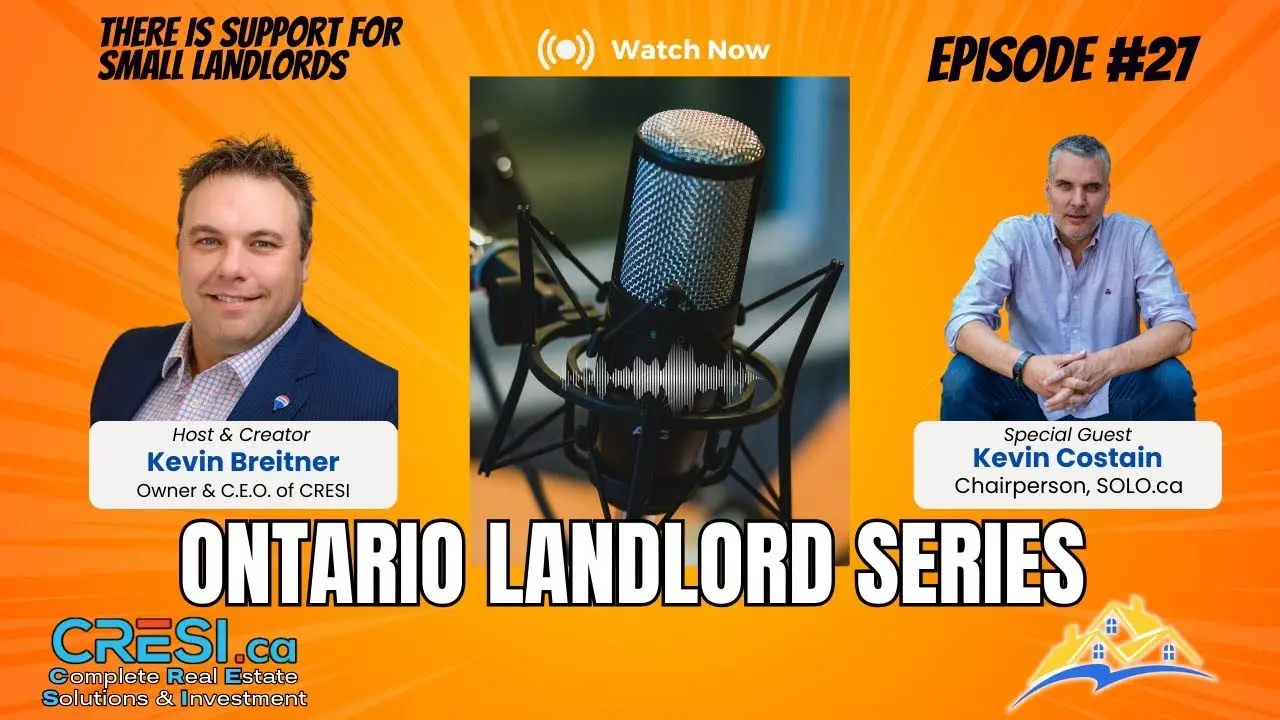
Kevin Costain, president of Small Ownership Landlords of Ontario (SOLO), explains how the nonprofit supports 'mom and pop' landlords with six or fewer units through free education, an adjudicator-tracking tool for LTB hearings, direct outreach for landlords in crisis, and advocacy at Queen's Park — work he says started after his own tenant set fire to his rental property.
Key takeaways
- Kevin Costain says SOLO defines a small landlord as roughly six units or fewer — often a 'mom and pop' owner with one primary residence and one additional property — and the nonprofit's core mission is education, advocacy, and lobbying at Queen's Park for that group.
- Costain's own tenant dispute — a fraudulent tenant who assaulted him and ultimately set fire to his property — led to an eviction process that took 16 months, with an additional 8 months after the fire before he regained possession; that experience led him to SOLO and eventually its presidency.
- Costain says police are often the first point of contact when a landlord-tenant situation escalates, but many officers lack training in the Residential Tenancies Act and default to calling it a 'civil matter,' which he says Stonegate Legal Services has begun addressing by presenting directly to police stations.
- SOLO runs a volunteer program that watches LTB hearings and records which adjudicator is assigned to which case, letting landlords research an adjudicator's tendencies before their own hearing — part of what Costain calls a broader 'knowledge is power' philosophy, including a free public wiki and hearing-recording archive.
- Costain says SOLO has around 3,200 vetted members and roughly 8,000 in its Facebook discussion group, runs regular meet-and-greets and an annual gala of 150–200 people, and provides direct outreach — including listening to landlords in crisis — through solo.ca.
Frequently asked questions
What is SOLO and who does it help?
What happened to Kevin Costain that led him to start advocating for landlords?
Do police understand landlord-tenant law in Ontario?
How can I find out which adjudicator will hear my LTB case?
How big is SOLO's membership?
Does SOLO provide legal advice to landlords?
How can I get in touch with SOLO?
Guests
Kevin Costain — President, Small Ownership Landlords of Ontario (SOLO)
President of Small Ownership Landlords of Ontario (SOLO), a nonprofit supporting small landlords through education and advocacy; author of From Rent to Ruin, about his own tenant dispute that led him to SOLO. (Not yet on the canonical roster — flag for Kevin/Jason.)
Chapters
- 0:00 Introduction to SOLO and Kevin Costain
- 2:19 What is a "small landlord" and who SOLO helps
- 5:04 Imbalance in the landlord-tenant system
- 7:19 Kevin's personal story: From tenant nightmare to advocacy
- 11:53 Police knowledge gaps in landlord-tenant matters
- 13:37 How Ontario landlords can get involved with SOLO
- 15:27 SOLO's innovative tools and resources
- 17:53 Direct landlord support and urgent assistance
- 21:36 Call to action: Join the movement for fair housing
Full transcript
Introduction to SOLO and Kevin Costain
Everybody, welcome to another episode of CRESI’s Ontario Landlord Series podcast. Today we’re talking to someone that I’ve just crossed paths with recently. I’m learning more about their platform and how they continue to help out landlords. I want to bring him on today to explain a little bit about what they do and how they can help Ontario landlords, and why I should be a part of their group and why they’re beneficial to all of us out there.
The gentleman’s name is Kevin Costain, and he is the president of a group called SOLO, which is Small Ownership Landlords of Ontario. Kevin, how are you doing this morning?
Yeah, I’m great, how are you doing, Kevin? Great, thanks for having me. I appreciate it. Let’s, why don’t I let you say exactly what SOLO is to everybody, who you help and why. We know you help Ontario landlords, but let’s share it from you. What is SOLO?
Right, SOLO — as you described, the first two letters are small ownership — SOLO itself is a nonprofit organization, we are primarily focused on helping and supporting small landlords. And a small landlord is not perfectly defined in terms of governmental issues, but you might consider a small landowner to be a person, or a group of people, that might have six or less units. So we’re more interested in helping what we call mom-and-pop landlords, more working-class landlords, folks that come in and maybe own one property that is their primary residence and then have another property. We support them through the very difficult struggles of being an Ontario landlord. We of course advocate for them, we lobby for them at Queen’s Park, we engage with all levels of government, primarily the provincial government.
What is a “small landlord” and who SOLO helps
And we’re on that every day, almost every waking hour — almost like a full-time job on its own. I’ve been helping landlords for almost a decade now with what we do at RE/MAX, helping people buy and sell, and our property management company has been around for just over four years now. Same thing when we were looking to do this — it’s to help that everyday landlord, the everyday investor that maybe thinks about getting an investment property and doesn’t really understand their rights or obligations, or what it actually entails to become a landlord. A lot of people just thought of it as a retirement investment, not really wanting to be that full-blown real estate investor, and they need some guidance and help. So that’s a great thing — we’re similar in that way for sure.
So with SOLO, you guys do education, correct? Of course, yes, education, as you know, is one major pillar — working with small landlords and helping and guiding them through the rental market in Ontario. Knowledge is sort of the power, because there are always gaps in knowledge, and filling those gaps will actually help landlords navigate this system. We’re just trying to educate landlords, or housing providers, as we might call them, rental operators — landlord is a bit of a loaded word in a way, but beyond the wording of it, the idea is we just want to help these folks, because the market is a little bit catered to the larger corporations that can take a $50,000 hit and carry on. A smaller landlord can’t really handle $20,000 or $30,000 of loss without being ruined, sometimes financially, sometimes because their primary residence is being used as collateral, so when they lose the investment property, they lose their home too. There are a lot of dangerous challenges out there for small landowners, and we’re here to help.
Imbalance in the landlord-tenant system
That’s great, and I agree — the RTA and everything created back in the ’80s was for those big corporations, where having a couple of people not pay rent isn’t much of a drop in the bucket. It isn’t as drastic for a landlord who owns one single-family residence and now has a tenant who isn’t paying rent. It all falls back on them. The tenants have too many rights in some ways — the one that’s crazy is if a tenant is in arrears, say $30,000 for rent, the landlord needs to hire legal assistance to get that back, while the tenant gets free guidance through everything.
So it’s kind of not balanced. I like the term ‘housing provider’ — that’s what we’re doing, putting roofs over people’s heads. How can we balance this? I don’t think it needs to be all in favor of the landlord either — that’s not what I’m advocating for. But it has to be a fair system where things get dealt with quickly. There’s no reason somebody should be able to live in a property for free — there are ways to get it back and things that can be corrected. We do have bad landlords out there, just like bad tenants, and it’s about letting the good tenants and the good landlords work with one another so it’s balanced and fair for both sides.
Kevin, when you were first getting started as an investor, I know from our conversations that something happened that led you into all of this with SOLO. Why don’t you let everybody know how it started, what happened, and why this is important to you.
Kevin’s personal story: From tenant nightmare to advocacy
So many now know my story, and it’s what drew me to all of this in the beginning, what drew me to SOLO for help, and then I rose in the ranks in SOLO to finally becoming the chair of the organization. This event is what really catalyzed everything for me. The essence of it is that I came across a tenant who was what we would call a professional tenant, or a serial offender when it comes to not paying rent or providing fraudulent documents. This person did all that — he fraudulently gained access to my property due to some of my own mistakes, but obviously his own mistakes too. He misrepresented a number of things, became angry, assault was in the mix, he started to destroy parts of the property. Really problematic. This ultimately culminated in him starting a fire and destroying my house.
There were ultimately arson charges. It was like a 12-month rebuilding process. But the core of all of this — layer that fire and destruction on top of the fact that this was already a 16-month eviction ordeal. The craziest part to me was that even after the fire, I had to wait 8 months to gain possession of my property. The fire was in January, and I still did not get possession of my property until August.
This is the essence of our everyday justice system, the system we have to resolve disputes between tenants and landlords — it’s slow-moving, incomprehensibly incompetent, and these kinds of things are playing out every day. Landlords are being — and tenants too — made to wait sometimes several years to get a hearing. This lack of access to justice is incredibly destructive to the environment, to the market itself, and destructive to relationships. I think my story really catalyzed this for me and made me realize we have to do something to change this environment. I turned to telling my story to government, trying to get the word out, trying to talk about my tenant. I also ended up writing a book about it — From Rent to Ruin. It talks about the whole story, what happened with the government, the LTB, and the police.
Strangely, police are a core component of a lot of this lack of justice, because they’re not very well versed in landlord and tenant procedures, landlord and tenant law, the RTA. So often police, as in my case, would come and say the classic line, “that’s a civil matter,” and then take no action — when if it was any other situation, it might be mischief or vandalism or some other charge. There are a lot of layers in this environment that create a perfect storm where a small rental operator or small housing provider could see a good 12 months of waiting while the tenant lives in their property for free, and the landlord pays utilities, pays for maintenance, and the tenant pays no rent and gets away with it.
Police knowledge gaps in landlord-tenant matters
There’s no penalty to it. It takes way too long for that to get resolved, and it shouldn’t take that long — things should be moved along faster. The comment you made about police not understanding that, I think that’s very interesting and definitely correct. Stonegate Legal Services, a paralegal firm we’ve been aligned with for over five years now, helps out all of our landlords with guidance and advice — Rob Di Lisi has been on our podcast several times to speak about different topics. They are actually going to police stations and doing presentations to help inform and educate police, so it’s interesting that you say that, because I know they’re doing that as well.
Yeah, there’s such a dire need for that, because that’s the first line of justice, right? As is often the case when something goes wrong, the first line of contact is going to be a police officer, and that’s often at their discretion. But if that discretion is coupled with a lack of knowledge of the particulars of the Residential Tenancies Act and other relevant acts, you have another sort of loss of justice. I think this is primarily about timely justice — this is why SOLO was created in the beginning, almost five years ago now, because of a lack of access to timely justice.
How Ontario landlords can get involved with SOLO
It’s great to have a support group out there in the system. I know you guys have a membership or community that is there for everybody. What else do you guys do for Ontario landlords? We talked about education — do you have networking events or anything like that where people can get together, or is it all online?
We do regular meet-and-greets. We have a Windsor meet-and-greet coming May 25th, I believe. We do a yearly gala, two years running now — we’ve had a large event, roughly 150 to 200 people come out to a gala, with round-table talks and presenters. It’s a large undertaking, but very rewarding. We have discussion groups of many thousands — 8,000 on the Facebook side — and somewhere around 3,200 vetted members that continues to grow. Our vetted members are folks closely intertwined with what SOLO is doing. We’re growing on all levels and always looking to reach out and communicate in person — we’re talking about an Ottawa meet-and-greet too. We have a ton of other initiatives across the board — our wiki site, which is like Wikipedia but for landlords, and webinars we’ve done with our entire archive free for landlords to view and watch.
SOLO’s innovative tools and resources
We have a tool where you can actually go and find out about adjudicators. Often you get into an LTB hearing and you’re not on the docket first, as with all court cases — sometimes you’re last, so you’re waiting three, four, five hours. You can look up more about the adjudicator you’re about to work with. We even take it to another level — we have a whole legion of volunteers who watch hearings and record details about them, including who the adjudicator is. So every day we have a group that goes into hearings and records a list of adjudicators, so even before you get into the hearing, you can know who’s going to be in which room, in terms of an adjudicator, and know that ahead of time. It comes back to knowledge is power — one of the core things I get across to a somewhat new landlord, or a landlord about to do an N12 hearing or any kind of LTB hearing, is just go and start watching them, go see how this plays out, what kind of questions the adjudicator asks, what kind of varied responses adjudicators have depending on the day. It can be a wide range of responses to the same kind of question from a person. So that kind of knowledge, and the ability to audit — it’s free for everyone to go and look and watch and observe. Those are the core public initiatives, but in the background we’re directly working with landlords on all sorts of things.
Direct landlord support and urgent assistance
We have been working to build fraud investigations and criminal charges against tenants that are serial professional tenants. We’ve worked with many landlords directly helping them with evictions, directly helping them with other issues. We can’t provide direct legal advice — we’re not paralegals, we’re volunteers — but the whole idea is we try to provide our knowledge and experience of things we’ve gone through. We do direct outreach every day to landlords — that’s our core mission. Call, and you get a person — that’s where I started. My tenant was destroying my home and I called that number and started to talk to somebody at SOLO, and they helped me, they set me right, they said do this, do this, this is the way to deal with that, walk into the police station and demand to leave a statement — that’s literally what one of the board members at SOLO said to me over the phone right in the very beginning. That kicked off everything for me in terms of understanding that maybe I wasn’t completely powerless.
They do provide some support, funded in part by the government, but on the respective legal services and other types of support, there is literally almost nothing. So if you’re a housing provider going through it, going through difficulties and urgent ones, you have no savings, you’re about to lose your home — things like this are happening and you almost feel completely helpless. It’s important to let them know they’re not helpless, that there are people out there that will try to help and will do what they can. Even if it is just that we listen — they call, they cry, they’re distraught, exhausted, and we try to listen. We do our best.
I love that, and I think that’s true — sometimes it is just the support, the understanding that they’re not alone, that there are other people who have been through something similar and that there’s light at the end of the tunnel. I think this has been a nice chat about what SOLO is, how they can help, so landlords understand that if they just need somewhere to turn to, this is a great start for them. There is a group of us here to advocate and support and make sure you’re understanding your options, because a lot of times we think option A is all we have, but really there’s B and C. Sadly, sometimes you may not like option A, B, or C, but at least you know there are three options, and we can figure out which one makes the most sense for you.
Call to action: Join the movement for fair housing
solo.ca, that’s our website — the phone number is prominently on the website, there is an email you can use, or solo.ca/contact where you can contact us. There’s even an urgent contact form to help us understand what’s going on on an urgent basis. Just reach out, join the movement. We need every homeowner, rental provider, housing provider, landlord — we need everyone to get involved and put our energy and time behind changing this environment, so it’s fair for everybody. It will provide not only a healthier market and lower rents economically, but justice for everyone, which is so sorely needed right now.
I agree — power in numbers, things are going to change. It’s not going to be quick and easy, I know that for sure. But the Ontario government will soon realize we can do things a little bit faster, a little bit better, and make things a little bit more balanced for both sides of this equation. Thanks so much for joining us, and reach out to solo.ca — Small Ownership Landlords of Ontario. Enjoy the rest of your day, and thanks for listening. Bye for now.
Please remember, while we are professionals, this podcast is for informational and entertainment purposes only. The advice shared may not apply to your unique situation. Always seek personalized advice from a qualified professional before making any investment decisions.
Hey everybody, thanks so much for joining us this week. I hope you enjoyed the episode. If you’re finding it informative and useful, make sure to like, subscribe, share with a friend so that we can keep getting the information out there to Ontario landlords. Keep on joining us — we’ll see you next time.
Derived guide: read the full guide.