
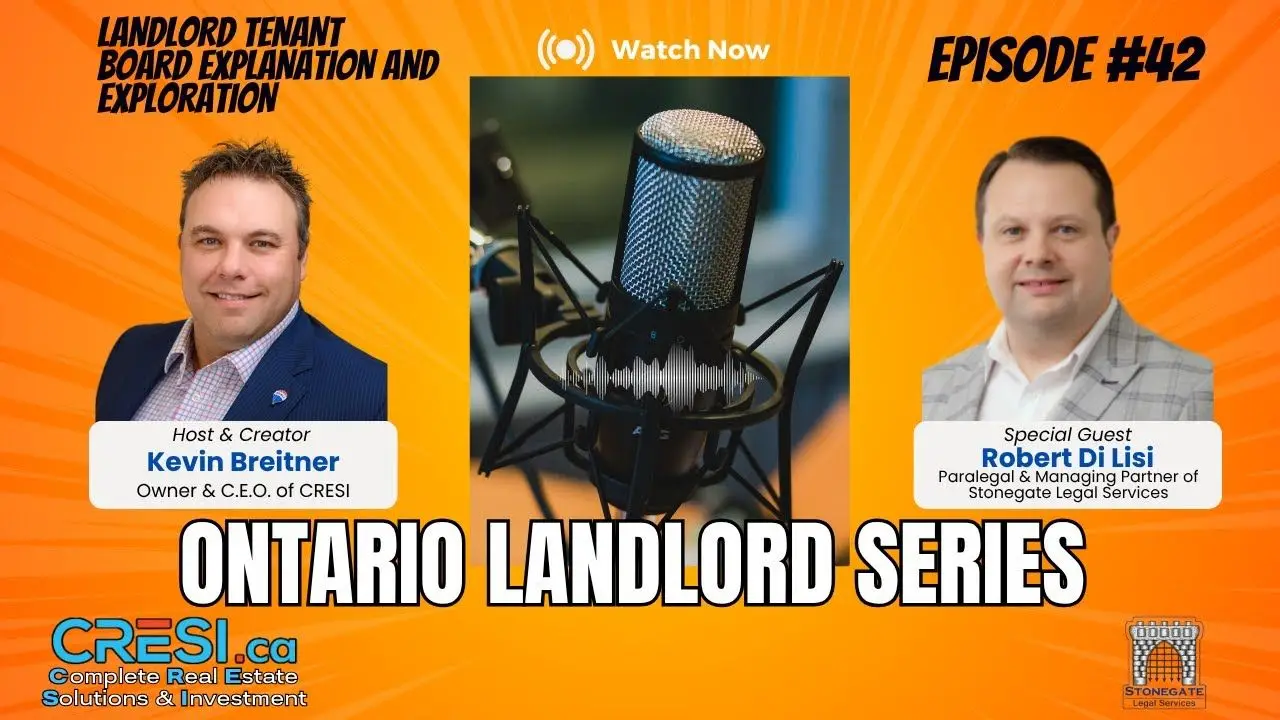
Episode 42 · with Robert Di Lisi
What Really Happens at an Ontario Landlord and Tenant Board Hearing
Even a strong non-payment case isn't guaranteed at Ontario's Landlord and Tenant Board, says paralegal Rob Di Lisi: landlords get a hearing date, not a guaranteed time slot, mediation comes first, and tenants can raise Section 82 or 83 defenses. Wage garnishment on an order to collect rarely works, so Di Lisi recommends staying open to settlement.
Key takeaways
- Rob Di Lisi says filing an L1 after an N4 currently takes about three to four months to reach a hearing, and landlords are guaranteed a hearing date but not guaranteed to actually be heard that day, since hearings run in morning, afternoon, or all-day blocks and cases aren't called first-come-first-served.
- Even a non-payment case with a correct notice isn't a 'slam dunk,' Di Lisi says — tenants can raise Section 82 issues (claiming they withheld rent over a maintenance problem) or Section 83 issues (asking the board to delay or deny eviction due to hardship, such as a single parent facing eviction in winter).
- If a tenant doesn't show up to a hearing, Di Lisi says the board typically still waits about 30 minutes and may move to another matter first; even after an order is granted, a tenant can later claim they weren't properly notified and get a new hearing, adding two to three more months.
- Wage garnishment on a court order to collect rarely pays off, Di Lisi says, because the employer — not the tenant — is garnished 20% per paycheck, and if the tenant loses or changes jobs, the landlord has to hire a skip tracer and restart the process; he says it rarely works unless the tenant has a stable, career-track job.
- Di Lisi warns that getting an L9 order to collect on unpaid rent (rather than pursuing eviction) resets the arrears calculation to zero for future N4 filings — so if a landlord collects on $12,000 in old arrears and the tenant later stops paying again, the new N4 has to start over from the new month's rent owed, not the original balance.
Frequently asked questions
How long does it take to get an LTB hearing after filing an N4 for non-payment of rent in Ontario?
Is a non-payment of rent case a guaranteed win at the Landlord and Tenant Board?
What happens if my tenant doesn't show up to the LTB hearing?
Can I garnish my tenant's wages if they owe back rent in Ontario?
What's the difference between an L1 and an L9 application at the LTB?
If I get an order to collect rent owed, does that reset what my tenant owes going forward?
Should I settle with a tenant instead of going to a full LTB hearing?
What is a Section 82 issue at the Landlord and Tenant Board?
Guests
Robert Di Lisi — Licensed paralegal, Stonegate Legal Services
Ontario licensed paralegal at Stonegate Legal Services; landlord-tenant and LTB representation.
Chapters
- 0:00 Introduction with Rob Di Lisi
- 1:33 What Happens Before Your LTB Hearing
- 3:00 Understanding LTB Hearing Blocks (Morning/Afternoon/All Day)
- 5:00 The Mediation Process Explained
- 6:17 Why "Slam Dunk" Cases Aren't Guaranteed
- 8:43 When Tenants Don't Show Up to Hearings
- 11:00 The Real Cost of Going to the Board
- 13:00 Wage Garnishment: Why It Usually Fails
- 15:14 The Settlement Solution You Need to Consider
- 16:19 Thinking Beyond Option A
- 17:37 Business vs Principle: Making Smart Decisions
Full transcript
Introduction with Rob Di Lisi
Hey everybody and welcome to another episode of CRESI’s Ontario Landlord Series. Today I’m joined again by Rob Di Lisi from Stonegate Legal Services and we’re going to dive into a not-so-fun topic, but a topic that we should all at least have an understanding about: what happens when we go to the board? How does that process look? What should we expect, and what outcomes should we
anticipate or have to work with? So we’ll start from the very beginning. Good morning. How you doing, Rob?
Say hi. Hi, Kevin. As usual, thanks for having me on here. This is going to be an interesting topic and I’m looking forward to talking to you and your audience about it.
Yeah, I think it’s something that people don’t fully understand, even how it works to get to this point, right? There’s a lot of mis- and disinformation that floats around about it. And, you know, you always say thanks for having me on, but I have to return that with thanks for being here, because your knowledge, wisdom, and experience is something our listeners surely get something from. So thank you.
So let’s just start. I have a tenant who hasn’t paid me rent. I’ve submitted my N4. We’ve gone our 15 days now,
and I’ve now submitted my L1 for my hearing, and I’ve gotten in the mail my date. What happens leading up to that actual hearing, what do I have to do — I’ll let you take it from there.
What Happens Before Your LTB Hearing
Sure. So let’s back up a bit, because when you do a notice for an N4, depending on the amount, the board wants to see that you tried to communicate with the tenant about a payment plan. Like you said, N4 is a 14-day notice — 20 days if you send it by mail, with Canada Post right now on strike, though I think that’s resolved.
By the time you file the L1, right now we are looking at about three to four months to get to the board. The thing is, what people don’t realize is that you are guaranteed a date, but you’re not guaranteed to be heard. Usually there are two kinds of blocks — sorry, three kinds of blocks: a morning block, an afternoon block, or an all-day block.
A morning block would be from nine to about, I believe, twelve or one o’clock. The afternoon block would be one to four. And the whole-day block would be from nine to four. So when you get there, there isn’t a first-come-first-serve order — you would log in with a mediator or a host, basically, where they’ll register you and give you a number, and say your block number is 25.
That doesn’t mean you’re in 25th place — it doesn’t work that way. Then what they’ll do is go through the uncontested matters, or the ones that can be resolved quicker.
Understanding LTB Hearing Blocks (Morning/Afternoon/All Day)
Now, even the ones that can be resolved quicker sometimes take time. Now, if you do get heard — and I say “if,” because you have to play devil’s advocate — the board member, or actually even before that, will ask if you want to go into mediation. Mediation being a third party who will hear your matter and hopefully work out a deal before you go in front of the adjudicator, or what many people would think of as the judge.
Now, if you don’t want to go into mediation, or mediation doesn’t go your way, or the tenant doesn’t agree, then you go in front of the adjudicator. The adjudicator will then hear the matter, go through the merits of the case, and based on that, they usually do not give you a decision right away. What will happen is they’ll say they’ll reserve their decision and send it out. Now, usually they say they’ll send it out as quickly as possible.
We’ve seen it come as quickly as 30 days, sometimes 60 days. Sometimes it even takes six months, because of the backlog or depending on the adjudicator. So when you go to the board, what people need to realize is that nothing is guaranteed. Even when you have a slam-dunk notice where there’s non-payment of rent, the notice must be 100% correct.
There cannot be any flaws or errors in the notice, and they will listen to both sides of the matter. They’ll listen to the landlord and they’ll listen to the tenant, because anyone can accuse anyone of not paying rent. The tenant may say the reason they didn’t pay rent was because their toilet wasn’t being fixed, and the only way they could get the landlord’s attention was to stop paying rent.
The Mediation Process Explained
Well, that now becomes something called a Section 82 issue, which is a reason why they stopped paying. Now, let’s say you go a little further in the hearing and the adjudicator does allow for an eviction. The adjudicator will ask the tenant, is there any reason why I should deny or extend the eviction? Let’s say it’s a single mother with a child, and it’s the winter months — she needs some time. This could be called a Section 83 issue, where they could delay or deny the eviction.
So again, Kevin, when you go to the board, it’s not a slam dunk. And this is why it’s always advisable to try to resolve the matter before you go to a hearing. Because any time you go to a hearing, anything can happen. There have been times where we think it’s a slam dunk and it’s not.
And there have been times where we think we’re not going to get it and we end up getting a positive result. The whole point here is that when you go to the board, you’re leaving it up to a third party — an adjudicator, a tribunal, what you would call a judge, but we would call an adjudicator.
Why “Slam Dunk” Cases Aren’t Guaranteed
I think we’ve said this a few times before, but I’ll say it again — that’s probably one of the biggest problems here, that there’s too much gray area. We don’t know exactly what’s going on and why something takes this or that different amount of time, or gets different rulings for the exact same offense. Anyways, so now here we are.
What if somebody doesn’t show up? What if you’ve waited all this time, and here you are at your hearing, and you’ve got your morning block, and you’re sitting there — the landlord or representative representing you — and the tenant doesn’t appear? Depending on when you’re heard —
let’s say you’re heard first, so it’s nine o’clock in the morning and they’re going to start. The board will say, “Well, Mr. Breitner, the tenant’s not here, we are going to wait half an hour to see if he does show up,” because they do want to give them the benefit of the doubt. They’ll move on to another matter and then come back to yours.
Now, in the event that a tenant doesn’t show up at all — I know a lot of people think it’s a slam dunk because they didn’t show up. It’s not always a slam dunk, because what will happen is, yes, you will get an order, but later on the tenant can say, “I didn’t know about it. I wasn’t informed. I didn’t get the notice in the mail,” whatever the case is. Being in Canada, we always have the right to be heard. So what will happen is they’ll have another hearing, and of course the adjudicator will ask the tenant what happened, when did it happen, why did you receive it, and they’ll start a new hearing again.
But remember, we’re talking about two, maybe even three months later. So a lot of the time it is a delay tactic, which I don’t think is fair. If they’ve been notified — and a lot of times the adjudicator will ask the legal rep or landlord, did you notify the tenant that this was happening today? At least in my office, we email them, we mail them, we let them know there is a hearing today.
Even at the hearing, we will email them, because a lot of times they do get their emails and just don’t show up. So this could be used later on. But again, being the Landlord and Tenant Board, they will allow the tenant to be heard.
When Tenants Don’t Show Up to Hearings
I think you’re right, it’s a delay tactic, right? You say, “Hey, I’m not going to be there.” Then, “Oh, you know what, I absolutely missed it, sorry, life happened,” or “I forgot the date,” or “I wasn’t notified” — give me a book of a dozen excuses, I’m sure they’ll allow all of them to be used. And now you have, again, a few more months of that same time, probably not paying their rent, right?
Where you’re out another five, six, seven thousand dollars, whatever it may be, out of the landlord’s pocket. And again, something we’ve said before on other episodes — you can steal $100 worth of gas or a t-shirt from a store and you’re a criminal, they’re going to come after you for that, but thousands of dollars from a landlord to live for free, and there’s no punishment, no ramifications, and it’s a lot. Yeah, so I do get this question a lot.
And the reason is because one is under the Criminal Code and one is under the LTB. It’s the same as when a cop comes to your door — if it’s a tenant issue, they do not get involved in landlord and tenant matters. They’ll tell you, “We are here to simply keep the peace.”
If there’s something going on with a landlord and tenant matter, you need to call the LTB. And I hear this all the time. Yep. No, and again, I get it.
It’s just funny how it comes from the top, right — the government is allowing both things to be seen as separate, when technically, to me, you’re still stealing from an individual, whether you break into their house and take their PlayStation, or steal a thousand dollars in rent. So you’re basically saying — let’s go into mediation. Both parties are going to be put in a room and they’re going to be able to agree on something that isn’t necessarily what’s actually owed, right? We’ll keep it to non-payment of rent because this is the easiest example for everyone to grasp. Let’s say my tenant hasn’t paid me for several months, they owe me $12,000, and we’re going into mediation before our hearing.
So basically, it’s a settlement — that’s what you’re doing. And a lot of landlords don’t like hearing this, but the term “cash for keys” — well, if you forgive what is owed, it’s called a reverse cash for keys, because you are forgiving what is owed to get this matter resolved. Because again, if it goes in front of the board and there’s one mistake, the board will more than likely dismiss the matter and you have to start all over again.
The Real Cost of Going to the Board
One last thing I forgot to mention: when you go on an N4 to the board, there’s something called an L1, L9 application that you fill out. The L1 is for the eviction. The L9 is in order to collect. So a mistake we often see landlords make — let’s say they make a mistake on the notice, but the tenant doesn’t show up.
The board will say, “I cannot grant an eviction because there’s a mistake, but I can grant an order to collect.” So let’s say it’s $12,000 — the landlord gets excited and says, “Yeah, I want an order to collect.” Here’s what people don’t realize: now that the matter has been heard, you get an order for $12,000 to collect that money, but you now need to go to small claims court. And you’ve now reset the clock
on what that tenant owes, because that $12,000 has already been spoken for. That means it resets back to zero. So if he owes rent, it’s not $12,000 plus what he owes going forward — it starts at what he owes from that point. Let’s say the rent is $2,000 — it goes back to $2,000, because the matter for $12,000 has already been heard. So now I have to go collect that $12,000.
We’ve had a ruling based on that last instance where the $12,000 he didn’t fight for — he doesn’t show up, so I can say, “Okay, I want that order to collect the $12,000.” I need to now go to small claims court for that. That situation is done.
Now moving forward, if he doesn’t pay rent again after that month, I then have to start with an N4 for that $2,000 and start all over again to get an eviction notice, because I didn’t get an eviction during that first instance — I only settled for collecting what was owed.
Wage Garnishment: Why It Usually Fails
Okay, so now think about this, Kevin — what if you get an order to collect on the $12,000, but the tenant now pays on time? You don’t have an eviction, you just have an order to collect, which more than likely you’re not going to collect. So sometimes it’s actually better to withdraw and start all over again for the full amount. This way you get an L1, which is an eviction, and the L9 at the same time. And then once you have that, you can put it on their record.
You can put it on Front Lobby, all these other places. And then you still have the order to collect, and you can do garnishment if there’s anything to garnish. That also depends on whether they have employment, what kind of work they do.
I always make the joke that if they work at McDonald’s — and there’s nothing wrong with McDonald’s — usually this is not a career path, so when you garnish, you’re garnishing the employer, not the employee. The court order tells the employer they must pay the landlord 20% per paycheck. But what happens if the tenant loses their job or gets fired? Well, that means you have to find out where they moved to or where they got a new job, which means you now have to hire a skip tracer, which is more money.
And then you have to restart the garnishment process, which means more cost, more time, more money out of your pocket. So usually, at least for us, if the tenant doesn’t have — how do I say this nicely — if they don’t have a career, like an accountant, doctor, lawyer, real estate agent, or teacher, and they just have jobs, like landscaping or something, we know there’s probably a really slim chance of being able to collect that money. Sad situation for people who are housing providers, giving roofs over heads for people who need shelter but can’t afford to purchase on their own. But this is something that could happen.
The Settlement Solution You Need to Consider
So what’s the solution then? If you don’t mind, I’ll speak to it. Even now that it’s taking a shorter time to get to the board, you are still risking waiting to go to the board, waiting for an adjournment, a delay. Sometimes the adjudicator doesn’t show up, technical difficulties, whatever the case is — which means, yes, it takes three months to get there, but you’re not guaranteed that you’re going to be heard.
So the solution we always tell our clients when they come to us saying “my tenant owes rent” is that you should always be open to the possibility of doing some kind of settlement. You don’t have to, but you should be open to it, because even though it’s taking a shorter time to get to the board, you still are relying on a third party to make a decision on this matter. And I don’t like a third party making a decision — I want to be in control. And the best way to do that is through settlement.
Thinking Beyond Option A
We’ve also broken that down before, and I agree — sometimes people only think about option A, but there is option B or C. We’ve got to think about all of them, because there are pros and cons to everything, and sometimes just being able to move on quickly, turn something around, and get it back moving again is a better solution than having that delay and being stubborn and thinking it’s going to work out. Yeah, I used the wrong word — it’s a matter of principle for people.
They always say to me, “Why am I going to forgive or give this tenant money and encourage them to do this again?” And I always tell them, because you have to step back and look at it from a business point of view — yes, you’re going to give them money, but they’re out in 30 days. And usually the money you give them is less than what it would take to go to the board. On top of that — I’m not an accountant or a tax lawyer, but my best friend is my accountant, and he tells me that if it’s in the course of doing business, it could be tax deductible.
So if it’s a business, you have to treat it like a business and keep your emotions out of it. At the end of the day, this is your asset.
Business vs Principle: Making Smart Decisions
No, agreed. And again, I think a lot of times in many different situations, people concentrate on the wrong number, whether they’re going to spend money or save money. The only number to ever think about, especially in a business situation, is what you’re going to net. We have to think about that and break down the situations.
You’re right, I used the wrong word when I said “stubborn” — it is about principle. “Why am I having to do this? Why am I sacrificing for them?” Kevin, I’m a landlord myself, you know this.
So there have been times I’ve even had to do settlements on my own properties. It’s like the expression — what’s good for the goose is good for the gander. So everything we do, we do for our own properties as well. The difference is I look at it differently, because I see it so often and I know it’s part of doing business.
That’s all it is. I’ll just reference this too — Rob, I did break this down in another episode, before, on cash for keys, looking at how this settlement actually works and how the numbers play out roughly. So you can always check out that episode.
If you’re looking for more details, you can always reach out to us, or Rob as well, if you want to chat about something — if you’re having a similar situation right now with a tenant that you’re trying to move on from, for different reasons. Rob and his team at Stonegate Legal Services are always here to guide, advise, and consult, to make sure you’re understanding your different options and what’s available to you, so you can make whatever choice is best for your specific situation — which is key to being a landlord, being a business owner, and being in business in any way: knowing all of your options. But specifically, being a landlord in Ontario, we’re here to help guide you.
Rob, do you have anything else you want to touch on today? I think we covered most of what we needed to talk about today. As always, if people ever leave comments on what they want to hear, I’m sure we could do an episode on that. I think that’s a great idea — throw some things out there,
we’ll talk about them. Reach out to us and we’ll figure those out for you and get all your questions answered. So as always, Rob, thanks so much for being here and doing this today. You’re awesome.
Thank you. And I will talk to you very, very soon. All right, take care. Cheers.
Please remember, while we are professionals, this podcast is for informational and entertainment purposes only. The advice shared may not apply to your unique situation. Always seek personalized advice from a qualified professional before making any investment decisions. Hey everybody, thanks so much for joining us this week.
I hope you enjoyed the episode. If you’re finding it informative and useful, make sure to like, subscribe, share with a friend so that we can keep getting the information out there to Ontario landlords and keep on joining us. We’ll see you next time.
Derived guide: read the full guide.