You want real estate to build wealth. Buying is the easy part. The hard part starts when you become a landlord.
In Ontario, the Landlord and Tenant Board (LTB) has rules. Tenants can file four “T” forms. Each one can cost you up to $50,000. You protect yourself when you run your rental like a business and write everything down.
What you’ll learn here:
- The four T forms you must know
- Why each can cost up to $50,000
- Simple steps to stay safe
- Why notes and records save you
The Real Cost If You Don’t Know the Rules
Do you have a license to be a landlord? Most people don’t. You buy a place, and then you’re on your own. No training. No playbook. That’s when trouble starts.
Tenants can file LTB applications for up to $50,000 each. Two forms can mean $100,000, plus legal fees. You need to act like a pro from day one.
Here are the four “T” forms you must know.
T2: Harassment and Quiet Enjoyment
A T2 is about how your actions affect a tenant’s peace and comfort. The easy way to slip up? Over-texting about rent.
Rent is late. You send a text. Then an email. Then more texts. That can look like harassment.
Do this instead:
- Send one clear message
- Keep a record of it
- Serve the proper notice (N4 for non-payment)
- Stop there
One message. One notice. No spam. More messages only give the tenant proof for a T2.
T6: You Must Maintain the Home
The law says you must repair and maintain the unit. It’s not optional. That means you handle things like:
- Changing filters
- Replacing light bulbs
- Cutting the grass
- Snow removal
- Fixing mold issues
- Maintaining appliances
- Repairing window parts
A tenant reports a problem? Answer fast in writing. Even a short reply helps: “Got it. Plumber coming tomorrow.” That timestamp shows you took action.
Get reports from pros. If a plumber says the toilet is clogged from items the tenant flushed, keep that in writing. Now you have proof. You may even serve an N5 if needed.
T5: Bad Faith Evictions
A T5 is about bad faith. Here’s a common mistake:
You give an N12 saying you (or family) will move in. The tenant leaves. Then you rent the place out at a higher price. That is bad faith.
The rule is clear: If you use an N12 for personal use, you or your family must live there for at least one year. If you don’t, a tenant can file a T5 for up to $50,000.
Tenants are smart. They can set a Google Alert for your address. If your unit shows up online for rent, they get a ping, take a screenshot, and file.
T1: Illegal Deposits
The market is tight. Some tenants offer six to twelve months upfront. It sounds helpful. It’s not legal.
What you can collect:
- First month’s rent
- Last month’s rent deposit
- A key deposit equal to the actual cost to replace the key or fob
That’s it. Anything more is an illegal deposit. Even if both of you “agree,” the law still says no. A T1 can force you to return the money and pay penalties. Those $500–$800 “key deposits” for two fobs? Illegal if they’re above the real replacement cost.
If It’s Not Written Down, It Didn’t Happen
This is your golden rule. At the LTB, proof wins. You need to show what you did and when you did it.
Keep:
- Timestamped messages with tenants
- Receipts from contractors
- Professional reports and photos
- Written agreements for things like lawn care
- Screenshots of important chats and posts
Property management software makes this easy. Every ticket, note and reply. When a T2 or T6 shows up, you already have your file.
Treat It Like a Business
Landlording is not a hobby. It is a business. Businesses use systems. Documentation. They follow the law. They get help when they need it.
Don’t have time to do it all? That’s okay. That’s why property management exists.
The CRESI Landlord Protection Program helps everyday landlords. You get education, smart communication, and rock-solid records. That protects you from $50,000 mistakes.
Bonus: management fees are a business expense. You can deduct them. A $50,000 LTB order? You can’t.
Your Next Steps
Here’s how you stay safe:
- Treat your rental like a business
- Learn the four T forms (T1, T2, T5, T6)
- Use legal notices the right way (like N4, N5, N12)
- Fix issues fast and in writing
- Never take illegal deposits
- Save every message, receipt, and report
Want help or a quick gut-check on your situation? Reach out to us at CRESI. We’ll walk you through your options so you can avoid expensive mistakes.
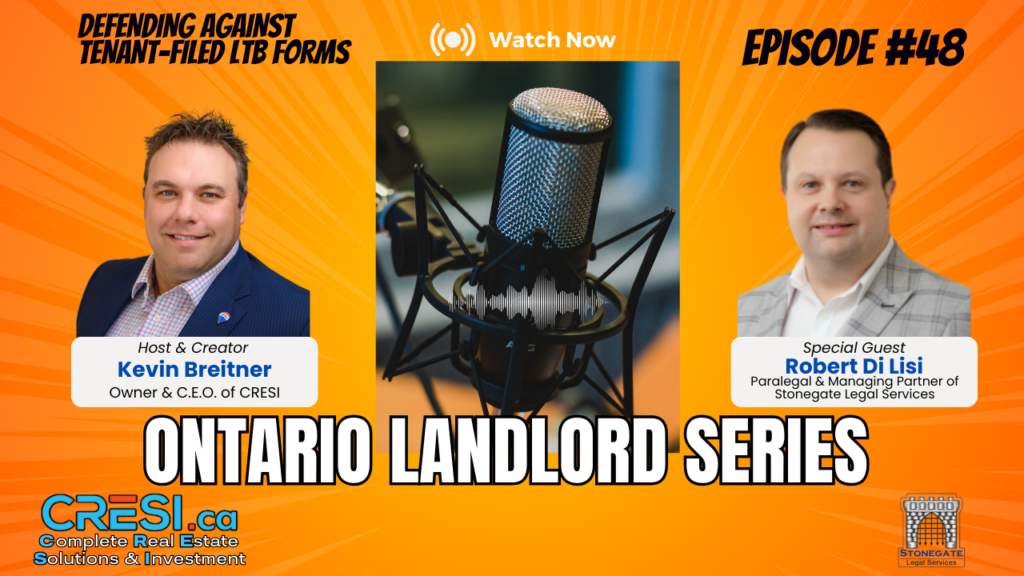
Want the full conversation? Listen to the latest Ontario Landlord Series podcast with Rob Di Lisi from Stonegate Legal Services. Grab the free Landlord Mastery guide at landlordmastery.ca for forms, templates, and simple steps to run your rental like a real business.